📦 Arknights Resource Calculator
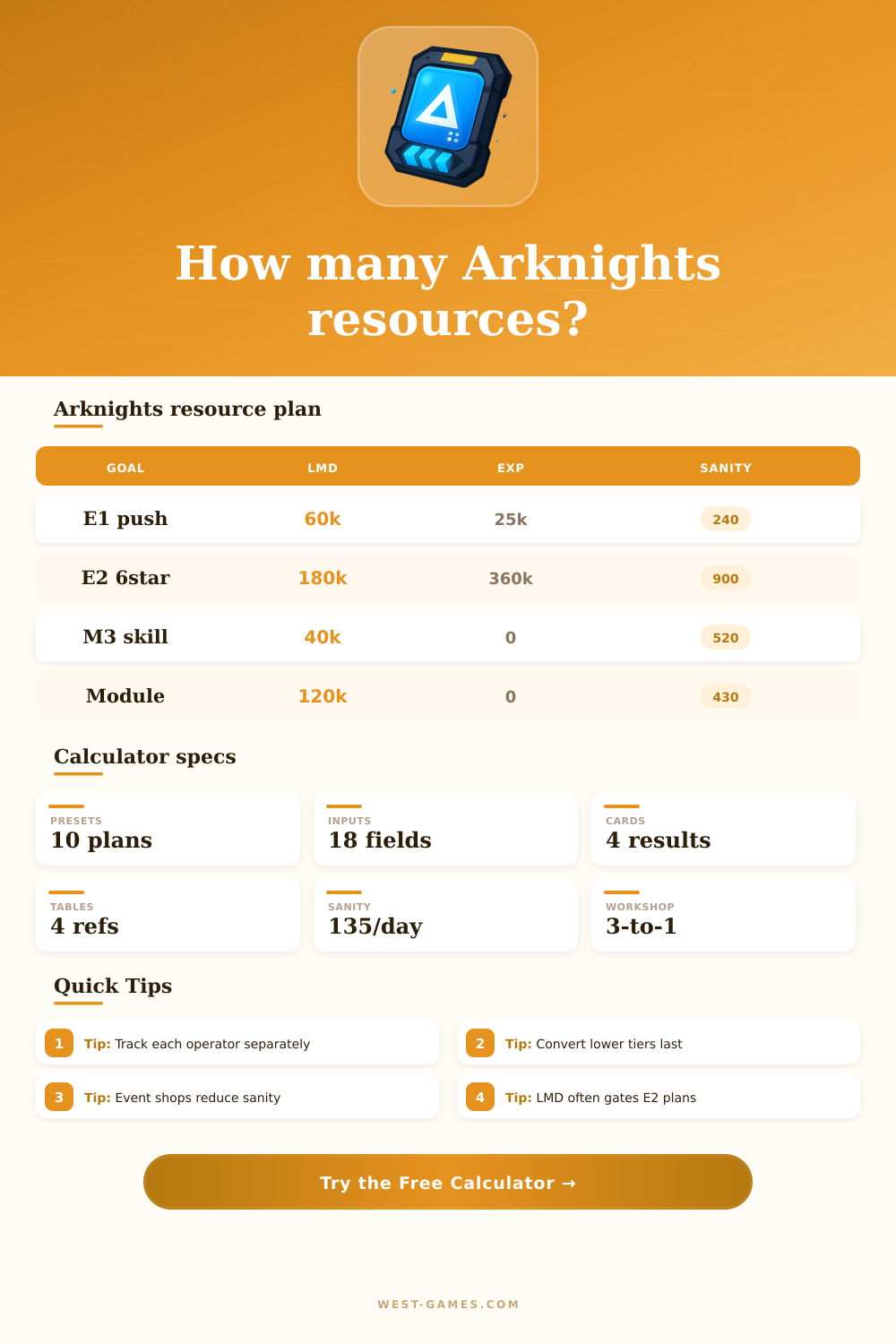
Plan operator promotion, skill mastery, module levels, LMD and EXP, sanity farming, drop stage efficiency, material tiers, workshop conversions, and event shop progress.
| Tier | Common use | Planning unit | Calculator handling |
|---|---|---|---|
| T1 and T2 | Early promotion | Lower-tier stock | Can feed workshop mode |
| T3 | E1, E2, M1-M2 | Primary farm unit | Entered as T3 equivalents |
| T4 | E2, M2-M3, modules | Major bottleneck | Farmed or crafted from T3 |
| T5 | High-end mastery | Recipe bundle | Convert into T4 and T3 pressure |
| Chips | Promotion gates | Class pack count | Tracked separately from materials |
Use exact operator requirements when available. This table explains how the calculator compresses different material families into planning units.
| Profile | Use case | Default drop | Default cost |
|---|---|---|---|
| Story T3 | Stable fallback material farming | 48% | 21 sanity |
| Story T4 | Direct high-tier target | 31% | 21 sanity |
| Event T3 | Event stage material focus | 72% | 18 sanity |
| Event T4 | Event high-tier focus | 42% | 21 sanity |
| Supply stage | LMD, EXP, or books | 100% | 30 sanity |
Drop rates are editable planning defaults. Replace them with your preferred planner or event sheet values before committing sanity.
| Mode | T4 offset | T3 pressure | Best for |
|---|---|---|---|
| None | 0% | No added T3 | Direct farming only |
| Light backup | 20% | Small lower-tier use | Protecting depot stock |
| Normal craft | 45% | 3 T3 per T4 | Balanced conversion |
| Byproduct credit | 55% | Reduced effective cost | Workshop with byproducts |
| Aggressive | 70% | High T3 drain | Depot cleanup plans |
The calculator credits workshop output against T4 gaps, then adds the implied lower-tier strain to the material pressure score.
| Shop block | Typical role | Offset value | Watch out |
|---|---|---|---|
| LMD block | Promotion funding | High for E2 | Can vanish quickly |
| EXP block | Level push | High for new accounts | Needs LMD too |
| Material block | T3 or T4 gaps | Route dependent | Buy exact family first |
| Skill books | Mastery plans | Strong for M3 | Books still need mats |
| Module mats | Module levels | Rare bottleneck help | Check module type |
Shop offset efficiency is deliberately adjustable because event shops differ. Use it to model how much of your gap the shop will actually solve.
| Preset | Primary bottleneck | Typical sanity pressure | Best adjustment |
|---|---|---|---|
| 6-star E2 push | LMD, EXP, T4 mats, chips | Very high | Use shop and supply days |
| M3 skill rush | Skill books and T4/T5 mats | High | Raise CA stage and material rates |
| Module level 3 | Module materials and LMD | Medium-high | Track module-specific stock |
| Event shop finish | Currency target | Depends on shop gap | Set drop rate to 100% |
| New account catch-up | LMD, EXP, low tiers | Medium | Use wider shop offsets |
The route comparison grid below recalculates the active plan through alternate stage assumptions so you can see whether event farming, direct T4 farming, or supply stages are the bottleneck.
You bring in a six-star operator who’s perfect for your team. Unfortunately they’re elite zero and has none of their skills unlocked. Exciting! It is also kind of dreadfull. Now you’ve acquired something you’re happy about, but the resource wall are going up faster than your happiness can go down. You glance over at depot, and it doesn’t add up. There’s such a gap between what you want to do and what you actualy have, you could fit a bruiser inside and it wouldn’t even slow down. It’s no longer an abstract question of “can I afford this?” but a logistical one: “how am I going to make this work?”.
Many players sees materials like they magically show up in their inventory after a couple days of grinding. Then they goes through the story stages, hoping they’ll get the exact drop rate they want. But each of these runs take time and energy; finite resources that is every bit as precious as big stacks of promotion chips or large material deposit sitting in your stockpile. It’s not that you don’t have any materials. It’s that you haven’t established a timeline. Is there any realistic way to close this gap before the next event rotation clears out all your shop access?
How to Plan Your Resources in Arknights
This is where the ideas becomes real: The calendar part of this page does all the heavy lifting. It asks you to get real about your needs and your inventory, since optimism bias makes every project look way more feasible than it actualy is. This allows you to choose a preset, say, a six-star elite two push, and then flags just how much of each big-ticket material and deposit you’ll need to gather to make it happen. That’s placed next to what you’ve got right now, and voila! You know exactly how many farm run you’re not accounting for.
This is where the workshop environment come in. New players frequently fail to understand what’s happening. Making low-end things into high-end stuff does not sound like a free lunch; it just moves the cost. Great, you don’t have to run as many of these farming mission (tier four), but now you do need to collect more of that (tier three) material to put through process. Depending on your overall state of emptiness based off your depot, it could be that you’re actualy extending your time because you were farming that lower tier already. You can turn this mode off in the tool to see if it really makes sense to do direct farming versus making items in the workshop based on your current state.
Event shops add even more complexity. They appear to be such an easy way out; use event currency to purchase big chunks of whatever materials is needed to get through the event, shaving days off your farming time. However, how you spend those shop points is key, spend too much buying those early skill books or chips (which many does), and there’s no event currency left by the time you need it to buy the promotion items. The calculator has fields for shop targets as well as efficiency offsets, which allow you to model a situation based off partial reliance on the shop instead of solely relying on farm runs. This allows you to determine whether or not it’s worth saving your sanity potions for that last push.
Arknights’ wildcard is its drop rates. Any plan is subject to change, and there’s no planner capable of predicting which stages will deliver tomorrow. What the tool does do, however, is let you add a safety buffer to your estimates to account for variance. This is key when transitioning between stable story stages with low variance and volatile event routes, where you might need to assume a forty-eight percent drop rate on a stage that typically produce only thirty percent.
When reality sets in, your timeline will crash hard. In Arknights, resource management is less about hoarding and more about pacing. When do I use this health item? When should I let my health naturaly regenerate? What happens if I promote an operator to an elite two? That’s not just one step; that’s a series of steps, time, materials, experience cards, chips. Seeing the steps visually eliminates guesswork and lets me act instead of guessing. I’ll still be grinding away but at least I’ll have a sense of duration: How much longer until I’m done with this and on to enjoying a full-fledged team?