🏰 AoE2 Resource Calculator
Plan Age of Empires II food, wood, gold, stone, villager allocation, gather-rate upgrades, civilization bonuses, unit queues, building targets, technology costs, and time to afford.
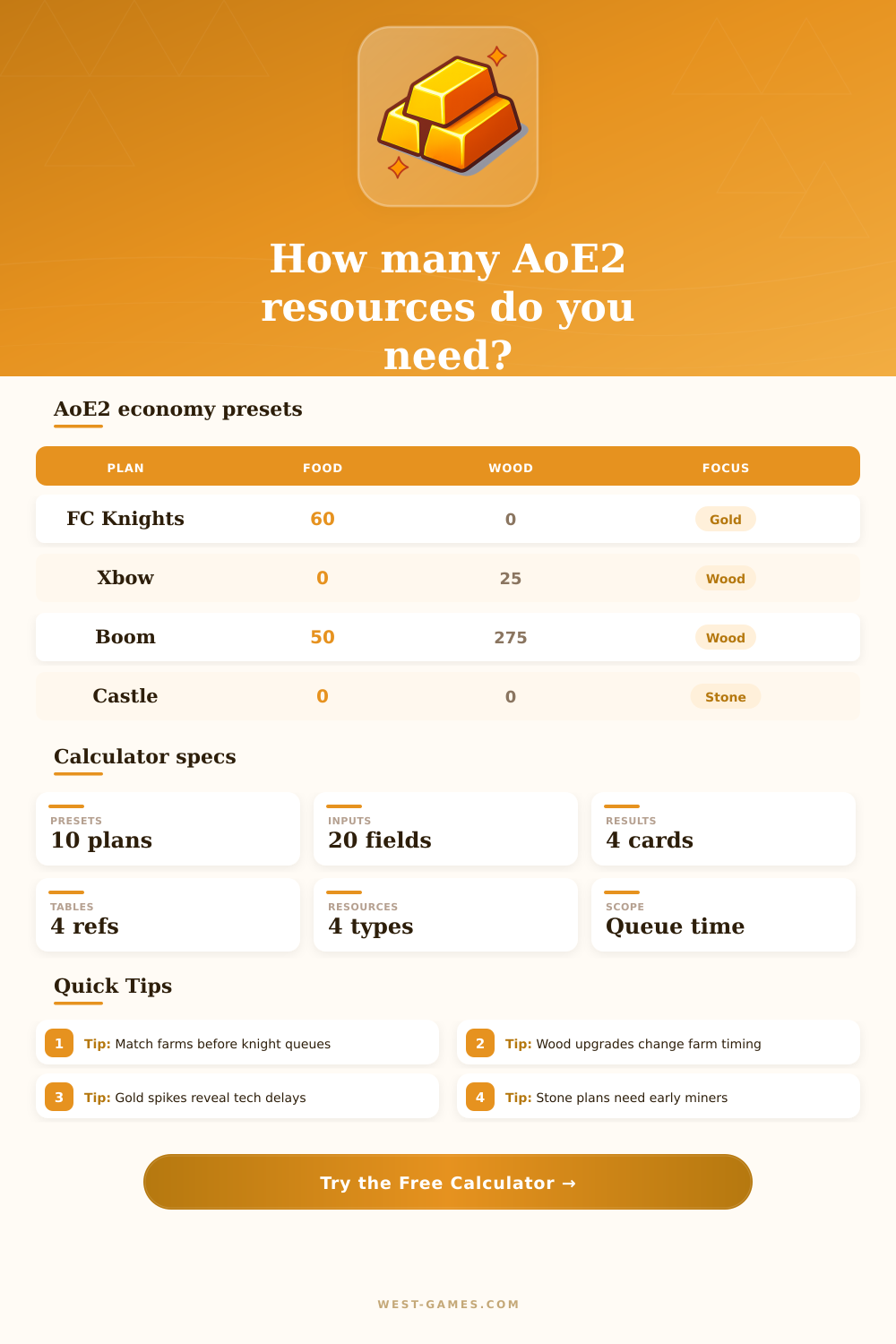
| Preset | Target | Pressure | Planning cue |
|---|---|---|---|
| Fast Castle Knights | 6 knights | Food and gold | Seed farms before queues |
| Crossbow Timing | Upgrade plus archers | Wood and gold | Ranges and blacksmith share wood |
| 3 TC Boom | Town Centers | Wood and stone | Villager queue adds food drain |
| Castle Drop | Castle | Stone | Stone miners must start early |
| Imperial Click | Age up | Food and gold | Banking matters more than queue |
Preset values are planning anchors. Overwrite costs, stock, villagers, and upgrades to match your build order, map, civilization, and current game state.
| Resource | Base rate | Upgrade effect | Notes |
|---|---|---|---|
| Sheep and boar food | 24/min | Food eco only | Good early-food estimate |
| Farm food | 20/min | Farm techs help | Walking and reseeds reduce net |
| Wood | 23/min | Axe techs multiply | Drop-off distance matters |
| Gold | 22/min | Mining techs multiply | Queue spikes are common |
| Stone | 20/min | Mining techs multiply | Castle and TC timings are sensitive |
Rates are rounded planner values per working villager per minute, after typical drop-off behavior. The idle and walking loss input handles messy real-game paths.
| Civilization | Modeled boost | Best target | Use carefully when |
|---|---|---|---|
| Britons | Sheep food +25% | Dark Age food | Main food is farms |
| Celts | Wood +15% | Archers, siege, farms | Villagers are often idle |
| Slavs | Farm food +10% | Knight and boom queues | Food is not farm based |
| Turks | Gold +20% | Gold-heavy units | Target has no gold cost |
| Poles | Stone support bonus | Castle or TC play | Actual folwark mix differs |
These are calculator multipliers, not a full civilization simulator. Use custom costs and villager fields for discounts, unique units, team bonuses, and map-specific starts.
| Target | Cost | Seconds | Queue pressure |
|---|---|---|---|
| Villager | 50 food | 25 | High food sustain |
| Archer | 25 wood, 45 gold | 35 | Wood plus gold balance |
| Scout Cavalry | 80 food | 30 | Pure food pressure |
| Knight | 60 food, 75 gold | 30 | Food and gold spike |
| Town Center | 275 wood, 100 stone | 150 | Wood, stone, villager food |
For mixed plans, pick custom target and enter combined per-item costs or use quantity to model a batch of the same unit, technology, or building.
The financial woes are common to Age of Empires II, which is why I built this calculator. When your villagers start aimlessly wandering while your Town Center blink red, it’s time to panic. What’s the issue? Chances are your money has dried up and now you need some gold to produce those knights. What’s worse is there’s a delay between clicking something and having your resources actualy increase. That’s where this tool comes in. It’s a bridge between being busy and being efficient. It converts vague feelings regarding your resource into specific timing windows. No more hoping; know exactly when your next unit spawn based on real gather rates.
So the tool takes your current economy, and compares it to a hypothetical goal (either an architectural goal or a military goal). First, it presets your starting conditions. Choose a pre-set like Crossbow Timing attack or Fast Castle Knights to load in basic villager distribution and costs. Then customize the inputs according to what you’ve got on screen. A lot of people mess up at this step because they don’t account for their idle loss percentage.
Why This Calculator Helps You Win
By default, a farmer generate a fixed amount of food per minute. But in real life, the farmers are walking to the barn, dropping off resources, finding new patches, getting bumped into by other villagers, and sometimes get attacked. The input allows you to take that friction out of your theoretical income. Sounds minor? Eight percent idle time really add up across a 20-minute game. What might of been a money-making attack suddenly turns into a ruinous one.
After setting these inputs, the output informs you whether your plan is viable. Time to Afford measures your window of opportunity. It shows how long it takes to get enough resources based on your current number of active villager and stockpile. If this clock displays “two minutes” until your next batch of knights and your enemy assaults in under a minute and a half, you instantly understand the window has shut. Now you must choose: should I stop making them or steal some villagers away from gold?
This brings us to the second critical piece, Sustain Check. It tells you whether your economy can sustains uninterrupted training. Is your number of gatherers matching the rate of your military spending? Yes? Great. No? Brace yourself, you’ll run out of stuff shortly. Your production queues will runs out and your base will be left vulnerable.
Your civ choice isn’t just flavor text; it also alters the math substantialy through civilization bonuses. For example, being Celtic will modify the efficiency with which you gather wood, whereas being British will increase amount of food you receive per sheep. This, in turn, affects the best number of villagers you should have on any given resource. Similarly, if you are playing a gold-heavy civ like the Turks, then the calculator will adjust the baseline income to match so that you don’t end up over allocating your miners based off fear of running out.
And the reference tables that comes with the tool make this very clear, displaying what sort of pressure various presets put on your economy. Do you want to attack with soldiers right away? That’s going to drain your gold and food nearly immediately. Or maybe you’ll go for a boom build? That’s going to strain your stone and wood early on. Knowing these things helps you decide when to pull your lumberjacks off the trees to fix your walls. It also helps you know when to stop hunting and start farming.
It makes you consider what you lose prior to clicking, which is a forced frame of mind that will make your villagers more productive. Each second walking to a far-off resource node means permanent loss of income. Each villager tasked with gathering gold cannot be on a farm. The calculator crunches the numbers while you strategize. It identifies previously unseen bottlenecks before they derail your army. It turns guesswork into a detailed income-production timeline. It allows you to confidently commit to an attack or retreat with certainty.
Instead of remembering unit prices, mastering economic management in AoE2 is about controlling the flow of money over time. Your enemy attacks at their own pace, but knowing the bounds on your income lets you know precisely when your next knight is coming. With this tool, you get this precision, replacing the chaos of resources with a schedule that you can predict and control. This changes the game from a mad scramble for survival, to carefully calculating ways to dominate.
Knowing that the Town Center will flash red, but only after you’ve planned ahead. That’s the difference between a competitive player and a casual one. And it shows that sometimes the most powerful weapon in your collection isn’t a sword at all, just a good old spreadsheet.