🏭 Hearts of Iron Factory Output Calculator
Estimate Hearts of Iron IV military production from factories, base IC output, factory output modifiers, production efficiency cap and growth, equipment cost, resource shortages, and stockpile targets.
| Resource | Needed per factory | Available to line | Notes |
|---|---|---|---|
| Steel | Common for rifles, support gear, artillery, tanks, and trains. | ||
| Aluminum | Important for aircraft and some support production. | ||
| Tungsten | Often appears on artillery, anti-tank, and advanced guns. | ||
| Chromium | Used by heavy armor and some late-game equipment. | ||
| Rubber | Core aircraft and motorized bottleneck. |
| Days | End efficiency | Average equipment/day | Gross equipment | Net stockpile change |
|---|
| Line type | Factories | Typical resources | Typical IC cost | Planning use |
|---|---|---|---|---|
| Infantry Equipment I | 10-25 | Steel | 0.5 | Early army expansion and reinforcement pool. |
| Support Equipment | 5-15 | Steel, aluminum | 4.0 | Engineers, logistics, maintenance, and field hospitals. |
| Artillery | 4-15 | Steel, tungsten | 3.5 | Line artillery and support artillery demand. |
| Aircraft | 10-50 | Aluminum, rubber | 24+ | Airframes vary by designer, module, and ruleset. |
| Tanks | 5-40 | Steel, tungsten, chromium | 8+ | Chassis and modules drive the real production cost. |
| Motorized | 4-20 | Steel, rubber | 2.5 | Logistics, mobile infantry, and tank divisions. |
| Mechanic | Input | Formula or handling | Why it matters |
|---|---|---|---|
| Factory IC/day | Factories, base output, output modifier | Factories x base IC x (1 + output%) x efficiency | Gives daily production points before equipment cost. |
| Equipment/day | Total IC/day, equipment cost | Total IC/day divided by IC cost per item | Converts production points into stockpile gain. |
| Efficiency growth | Current efficiency, cap, growth modifier | 0.001 x cap squared / current efficiency x growth modifier | Ramping lines produce much less than capped lines. |
| Resource shortage | Need per factory, available resources | Per-factory shortage penalty averaged across line | A small deficit may be tolerable; a deep deficit kills output. |
| Stockpile timing | Target, current stockpile, daily losses | Daily net gain accumulated until target is met | Shows whether a war plan is supplied in time. |
| Situation | Start efficiency | Cap | Factory output | Read the result as |
|---|---|---|---|---|
| Fresh 1936 line | 10% | 50% | 0% to 20% | Low early output, strong ramp value over months. |
| Dispersed-style flexible line | 20%+ | 50% to 80% | Lower than concentrated | Better after switching or adding newer equipment. |
| Concentrated-style long line | 10%+ | 50% to 80% | Higher output | Strong if production runs uninterrupted for a long time. |
| Shortage-heavy line | Any | Any | Any | Resource penalty can erase tech and efficiency gains. |
The vast majority of Hearts of Iron IV players will eventually discover that owning factories doesn’t necessarily mean owning equipment. You might run 100 factories churning out militaria but then fail to notice a lack of resources or miscalculate an efficiency curve, leaving your front lines starving. In this game, production isn’t simply a matter of clicking buttons and waiting for numbers to rise. It’s a logistical puzzle involving matching industrial capacity, raw materials and time before you’re able to actualy engage your enemy.
Before war begins, the calculator above can help you solve that puzzle.
How to Manage Production in Hearts of Iron IV
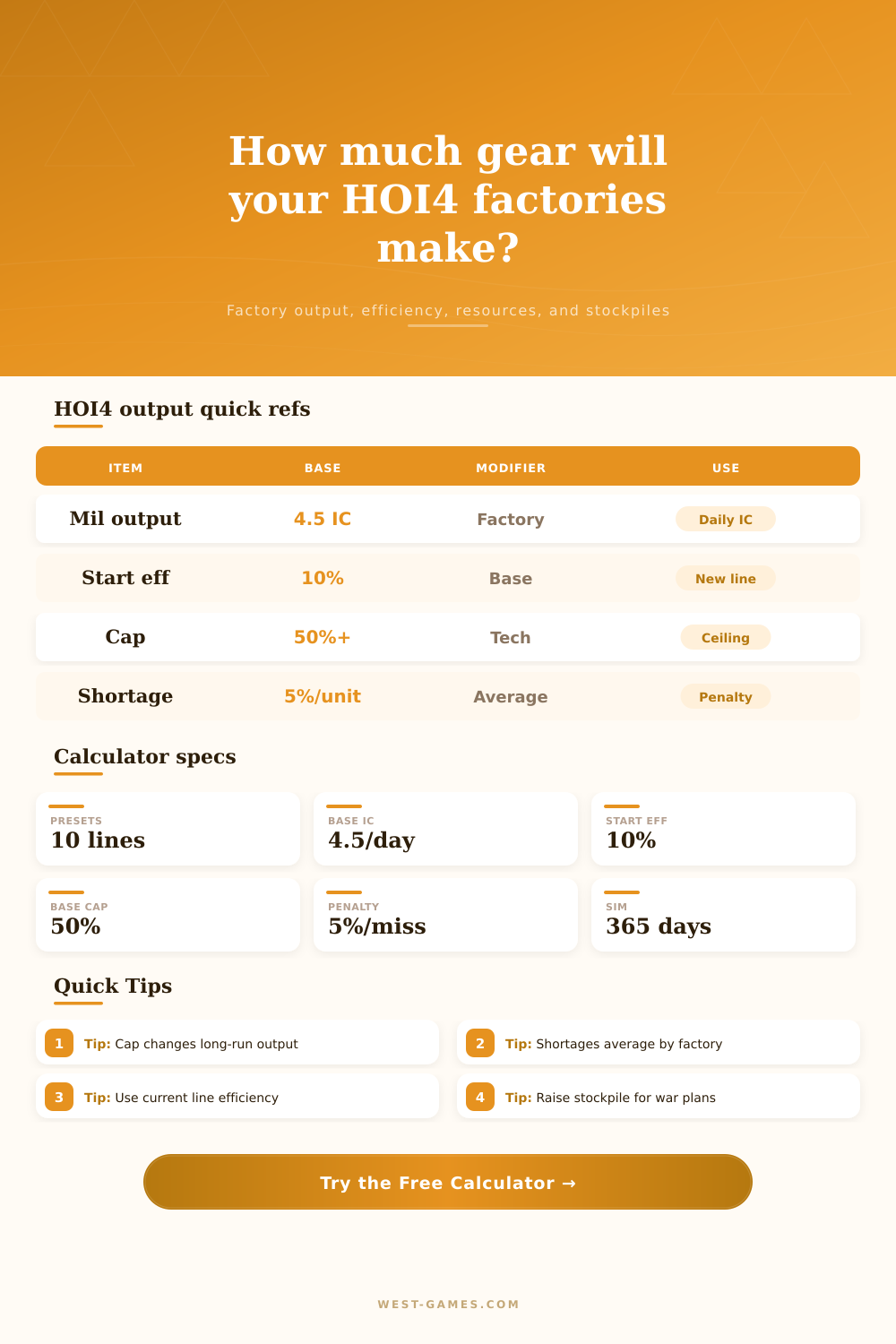
Don’t ignore the ramp-up phase. That’s the most dangerous trap for newcomers. Efficiency start at ten percent when you begin a new production line. Initially it increases very gradually, as it nears the cap however, it speeds up. Plan an invasion like your production lines is operating at full capacity immediately and you’ll get caught with your pants down. The tool models this gradual increase on a daily basis, meaning it can shows that a line may not produce at its potential for months. This is why you should of never think of production as a fixed number. It’s a variable. It change each and every day. Knowing the time-line is what separates being prepared for a campaign from running out of rifles within the first week.
Finally, there’s the matter of resource management, which most people don’t do right. A factory might be able to produce infinitely much stuff, but what good is that when it doesn’t have any aluminum or steel? Not having all the necessary resources isn’t penalized as a flat rate; it’s a step-down function based off how many units of a specific resource are short in each factory. That is, losing 1 unit of a resource in a very large factory produce far greater output loss than an entire absence of that resource in a very small factory. So yes, you must take stock of your resources and factory numbers relative to each other (not merely in absolute terms). The calculator takes into account the average of this penalty along your line so you get an idea of exactly how much each factory will actualy generate after logistical friction has been added.
Ultimately, the number of factories is less important than their efficiency caps. The higher your cap, the further you can push production; the lower your cap, the more your production are limited. Investing in industry techs that increase the cap pays huge rewards over time if you’re a major power with a long timeline. That tiny cap boost compounds each day until it surpass the value of building another couple of factories. Unfortunately, most people focus on short term gains (output now) instead of potential gains (production two years from now), which leads many players to overlook this tradeoff. Do you want max production in two years, or do you need the gear now?
For stockpiles, though, the math is another story. You’re not only creating gear, but you are also accumulating a cushion against loss in combat. Attrition chips away at your reserves, divisions break up and equipment is lost in combat. Unless you plan for these everyday costs, your calculated stockpile will be overly optimistic. With the calculator, you can plug in anticipated losses, which means the tool will adjust timeline for reaching your stockpile goal. This becomes vital for war planning. Instead of hoping that you’ll have enough tank for a mechanized corps by X date, you’ll know precisely when you will be ready to launch an offensive.
Production is a race against time and attrition. So is talent. This creates a race between attrition and production. And those races are where these tables and tools becomes useful. They remove the guess work. They reveal hard limits of your industrial base. Once you understand how caps, resources, and efficiency affect one another, you stop treating production like a magic box. Instead, you learn to treat production as a strategic asset.
That’s the difference between being a casual player and a competent grand strategist. It doesn’t mean you won’t lose a few battles, but it means you won’t lose a battle for lack of bullets.