Hearthstone Dust Cost Calculator
Total Arcane Dust needed for missing cards, estimate disenchant returns, compare regular, golden, and signature copies, and test limited full-refund windows without entering any pack or store data.
| Card | Rarity | Target finish | Need | Owned reg | Owned gold | Owned sig | Dust selected | Refund |
|---|
Use Dust selected for copies you plan to disenchant manually. The calculator also estimates extra duplicate dust above deck copy limits when that setting is enabled.
| Rarity | Regular craft | Regular disenchant | Golden craft | Golden disenchant |
|---|---|---|---|---|
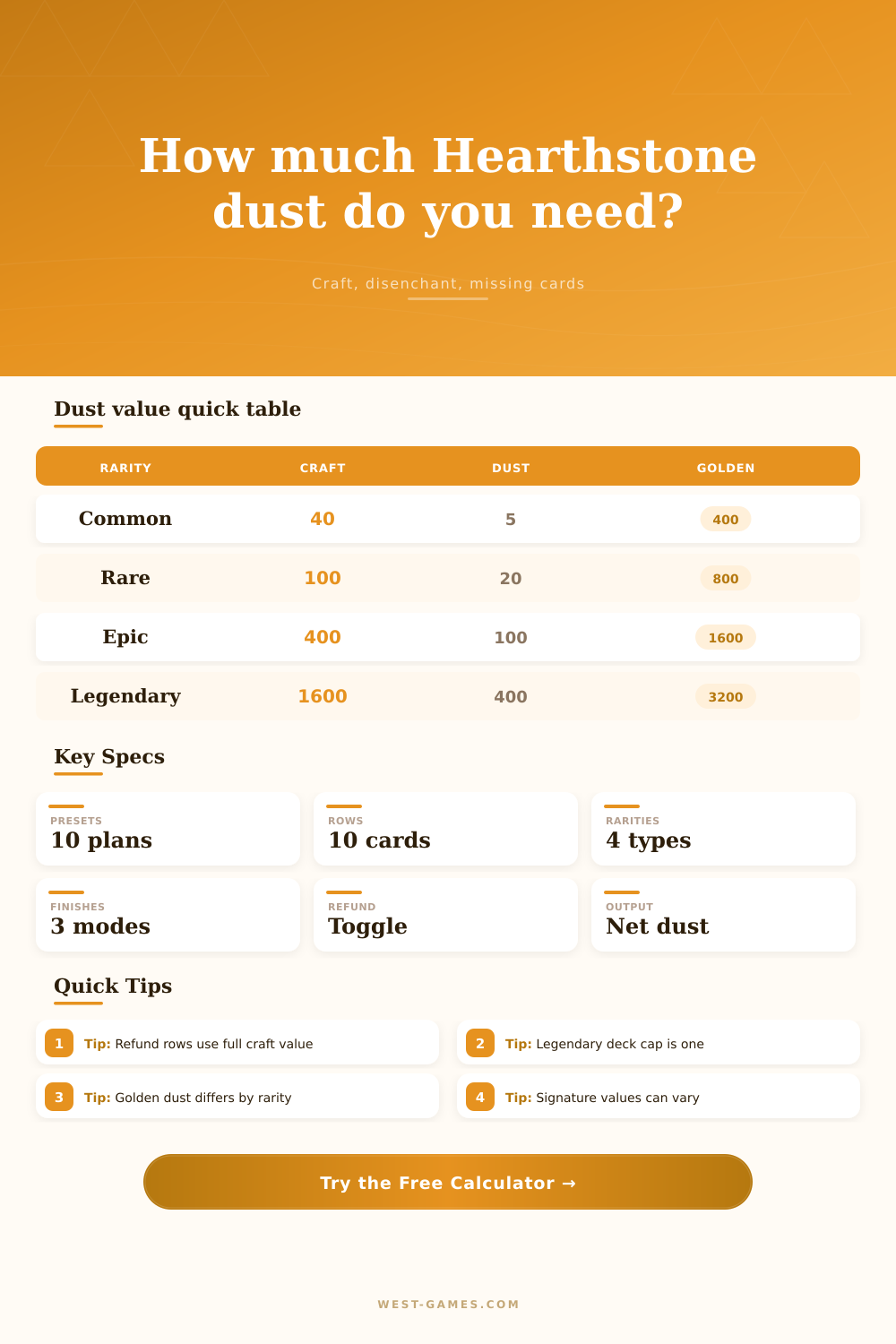
| Common | 40 | 5 | 400 | 50 |
| Rare | 100 | 20 | 800 | 100 |
| Epic | 400 | 100 | 1600 | 400 |
| Legendary | 1600 | 400 | 3200 | 1600 |
These are Blizzard's published baseline crafting and disenchanting values. During eligible card-change windows, Hearthstone patch notes commonly state that craftable cards can be disenchanted for full dust value for two weeks.
| Finish | Craft handling | Disenchant handling | Calculator setting |
|---|---|---|---|
| Regular | Uses regular craft values | Uses regular return values | No extra setup |
| Golden | Uses golden craft values | Uses golden return values | Select Golden in row |
| Signature | May be uncraftable or special | May dust like golden or vary | Choose signature policy |
| Refund row | Craft side unchanged | Return becomes full craft value | Check row refund box |
| Card type | Deck copy cap | Missing logic | Duplicate dust logic |
|---|---|---|---|
| Common, Rare, Epic | 2 copies | Target minus owned finish | Copies above two can be counted |
| Legendary | 1 copy | Target normally capped at one | Copies above one can be counted |
| Golden target | Same deck cap | Only owned golden fills target | Regular extras still dust separately |
| Signature target | Same deck cap | Depends on craft policy | Depends on dust policy |
Here’s what happens: You see a deck list that seems strong. Your rank go up in your mind. Next, you open your collection manager. The anticipation evaporates. You don’t have enough dust for some cards. Some are duplicate. Others are rare. How much will it all cost? It is too hard to calculate.
That’s where this card calculator come in. After you input your inventory, it crunches the numbers for you. No need for guesswork. Just strategize.
Why You Should Use This Card Calculator
But it’s a deceptively simple core mechanic. It ramps up in cost quickly; a single Common is equivalent to half a dozen other Legendaries. And that’s the thing people misunderstands about it. They look at their stack of Common commons and figure they’ve got plenty of currency there. They don’t. Look at page, at its reference table: a Common will cost forty dust. A Legendary will cost 1600. Ten times as much.
Plan your decks with that in mind, because those Legendary spots is a budget unto themselves. Don’t disenchant fifty Commons hoping to make up for a lack of Ysera, it’s a waste of resources. But the tool break down the specific resources you need so you’ll be able to spot that discrepancy.
Finally, there’s the fact that Golden cards are a vanity tax (not a power requirement). Meaning, you don’t have to run foil finish to play the deck. But dangit, you want that shiny thing. The calculator give you an option to toggle between Golden and regular versions of your targets. That’s key if you’re being honest with your planning. Set a goal of crafting a Golden Epic? It will quadruple cost compared to regular version. It is easy to forget until you go to craft it and realize you’re low on dust. Marking which ones should of been Golden forces you to see the cost up front. It is a small step but it can help you avoid disappointment down the road.
It is also worth noting the problem with duplicates and refunds. On occasion, Hearthstone will let you disenchant your cards back to their entire crafting value. That’s pretty rare but when it happens, it alters your economy. Toggling the refund option in the tool shows what would happen there. Marking cards as being refundable has a huge impact on the net cost. It becomes an asset rather then a liability if you think one might be changed or weakened. However, be warned, those windows don’t last long. The tool provides the information; now you just need to act at the right moment.
What it does is provide you with a snapshot of where you stand financialy given certain circumstances.
Then there’s the wildcards: Signature cards. Some can’t even be disenchanted and some has special rules for crafting. For those quirks, the calculator lets you set custom values or assume they’re uncraftable. Why? Because Blizzard switches up these rules on each new expansion. The point of a calculator isn’t just what worked in the past (the raw numbers), but to account for the current meta. You need to know how the cards in your collection fit within its constraints.
Bottom line: Deck building is a resource management game masquerading as a card game. It’s all about exchanging dust for win rate. This thing doesn’t play your games for you, but it prevents you from being broke once you’re in higher ranks. It takes away the anxiety of “what are these cards going to cost me?” It lets you go into a match knowing what total will be and whether or not it’s a trade-off that makes sense. Your dust supply is limited, but your ability to plan within those limits are not. And that’s where it works best.