MTG Arena Wildcard Calculator
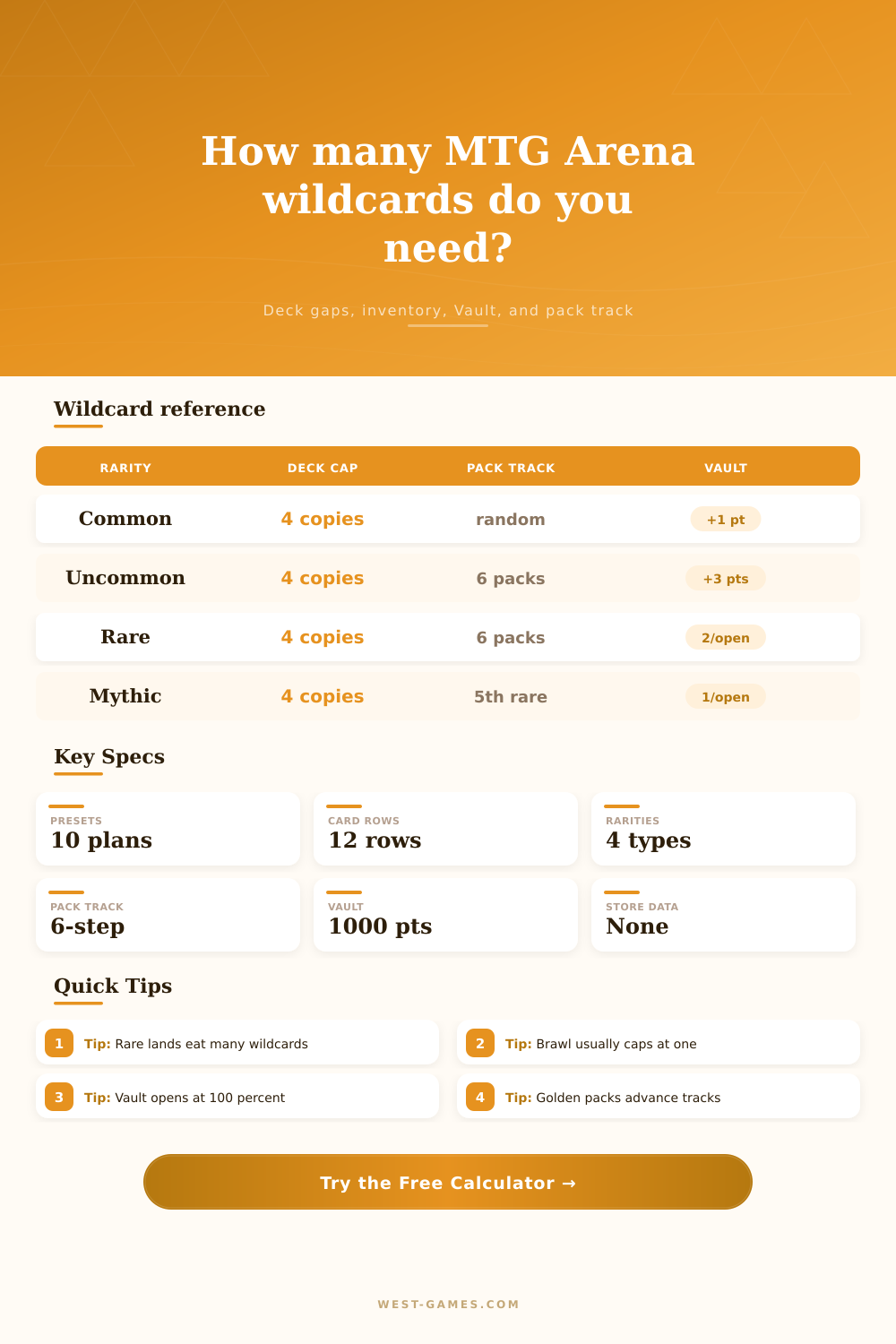
Total missing MTG Arena deck copies by rarity, compare them with your wildcard inventory, estimate guaranteed pack-track rewards, and check Vault progress from extra commons and uncommons.
| Card or slot | Rarity | Wanted | Owned | Missing | Notes |
|---|
| Track | Advance | Reward cadence | Calculator use |
|---|---|---|---|
| Uncommon wheel | Each regular or golden pack | 1 uncommon wildcard every 6 advances | Adds guaranteed uncommons |
| Rare/mythic wheel | Each regular or golden pack | Rare rewards, then mythic on the fifth reward | Uses your rare-cycle input |
| Regular pack randoms | Only regular packs in this estimator | Expected wildcards by published odds | Optional expected model |
| Golden packs | Advance wheels | No random wildcard slot modeled | Track timing only |
| Source | Point value | Vault opening | Reward bundle |
|---|---|---|---|
| Extra common | 1 point | 1000 points | No common wildcard |
| Extra uncommon | 3 points | 1000 points | 3 uncommon wildcards |
| Full Vault | 100 percent | 1 bundle | 2 rare wildcards |
| Full Vault | 100 percent | 1 bundle | 1 mythic wildcard |
| Preset | Format | Likely bottleneck | Best use |
|---|---|---|---|
| Standard Mana Base | Constructed | Rare dual lands | Check land-heavy deck gaps before crafting spells. |
| Brawl Legend | Singleton | Mythic commander and rare utility cards | Use one-copy caps for a commander-style list. |
| Draft Upgrade | Constructed | Few rares plus many uncommons | Upgrade a limited shell into a ladder deck. |
| Golden Pack Track | Any | Wheel timing | Compare guaranteed rewards from planned packs. |
Webhook row marker: index 1161, gid 1450490472. This tool models wildcard quantities only and intentionally omits store amounts.
Have you ever looked at your collection in MTG Arena and thought “I am just one rare land away from a viable Standard deck, but I don’t have the wildcards to craft it.” It’s a problem every digital card player has.
You see your cards, but do you see how much you can afford to play? Building your wildcard economy are key. That is how you turn the cards you own into the cards you actualy play.
How to Manage Your Wildcards
Once you know what you own, this tool will do the math for you (above), but knowing how it works prevents you from screwing up. One of the biggest mistakes most player make is treating every wildcard like currency. You can’t craft with a rare land without its counterpart; that’s not a wildcard that will substitute for it. So you need to keep track of rarity as well. This calculator do that. It keeps those separate so you can identify where things is equal or where you’re stashing worthless commons.
With Presets, you can jump into some pre-configured deck strategies to get an idea of what strategy a deck may take before you spend time entering any cards yourself. For instance, most of the cost in a constructed deck will likely be for the mana base. Usually, the dual lands and fetches will be mythic/rare; taking up your most precious cards. However, in a Brawl deck, you may only require fewer cards, but they hinge on specific legendary commanders that is expensive to acquire. The appropriate preset will automatically adjust your copy cap accordingly. This makes a huge difference in the math, whether you’re looking for one copy of a creature or four copies of a spell.
There are two other parts of the pack track system that most people don’t account for correctly. Yes, opening packs grants you cards, but it also advances wheels that give you wildcard rewards after 6 opens. For example, if you’ve got 5 advances on the uncommon wheel, then your next pack has a chance of being a guaranteed uncommon wildcard. Failing to account for this advancement will either lead you to underestimate how many packs you should of buy, or overestimate how much you’re able to spend. This is why calculator takes into account those guaranteed wildcards and allows you to view how much you can spend both now and down the line.
Next, there’s the Vault, a sort of long-term storage for any extra cards you acquire. Each extra uncommon or common you snag will gain you points towards a wildcard pack bundle. It takes time, sure, but if you’ve been playing for years, it will reward you steadily. Based off how many duplicates you should expect to get, the tool also guesses at how close you are and gives you an idea of whether you want to wait for the Vault to open or drop gold on packs now.
The common wisdom is to keep opening packs until you get what you want. But random drops follow a law of diminishing returns, which this advice overlooks. Planning strategically involve understanding your shortage before spending any tickets. The interface’s reference tables explains the Vault point accumulation schedule along with the cycling of track rewards. That way, you know the rules that govern your inventory.
In conclusion, it is not just about which cards you play. It is also about how many resources you can use. These factors determines whether or not you build a deck. Wildcards act as a separate budget that gives you control over your collection. Instead of guessing at whether you’re close enough to the meta deck, now you can calculate exactly how far away you are. That clarity transforms frustration into a plan, and plans gets you to the top of the ladder.