Tournament Bracket Calculator
Plan event structure from entrants, bracket type, byes, rounds, match count, setup buffer, station throughput, match length, and total runtime.
Planner model: single elimination uses the next power-of-two bracket and byes. Double elimination estimates winner and loser bracket load. Swiss and round robin use scheduled pairings instead of knockout byes.
| Type | Main match logic | Round logic | Best use |
|---|---|---|---|
| Single elimination | Entrants - 1 | Log2 bracket size | Fast events with clear elimination. |
| Double elimination | About 2 x entrants - 2 | Winner and loser bracket waves | Competitive events that allow a loss. |
| Round robin | n x (n - 1) / 2 | Entrants - 1 or paired waves | Small groups where everyone plays everyone. |
| Swiss | Entrants / 2 x rounds | User-set rounds | Large card, tabletop, and open events. |
| Groups into playoff | Group games plus cut bracket | Group waves plus playoff rounds | Leagues, pools, and broadcast finals. |
The calculator rounds odd pairings upward for scheduling, then estimates practical station waves.
| Entrants | Bracket size | Opening byes | Rounds |
|---|---|---|---|
| 9 to 16 | 16 | 0 to 7 | 4 |
| 17 to 32 | 32 | 0 to 15 | 5 |
| 33 to 64 | 64 | 0 to 31 | 6 |
| 65 to 128 | 128 | 0 to 63 | 7 |
| 129 to 256 | 256 | 0 to 127 | 8 |
Byes only remove opening matches from a knockout shell. They do not shorten every later round.
| Event scale | Entrants | Good stations | Common limiter |
|---|---|---|---|
| Side event | 8 to 16 | 2 to 4 | Late arrivals and setup swaps. |
| Local bracket | 24 to 48 | 6 to 10 | Early wave congestion. |
| Regional | 64 to 128 | 12 to 24 | Reporting, stream matches, and disputes. |
| Online qualifier | 128+ | Server capped | No-shows and admin calls. |
| Group stage | 32 to 80 | 8 to 20 | All group matches must finish before cuts. |
Stations are useful only while enough available matches can be called without waiting for prerequisite results.
| Game format | Typical match | Buffer | Planning note |
|---|---|---|---|
| Fighting game Bo3 | 8 to 14 min | 3 to 5 min | Controller checks can dominate short sets. |
| Platform fighter Bo5 | 15 to 25 min | 4 to 7 min | Stage bans and counterpicks add variance. |
| Card game round | 40 to 55 min | 5 to 10 min | Use fixed round clocks for Swiss. |
| Shooter map set | 25 to 45 min | 8 to 15 min | Lobby creation and side swaps matter. |
| MOBA match | 35 to 55 min | 10 to 20 min | Draft, pauses, and remake policy add time. |
Use the average match length field for one played set, then use the buffer field for overhead around that set.
Tournaments are a beast with many moving pieces. There’s a strict timeline, a bunch of player eager to play, and a bracket structure that needs to stay intact. How do you plan for the delays? These delays aren’t related to gameplay. They are things like setup times and controller swaps. They also include score reporting and rule arguments while the next round is waiting in line.
The difference between a tournament finishing on time or running long can be linked to this. After you plug-in your station availability and player count, the calculator do all of the math for you. No need to track all possible bottlenecks on your own!
How to Plan Tournament Time Well
Length of matches is the most obvious metric that most organizers obsess over. For example, if we’re doing a best-of-three fighting game set, then each match might take twelve minutes on average. Multiply that by our number of matches, divide by our number of stations, and you have the runtime. On paper, this makes sense, but in reality, it doesn’t work out.
Shorter format events will have as much or more overhead than actualy play time because of the time spent choosing stages and waiting for players to join. If not accounted for, it’s what turns a six hour event into an eight hour event.
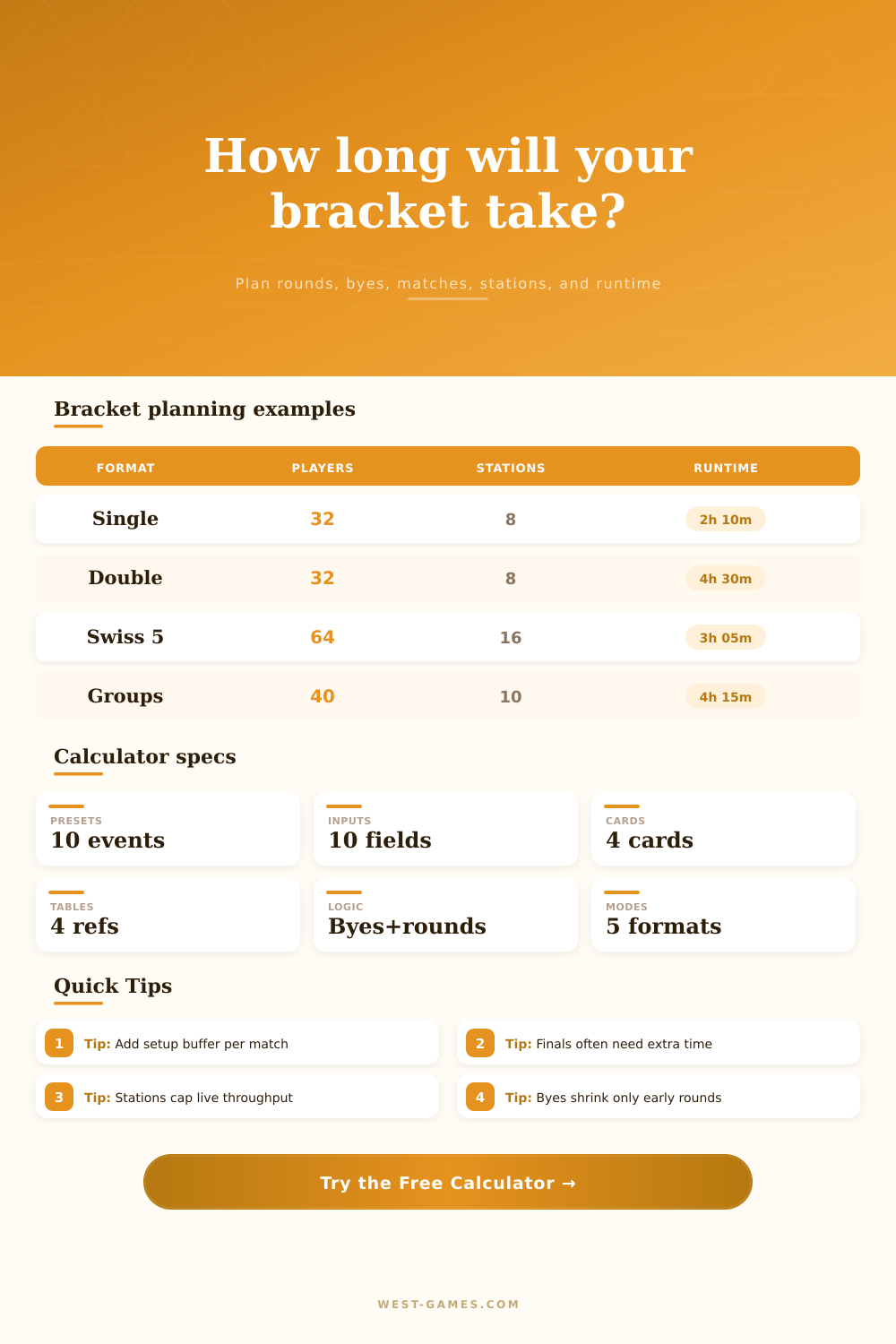
Now let’s talk about brackets. Which types works best? Some formats are leaner. Single elimination is ruthless with fewer matches but no second chance. Other formats give player a safety net, like double elimination, which audiences love but stretches out timeframes by about doubling the number of matches. Others keep players in the game longer (Swiss systems) but need tight schedules to avoid getting stuck in rounds. The page includes tables that demonstrates how each structure scales up/down with player numbers.
In other words: there is no single “best” format so much as a format that best suits your venue’s endurance level. Your throughput depends on your stations. The number of stations you use determines how much throughput you can reach. It might seem like “just add some more stations” is the solution to a long runtime, but that’s only true if you have enough independent matches running simultaneously to make use of them.
Many matches are dependent on other matches, especially in early rounds of a knockout bracket. While Round 2 continues to finish up, you can’t go ahead and begin Round 3. Even with empty tables waiting, there is idle capacity. The tool considers this dependency logic so it will show you what the realistic number of stations needed vs. This is the theoretical maximum. Your calculated need may exceed the physical space available; in which case you’ll need to accept a longer day or adjust buffer on the match length.
Of course, there’s always something about finals that throws off expectations. Match time slots are typically set during a tournament. Organizers assume that grand finals will be much longer to account for broadcast delays, ceremonial introductions, and upgrades to best of five. Putting a multiplier on these last rounds can help avoid anxiety over main-stage lag. It also allows staffers behind the scenes to anticipate more time before late games come back on, making the breaks seem much slower than those in the early rounds.
The other thing that commonly happens is check-in time. It’s very easy to assume all of your players will be online on-time at the beginning hour of your event. You have people who are late, issues with payment, arguments over pairings that bleed into your first hour without starting even one match. This extra work can be entered as an additional variable so it isn’t hidden within the average match timings.
You’re never trying to pack as much as you can into a single day. You want to create a cushion that swallows up the unexpected without disrupting your plan. If you know how buffers for stations, byes and limits work together, you cease to react to setbacks and instead design around them. Your well-planned bracket doesn’t feel hurried, it feels inevitable. You should of known it would look this good.