The Forge Armor Calculator
Estimate armor rating, practical damage reduction, load pressure, set synergy, and effective mitigation score for planned forge builds.
⚒Forge Armor Presets
🛡Armor Build Inputs
Calculation Breakdown
⚙Material and Spec Comparison Grid
📊Armor Tier Reference
| Tier | Base Rating | Best Use | Planning Note |
|---|---|---|---|
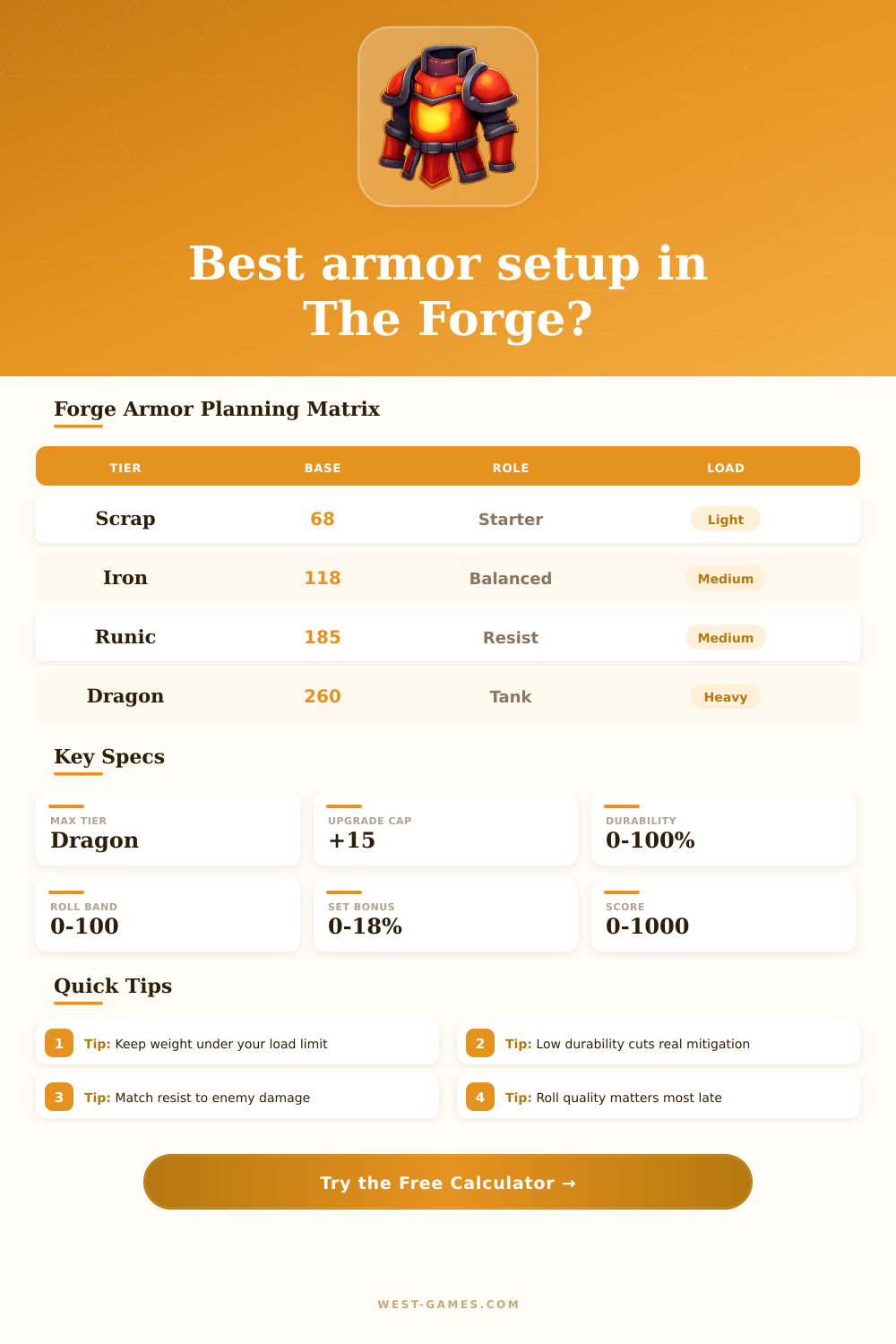
| Scrapbound | 68 | Early exploration | Light and forgiving, but falls off against burst damage. |
| Bronze | 92 | Starter defense | Useful when roll quality is high and weight must stay low. |
| Iron | 118 | Balanced fights | Solid comparison baseline for most forge planning. |
| Steel | 150 | Frontline melee | Good upgrade scaling before rare materials are available. |
| Runic | 185 | Mixed resistance | Works well when elemental resistance matters. |
| Obsidian | 220 | Heavy impact tanking | Strong raw armor with a noticeable load penalty. |
| Dragonforged | 260 | Endgame mitigation | Highest base rating, best with strong durability upkeep. |
🔬Material Quality Reference
| Material | Armor Factor | Weight Factor | Resistance Bias |
|---|---|---|---|
| Crude ore blend | 0.86x | 0.92x | No bonus; easy to carry but weaker. |
| Standard ingot | 1.00x | 1.00x | Neutral baseline for planning comparisons. |
| Tempered alloy | 1.12x | 1.06x | Small physical resistance lift. |
| Refined masterwork | 1.24x | 1.10x | Balanced physical and elemental lift. |
| Mythic infused metal | 1.36x | 1.18x | Higher elemental mitigation and roll value. |
| Ethersteel composite | 1.30x | 0.96x | Light high-end armor with set synergy. |
📐Upgrade and Resistance Planning
| Upgrade Band | Armor Multiplier | Roll Sensitivity | Durability Advice |
|---|---|---|---|
| +0 to +3 | 1.00x to 1.14x | Low | Fine for testing new sets before committing materials. |
| +4 to +7 | 1.18x to 1.32x | Medium | Repair before boss attempts if durability is below 70%. |
| +8 to +11 | 1.36x to 1.50x | High | Resist matching starts outperforming raw armor alone. |
| +12 to +15 | 1.54x to 1.68x | Very high | Prioritize strong rolls because every factor compounds. |
🧩Set Bonus and Load Bands
| Band | Range | Effect | Interpretation |
|---|---|---|---|
| Light load | 0% to 45% | Full mobility | Best for dodging, ranged play, and fragile builds. |
| Balanced load | 46% to 70% | Minor pressure | Good tradeoff for mixed armor sets and general combat. |
| Heavy load | 71% to 90% | Noticeable drag | Use when mitigation gain clearly beats mobility loss. |
| Overloaded | 91% or more | Score penalty | Only acceptable for shield walls or stationary tank roles. |
| Partial set | +4% to +8% | Reliable boost | Often better than a mismatched high-tier piece. |
| Full set | +12% to +18% | Strong scaling | Most valuable when durability and roll quality are high. |
💡Forge Planning Tips
Choosing armor in The Forge requires player to make several decisions about armor tier, armor material, and armor upgrades. Each of these variable impact a player’s movement and damage absorption. Armor tier is one of the first variable to consider in armor construction for it provides the minimum level of protection that a player will recieve from there armor.
For instance, Scrapbound chest armor may provide mobility for a person, but does not provide much protection against enemy that have high strength values. Armor of the tier of Runic armor or Dragonforged armor will provide more better protection than Scrapbound armor, but will also increase the cost of any mistake that a player make with their armor. Calculators can help armor progression by providing tools to determine the degree of protection that different armor tiers will provide to a player.
How to Choose Armor in The Forge
Armor material is another factor to consider when constructing armor. Armor material impacts the density of the armor and how resistant that armor is to damage. Standard ingots is a material that can be relied upon with armor construction, but materials like mythic and ethersteel provide increased resistance and density to the armor.
However, mythic and ethersteel armor also has increased weight and require more repairs to the armor. A player may find that one set of armor remains effective after taking many hits to the armor, but another build may become ineffective after its durability drop to 70% of its total value. Additionally, armor upgrades and armor durability interacts with one another.
Armor upgrades increase the multiplier for the armor, but the armor multiplier becomes less beneficial the lower the durability of the armor. A player may purchase a set of armor with high upgrade level but low durability, which can be worse than a set with a moderate number of upgrade levels but high durability. Other variables to consider with armor are the resistance values of the armor.
Resistance values provide protection against physical and elemental damage. The resistance values of the armor should be matched to the type of damage that a player expect to take in The Forge. Set bonuses to armor changes the way that armor functions.
Partial set bonuses may be obtained by wearing armor items that are part of a set, but not all of the items in that set. Five-piece sets provide greater bonus to players, but may lock a player into a set of armor pieces that may not be suitable for each situation in The Forge. Additionally, the load that armor places upon a player impacts their movement within The Forge.
Armor that is lightweight will allow a player to dodge more effective, but armor that is heavier will slow the player and impact their recovery from taking damage. Crafting roll quality is another factor that contribute to armor progression and effectiveness. Crafting roll quality becomes more important as players increase their level in The Forge.
Players will earn a strong roll with high-tier armor pieces that has good durability. A mediocre roll with a high-tier piece of armor will provide less protection than a lower-tier armor piece that has a better roll with crafting. Through making comparison between different types of armor, players can learn which variables impact their performance within The Forge.
Variables like durability, resistance, and load are more important then armor tier. Additionally, the armor calculator can help players to determine if a change to their armor is worth the risk and the materials required to obtain it.