🏆 Achievement Completion Time Calculator
Estimate remaining achievement hours from your earned count, average unlock time, rare achievement friction, missable rerun risk, online coordination, grind cleanup, collectibles, and weekly play pace.
Use this grid to sanity-check inputs: category overhead should explain why your plan is faster or slower than the base average.
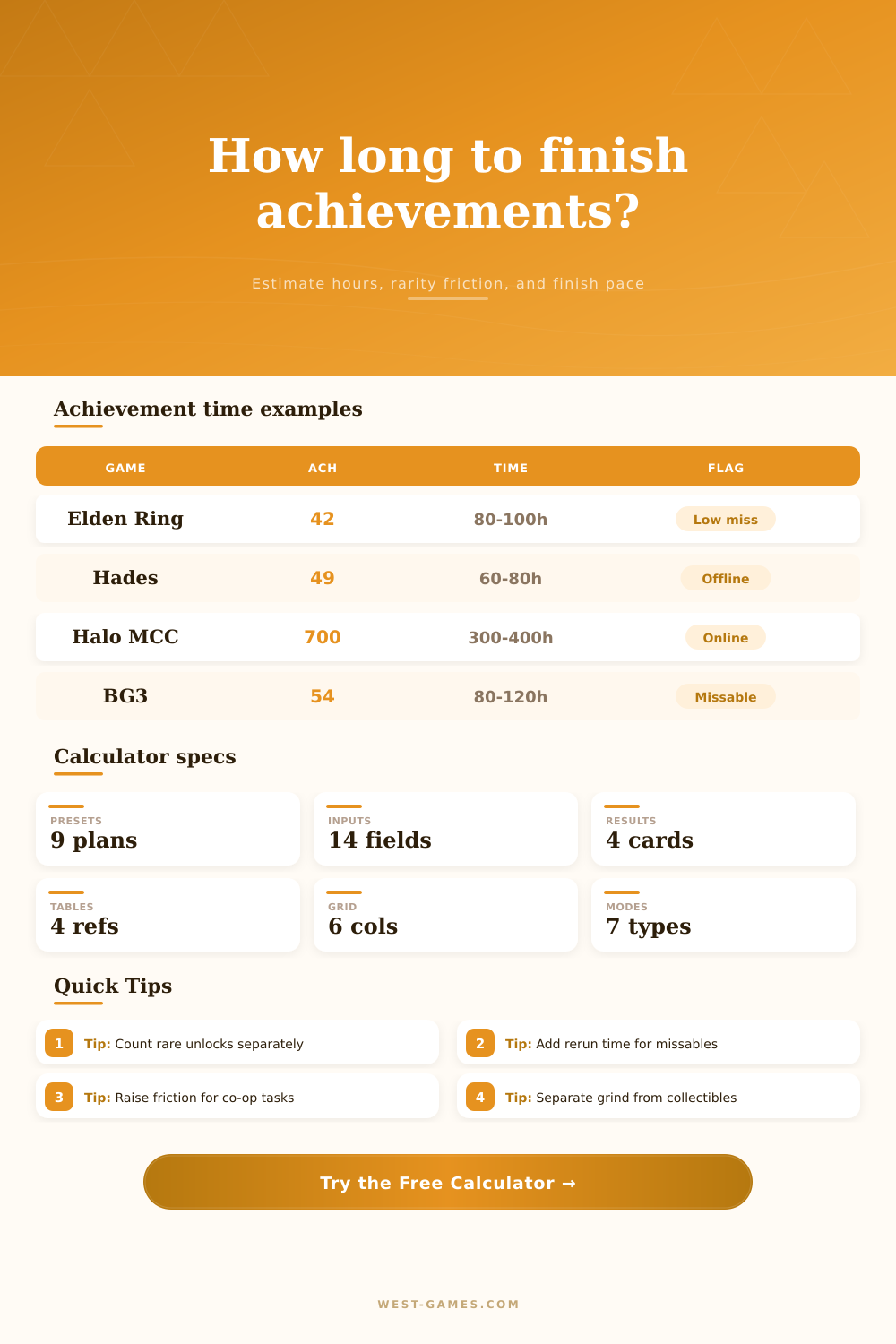
| Game or set | Achievement count | Published time estimate | Known modifier | Calculator preset |
|---|---|---|---|---|
| Elden Ring | 42 achievements | 80-100 hours | Mostly offline, low online friction | Elden Ring Late Cleanup |
| Hades | 49 achievements | 60-80 hours | Offline grind and relationship progression | Hades Prophecy Grind |
| Hollow Knight | 63 achievements | 60-80 hours | Skill walls and alternate run conditions | Hollow Knight Pantheon Push |
| Stardew Valley | 49 Steam achievements | 100+ hours guide estimate | Offline, includes missable platform achievements | Stardew Perfection Chase |
| Halo: The Master Chief Collection | 700 achievements | 300-400 hours walkthrough estimate | Online-only achievements and co-op coordination | Halo MCC Co-op Sweep |
| Baldur's Gate 3 | 54 achievements | 80-120 hours walkthrough estimate | Heavy missable-routing pressure | Baldur's Gate 3 Missable Run |
| Grand Theft Auto V | 77 achievements | 80-100 hours base-game reference | Online achievements can dominate cleanup | GTA V Online Cleanup |
| Terraria | 115 Steam achievements | 80-100 hours base reference | Collection and grind achievements expand time | Terraria Collection Push |
Counts and time bands are platform-sensitive. The calculator uses these as examples, while your input count should match your exact platform, DLC state, and achievement list.
| Rarity band | Global unlock rate | Suggested multiplier | Why it adds time | Input to change |
|---|---|---|---|---|
| Common cleanup | 30% or higher | 1.00-1.10 | Usually natural progress or simple checklist work | Average minutes |
| Uncommon cleanup | 10% to 30% | 1.10-1.25 | May need specific modes, routing, or moderate skill | Rare multiplier |
| Rare achievement | 5% to 10% | 1.25-1.45 | Lower completion rate usually means extra attempts | Rare count |
| Ultra rare | 1% to 5% | 1.45-2.20 | Can involve hard modes, perfect runs, or long counters | Rare multiplier |
| Exceptionally rare | Under 1% | 2.20-5.00 | Often requires mastery, luck, or coordinated sessions | All modifiers |
Rarity does not prove difficulty by itself. It is a useful time signal when paired with missable, online, grind, and collectible categories.
| Modifier type | Time input | Typical range | Completion-rate effect | Best use |
|---|---|---|---|---|
| Missable route lock | Rerun hours per missable | 2-40 hours | Low completion if many players pass point of no return | Endings, faction choices, one-save checks |
| Online matchmaking | Online friction percent | 10-75% | Lower completion when queues or servers thin out | Ranked, versus, seasonal, or population-gated tasks |
| Co-op coordination | Online friction percent | 20-100% | Completion depends on partner availability | Boosting, team medals, raid timing, party actions |
| Pure grind | Extra minutes per grind | 15-180 minutes | Completion drops when repetition outlasts main play | Kills, runs, currency, reputation, mastery counters |
| Collectible sweep | Extra minutes per collectible | 10-120 minutes | Completion drops when tracking is incomplete | Map items, cards, fish, logs, hidden rooms, codex entries |
For overlapping achievements, the cap option limits category counts to your remaining total, but overhead can still stack when a single achievement is rare, online, and grind-heavy.
| Average minutes | Remaining achievement type | Expected behavior | Risk signal | Adjustment to check |
|---|---|---|---|---|
| 5-20 minutes | Simple cleanup | Fast unlocks, chapter select, simple counters | Low if tracked well | Earned count accuracy |
| 20-60 minutes | Normal post-game list | Specific tasks with moderate travel or attempts | Moderate if rare count is high | Rare multiplier |
| 60-120 minutes | Skill or grind achievements | Repeated attempts or long sessions per unlock | High when completion rate is already above 70% | Grind minutes |
| 120-240 minutes | Late-stage completion | Remaining list is probably concentrated and difficult | Very high if many are missable | Missable rerun hours |
| 240+ minutes | Ultra-rare endgame | One achievement may control the whole schedule | Extreme if online is required | Online friction and buffer |
If the estimate feels too low, raise average minutes first, then tune the category-specific fields. That keeps the model easy to audit.
With a fresh save file and spring in your step, you set out to chase down platinum. You are armed with a spreadsheet, a supply of coffee, and the certainty that you’ll finish before next Friday. And then it hits you: the late game doesn’t give a damn for your plans. Now you’re grinding some skill-based achievement that demands flawless execution. You also discover a collectible from three hours ago that’s forcing you to repeat entire playthrough. That’s when it happens, that moment where panic sinks its teeth into your neck.
That’s what the achievement completion time calculator up top is for. Instead of leaving you anxious, it gives you a date on the calendar. What was once a vague mountain of work becomes something you can chip away at over time.
How the Calculator Helps You Plan
That’s all pretty straightforward. But it’s also kind of deceptive. Take total number of achievements left to get, then multiply them by their average unlocking time. For most click-through-the-list checklist games, that’ll be the baseline. It is easy to clean up. Then things break down when you start getting to hard stuff. Here, the calculator lets you tell the difference between finders and grinders. Five percent of the playerbase has gotten a rare achievement? That’s not “another thing to unlock.” It’s an obscure requirement, a wall of difficulty. You adjust for that by raising the multiplier based off rarity. This indicates to the system that these unlocks will seriously mess with your average pace. It’s a small change, but it keeps the estimate from getting more optimistic then it should of.
Completion runs have one silent killer: Missables. Those are the achievements that falls behind a point of no return or a decision you have already made. In a narrative heavy game, they can mean more than just wasting five minutes. They can mean two or three full run through the game. For this type of item, the tool will ask you to enter how many hours it took to do a rerun. It makes you realize the true price of failure. You lose not only the time spent on the task, but also your progress if you do not plan your path well enough.
The other sort of friction comes from online dependence. There’s no way to solo some achievements. No way to speed run matchmaking. There are games where you need particular kinds of person in particular numbers on servers for things to work out. Online friction adds the time it takes to find someone to play with, start playing, queue up, get disconnected, schedule around busy friends or strangers and so on. That’s your dead time after you find a match, and it can be most variable component of any completionist quest.
Achievements by category: Sweeps and grinds use a different type of mental model. Sweeps rely on routing, while grinds are pure repetition. With grinds, you know exactly what to do. Just do it enough times. That’s why the calculator allows you to tack on some additional minutes for each grind achievement to account for the monotony. For sweeps, on the other hand, you may know where things are but finding them efficienty (without backtracking) takes planning. The tool divides them up so that you don’t overestimate your time spent tracking down hidden objects.
And it helps that the tool comes with some presets, which show its ability to crack open games of various genre types. Skill walls and grind feature prominantly in an action title such as Hades. Decisions that have consequences and paths you might miss dominates a narrative roleplaying game like Baldur’s Gate 3. You can get a reasonable starting point from using the correct preset, then adjust the numbers according to your preferred style of play.
After plugging in your information, it outputs an estimated finish date and how much longer you think it’ll take. And again, that finish date is only as accurate as your level of discipline. The calculator will tell you when you’re likely to finish if you go out and play for two hours on four days per week. It won’t guarantee you’ll finish soon. But it will guarantee you’ll finish honestley. There is no more guesswork, just scheduling. With a map, the mountain appears smaller.