🔥 Fire Emblem Growth Rate Calculator
Project Fire Emblem stat growth from character base growth, class growth, bonus growth, level-ups, fixed or random mode, binomial odds, expected stat, target gain chance, and stat caps.
| Gains | Exact Chance | At Least | Projected Stat | Read |
|---|---|---|---|---|
| 0 | 0% | 100% | 14 | Waiting for calculation |
| Mechanic | What To Enter | Calculation | Common In |
|---|---|---|---|
| Personal growth | Character's stat growth | Base growth field | Every main FE |
| Class growth | Class modifier for that stat | Added to base growth | Awakening, Fates, Three Houses, Engage |
| Random level-up | Level-ups and total growth | Binomial probability by stat | Traditional mode |
| Fixed level-up | Starting hidden points | Growth points accumulate | PoR and modern fixed options |
| Over 100 growth | Check the over-100 box | Guaranteed gain plus leftover odds | High-growth builds |
| Stat cap | Cap for current class | Final stat cannot exceed cap | Late-game planning |
| Total Growth | Expected Gains In 10 | Chance Of 0 In 10 | Chance Of 5+ In 10 |
|---|---|---|---|
| 20% | 2.0 | 10.7% | 3.3% |
| 35% | 3.5 | 1.3% | 24.9% |
| 50% | 5.0 | 0.1% | 62.3% |
| 65% | 6.5 | 0.0% | 90.5% |
| 80% | 8.0 | 0.0% | 99.4% |
| 120% | 12.0 | 0.0% | 100% |
It’s the rage we all know, grinding out 10 levels on a Fire Emblem unit only to see no gains in Strength. It’s a certain type of anger that’s caused numerous forum debates throughout the years. They gets faster and faster, but their actual attacks stays weak as molasses. How did it happen? Why’d it have to be like this? Answer: You got unlucky. That’s different from getting screwed. Being able to tell the difference between these two will make you less of a casual player and more of a veteran.
The numbers game is a big part of that learning process, which is why I’ve developed this calculator. Things like percentages becomes real expectations. No need to hope anymore; plan ahead for what is likely.
How to Use the Growth Calculator
Here’s the basic concept: it’s about probability. Half your stats increase by 50% each time? Then you have half a chance to see that stat increase at every single level up. It seems reasonable, until you remember that consistency doesn’t count unless every event are separate. Leveling up is a coin toss. They happen one after another. And while over time they even out, in the moment, you get all this variability. Your knight could roll a streak of tails where she can never lands a hit.
Enter the magic of the calculator above. Plug in what percentage of your stats grow on each level, and then let it do the work for you. Forget trying to mentally figure out what the average results would looks like. Not only does this tell you the expected average but also actual odds of getting to one particular number or another. That’s infinitely more helpful if you’re attempting to reach a certain damage threshold or speed cap.
It’s easy for many players to overlook growth modifiers by class. It isn’t just about your units personal growth anymore. In titles like Engage and Three Houses, both your personal growth and current class bonus matter. Are you trying to create a certain kind of unit? Neglecting this class modifier will disappoint. Based off personal stats, you might feel a unit is destined to be a powerhouse with magic. But if they’re classed in one that negatively impacts magic growth then you’re going to be swimming upstream. With these input fields, you can distinguish between the two. What percentage of your growth rate is due to class vs. It asks about character. That makes a difference when you’re thinking of promotions or reclassing early on.
There’s also the mode debate: old vs new. Some like the randomness because it makes the units history unique, and because it pays off in the long run for those who stick around. Others (often newer) likes fixed because it gives them a path to consistent improvement. You can play with both on the calculator at once and compare. Fixed mode works by amassing growth points until a certain number hit. That way you’re not really wasting a level up. That takes away the pain of getting 0, but it also wipes out excitement of the ideal build. The tool mimics this by turning your percent growth into points. Then it shows what the deterministic version of that would look like, how many points would of been reached had the game done that instead of rolling dice. This is a nice sanity check to determine whether your random results are just bad or below average.
Plan for the late game. This is also where stat caps becomes the silent killer. Having a 100 percent growth rate doesn’t mean anything if you’ve already hit the cap. To account for this, I let you set a cap in the calculator so it won’t truncate your projected stats (since they might not look as impressive on paper). This is important for units that level up quite a bit, end-game units specifically. Without this feature, you might feel like things are improving but then realize you’re burning levels for nothing!
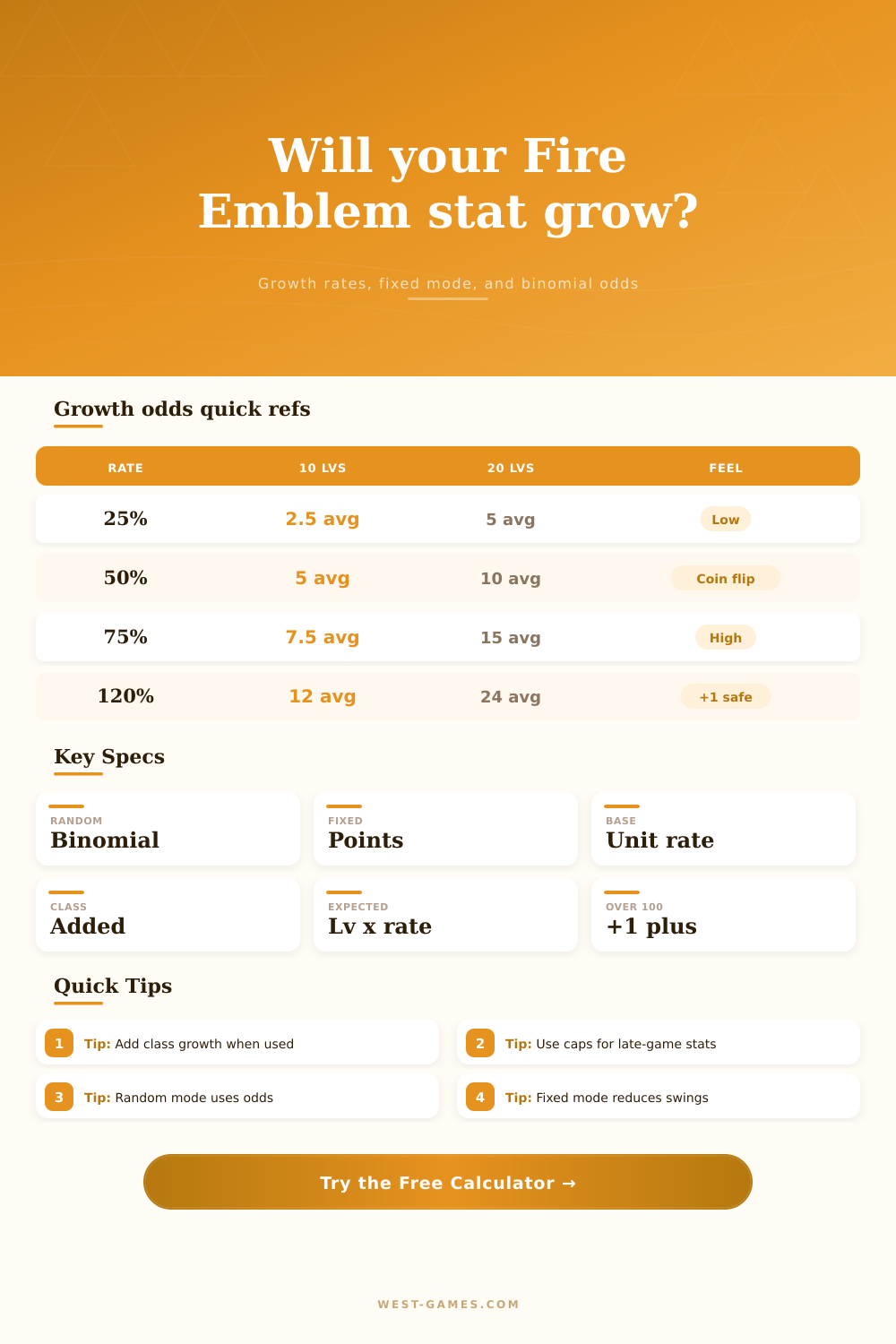
All in all, growth rate management is about risk. Is it worth gambling for a 25 percent? How about a 75 percent? The guts of deep strategy are knowing which growth you can afford to gamble on and which growth should be locked down. Skills and weapons will patch over any weak growth eventually. Bad growth could cost you a promotion and that’s tougher to fix. The page lays it all out in the reference tables. It shows you expected gains as they scale with level count. Use this information to make decisions on where to spend your training items and support bonuses. Time to stop leaving your build to the dice, time to engineer your victory.