🎯 FGO Pity Calculator
Estimate Fate/Grand Order Saint Quartz, tickets, 11-roll bonus summons, 330-count pity, SSR odds, rate-up chance, and target-copy probability before rolling.
| Banner type | SSR rate | Target input | Pity logic |
|---|---|---|---|
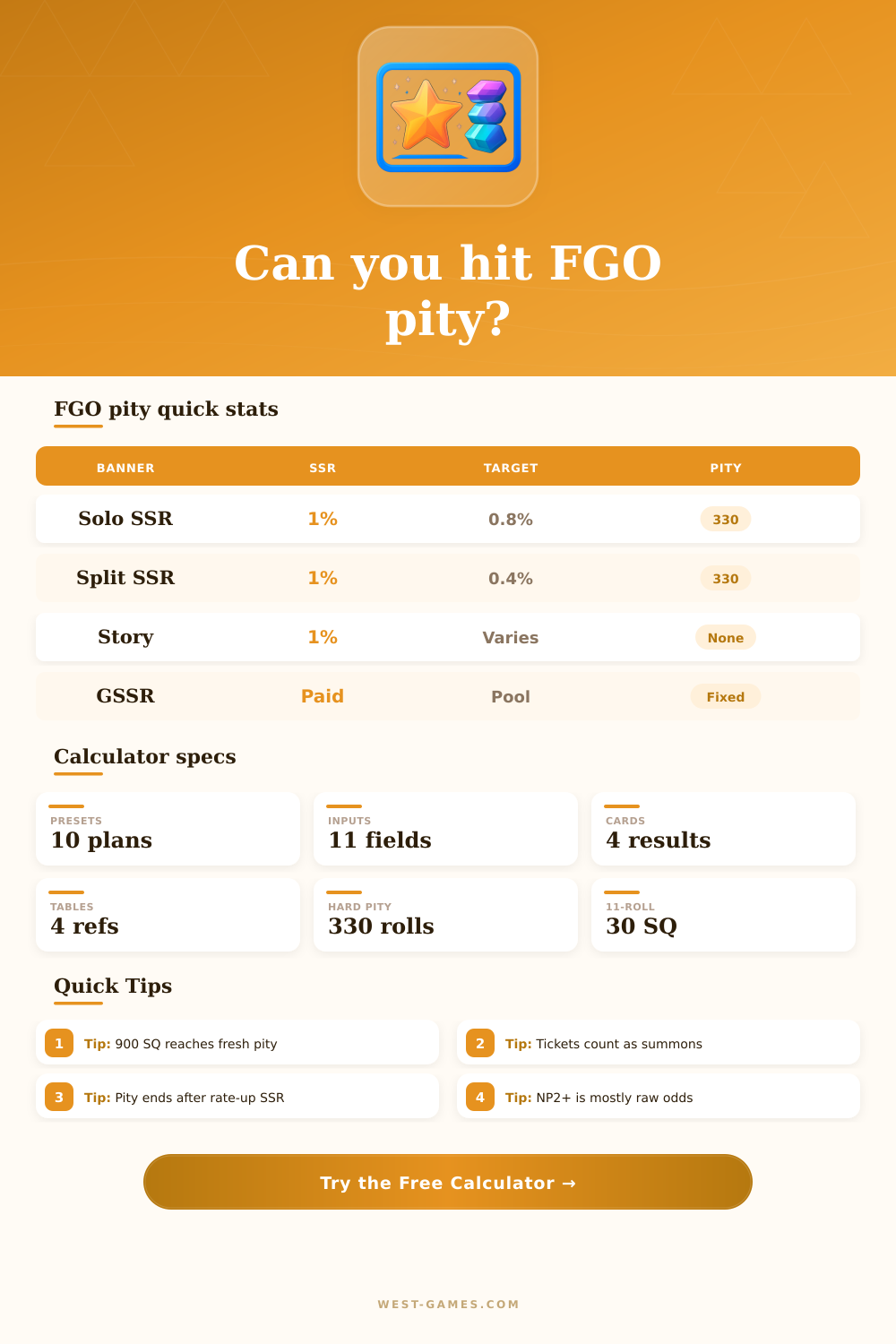
| Solo pickup SSR | 1% | 0.8% | Exact 330 target |
| Split pickup SSR | 1% | 0.4% typical | Use custom share |
| Permanent story | 1% | Pool share | No 330 safety net |
| GSSR paid pool | Fixed SSR | 1 divided by pool | One fixed roll set |
FGO does not use a rising soft pity curve in this model. The per-summon target rate remains flat until an eligible hard-pity trigger.
| Counter item | Value | Calculator field | Planning note |
|---|---|---|---|
| Fresh pickup pity | 330 summons | Counter 0 | 900 SQ reaches cap |
| One 11-roll | 30 SQ | SQ available | 10 paid plus 1 bonus |
| Single ticket | 1 summon | Tickets | Counts toward pity |
| Rate-up SSR hit | Pity ends | State spent | NP2+ has no safety net |
Use the banner's visible counter when available. Rotating pickups and separate campaigns should be tracked separately.
| Resource | Paid actions | Counted summons | Use |
|---|---|---|---|
| 30 Saint Quartz | 10 | 11 | One multi |
| 900 Saint Quartz | 300 | 330 | Fresh pity cap |
| Summon ticket | 1 | 1 plus bonus track | Singles |
| Bonus counter | 0 to 9 | Next free summon | 10+1 tracking |
The calculator converts SQ and tickets through paid summon actions, then adds bonus summons produced by the 10+1 system.
| Scenario | Main risk | Input to check | Watch card |
|---|---|---|---|
| First copy | Bad luck before 330 | Eligible pity | Pity position |
| Split target | Wrong rate-up SSR | Total rate-up | Chance target |
| NP2 chase | No second pity | State spent | Expected summons |
| Story target | Huge pool | Target rate | Resource gap |
For exact account planning, keep separate notes for current pity counter, bonus counter, and whether the rate-up SSR already appeared.
In Fate/Grand Order, instead of gambling, you’re managing a complex inventory system. There is saved tickets and Saint Quartz in your pocket. It’s the long game; you’d like to get a particular Servant. How do you get that Servant? The math are unclear until you break it down yourself.
The calculator gives you concrete probabilities. Knowing them make for real strategy. Pity acts like a rising tide for many players. It doesn’t. FGO has a hard cap of three hundred and thirty summons. There is no soft curve where chances rises with each pull. Keep that in mind when planning out your resource usage. Do you believe that every pull gives you better odds? Then maybe you’ll be waiting longer then necessary, or spending prematurely.
How to Plan Your Summons in Fate/Grand Order
Chances per summon remains static until the guarantee kicks in. This is why it also visualizes what your current counter position are. You’ve had one-hundred pulls so far? Then the next two-hundred-and-thirty carries just as much weight as initial ten. They’re just nearer to safety net.
Player intuition fails at resource conversion. Thirty Saint Quartz converts to ten paid summons (and a bonus eleventh pull). That’s an eleven percent increase in your pool, for free! And that count as part of your total. Those tickets also apply to this total. Burning a single resource may not be optimal; mixing them together could of been more efficient.
Here are the reference tables demonstrating how the bonus summon mechanic interact with both tickets and Saint Quartz. It doesn’t save much on its own, but multiply this across several banner and it adds up.
Different risks is associated with different types of banners. Solo SSR pickups have an eight-tenths of one percent chance to feature desired Servant each pull assuming a normal one percent SSR rate. That’s split in half for split SSR banners. Your chances of getting your character drop accordingly, but both targets retains the pity mechanism.
Story banners frequently lack any real pity, instead relying on a wider and less predictable pool distribution. The calculator takes into account what kind of banner you’re using. Even if it appears same as a limited pickup, don’t approach it the same. This makes planning for duplicates more complicated because after your first pity, there’s no resetting it.
The guarantee triggers at 330 summons, but everything after depend entirely on base rate. At this point it’s pure luck if you manage to chase Noble Phantasm level 2-5. There is no safety net to catch your second one like there was with your first. Veteran advice recommends saving enough for a complete pity cycle prior to pulling. Don’t go half-in and hope for an early stroke of luck. It feels good when you do, but leaves you high-and-dry if the rest of banner doesn’t cooperate.
That’s where the confidence intervals come in to bridge budget with hope. If you’re asking for a ninety-five percent chance of succeeding, it’ll take much more money than if you’re aiming for just fifty percent. It points out the volatility of tails of the distribution. Just because you’ve got the numbers right on paper doesn’t mean you’ve accounted for worst case scenario, which is something that will still punish you. That’s what people overlook when they plan their wallets.
Spending money isn’t the only part of summoning strategy, but managing expectations is too. By knowing your spot on the pity counter, you remove emotion from the equation. How many bonus pulls are you banking? When do you stop pulling out of a sense of luck? When does it make sense based off the math?
That Servant might be the one you want most in the world and the numbers don’t give a damn. They will help save your bank account while you wait for fate to line up.