🎯 Elo Percentile Calculator
Estimate a general game ladder percentile from rating, pool mean, standard deviation, active population, ladder type, and target percentile without tying the math to chess-only rating tables.
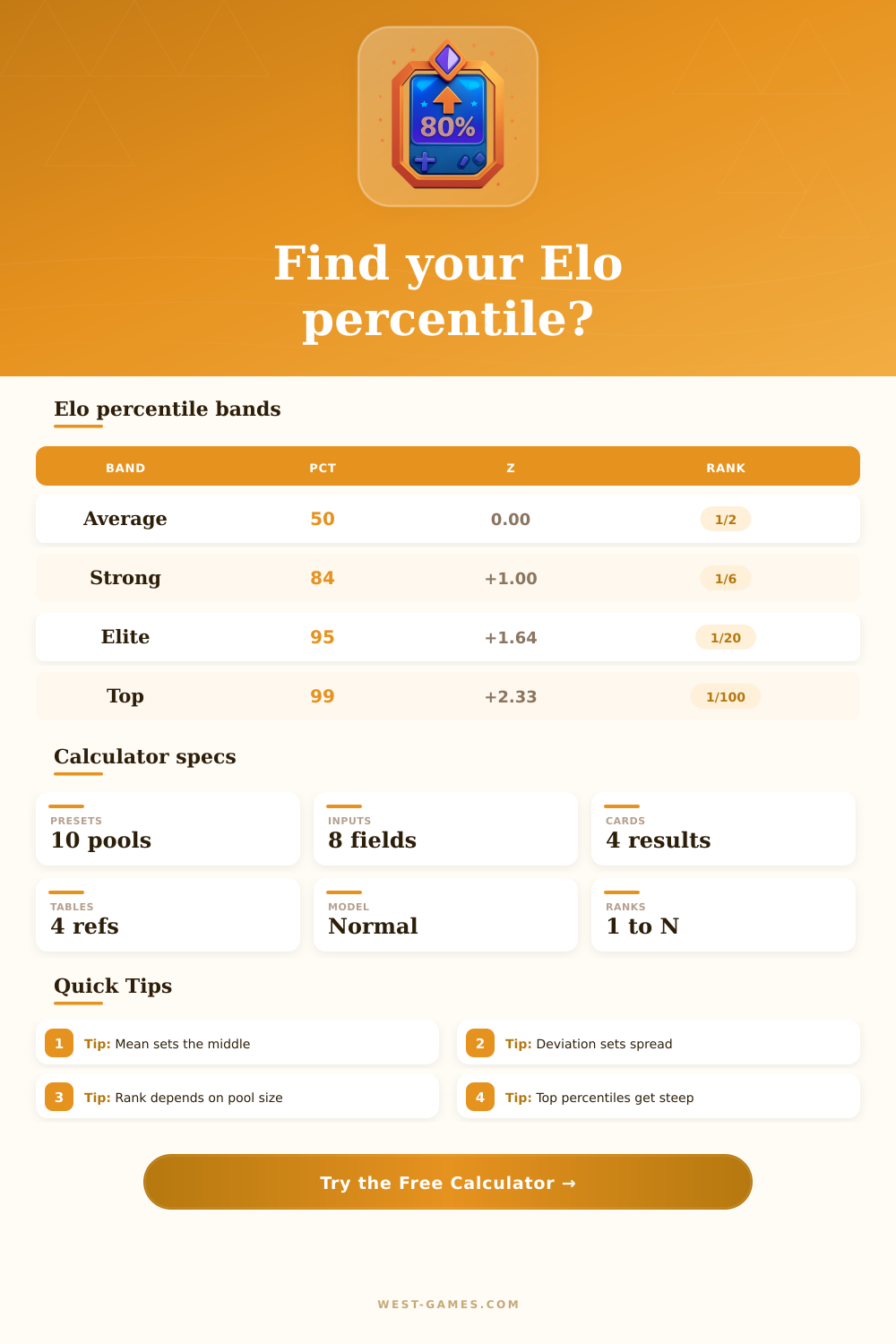
| Percentile | Z-score | Rating formula | Meaning |
|---|---|---|---|
| 50th | 0.00 | Mean | Middle of pool |
| 75th | +0.67 | Mean + 0.67 SD | Above average |
| 90th | +1.28 | Mean + 1.28 SD | Strong ladder cut |
| 95th | +1.64 | Mean + 1.64 SD | Elite range |
| 99th | +2.33 | Mean + 2.33 SD | Top 1 percent |
The calculator uses the same idea but lets you enter any target percentile from 0.1 to 99.9.
| Pool size | 90th | 95th | 99th |
|---|---|---|---|
| 1,000 | Top 100 | Top 50 | Top 10 |
| 10,000 | Top 1,000 | Top 500 | Top 100 |
| 100,000 | Top 10,000 | Top 5,000 | Top 1,000 |
| 1,000,000 | Top 100k | Top 50k | Top 10k |
| 5,000,000 | Top 500k | Top 250k | Top 50k |
Estimated rank is simply the unpassed share of the active population, rounded up to a ladder place.
| Type | Rank feel | Top pressure | Use when |
|---|---|---|---|
| Open public | Broad | Normal | Many active players |
| Seasonal | Compressed | Higher | Recent reset |
| Ranked match | Stable | Normal | MMR-like queue |
| Tournament | Seeded | Higher | Entrant field |
| Provisional | Noisy | Lower trust | Few games played |
These adjustments do not change the core percentile formula; they change the interpretation and confidence text.
| Preset | Mean | SD | Population |
|---|---|---|---|
| FPS ranked | 1500 | 350 | 250,000 |
| MOBA solo | 1500 | 375 | 1,200,000 |
| RTS 1v1 | 1450 | 325 | 80,000 |
| Fighting ranked | 1400 | 300 | 60,000 |
| In-house | 1500 | 180 | 64 |
Presets are editable baselines for general ladders, not official values for any single game.
You’ve hit sixteen hundred Elo in your shooter, but when you look at the leaderboard you’re not sure what that really means. According to your kills and deaths, you should of be close to first place, but now you’re in the middle of the pack. That’s because raw stats dont account for who is being compared to whom. One thousand points feels like a lot in a casual server with just a few players. In a pro ladder, not so much.
Rather than having to guess where you’d land in another group of player, the calculator figures it out when you select your game environment. No more ego, just a statistical reality check, backed up by population data different than your own feelings.
Why Your Elo Score Changes Meaning
Elo is perceived by most players as an absolute measure of their skill, they are 1600 just like there height or weight. They aren’t. It’s a relative measure of where they is in a certain distribution. The average will drop if there is a lot of beginner entering the game each month. The curve will flatten out. A high score now might be nothing more than the sixtieth percentile. On the flip side, if there’s a small but dedicated group who has all been playing for years, then the same score would represent top ten percent.
This difference alters what we think about our own progress because it stops us from thinking about chasing a number and starts us thinking about where we stand compared to those actualy playing the game. That context, rather than the integer beside our usernames, matters more.
The second number that matters is the ladder’s standard deviation, which show how spread out its players’ ratings are. Higher dispersion indicates a big difference between experts and newbs, meaning it’ll take longer for you to climb. Lower dispersion indicates tight grouping near the mean (a.k.a., most player are bunched), implying you might leap multiple rank bands with relatively minor rating increases. Adjust the dispersion according to whether your game feature continuous play or has seasonal resets.
Continuous ladders have high spread when they is established because players separate by skill. Seasonal ones begin bunched together with all player starting from scratch, but they tend to form long tails of veteran elites on top over time. Examine such trends within your own gaming timeline and pick accordingly.
The second thing is active player counts. People often assume that raw account creation counts are a measure for their rank. They aren’t. Accounts created but never used, smurf accounts, and bot accounts all gets counted. Your actual percentile is only made up of humans who queued up during the last week. When there are only 50k active players in your game, then reaching top ten percent means you beat out four or five thousand human player. That’s nothing like what it takes to reach top ten percent in a two million-player mainstream title where you’d have to beat out two hundred thousand people. That is a massive difference. It adjusts the concentration of opponents at each rung of the ladder.
The page contains reference tables showing how rank cut-offs change based off pool size. These variables make target setting simpler; instead of mindlessly grinding away, you know what you need to achieve. The calculator tell you exactly how much you have to improve (in terms of rating points) to hit a particular percentile with your present deviation and mean. And it emphasizes that the climb gets steeper as you near 100%, percentiles becomes exponentially more difficult to increase as you approach one hundred. So you can determine whether chasing elite status makes sense or if strong play in the eighty percentile will give you greater bang-for-buck. You can tweak its compression settings to reflect new seasons where ratings fluctuate wildly and arent very reliable. The percentile doesn’t chase validation; it manages expectations.
If you’re climbing a fighting game leaderboard, if you’re improving with a strategy card game, if you’re doing anything… The principles apply equally. They depend on fundamental nature of probability instead of mechanics of any specific game. The point isn’t so much the instant snapshot of where you are today, but what you do with it. Use that information to set reasonable goals and monitor actual progress over time.
When you understand your rank as not a static sense-of-self but a statistical place on a curve, it lifts some of the pressure off you and makes the climb seem like a more obvious path. Instead of focusing on individual matches, you focus on the curve. That’s the difference between a good player and a great one.