🔮 WoW Classic Warlock Talent Calculator
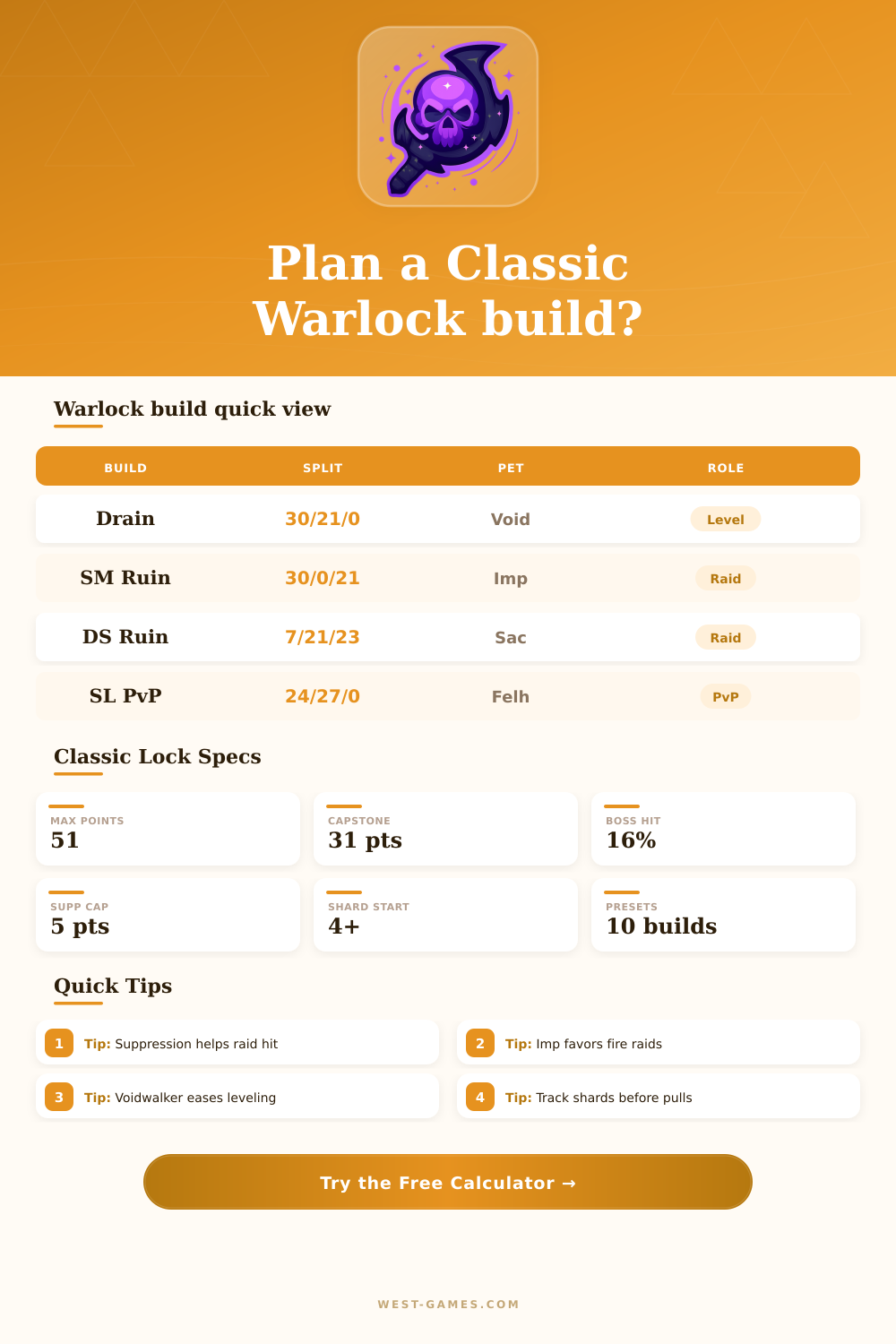
Plan Affliction, Demonology, and Destruction points with pet synergy, raid hit, threat comfort, PvP control, and shard preparation checks.
| Breakpoint | Tree or input | Points or value | Calculator meaning |
|---|---|---|---|
| Suppression | Affliction input | 0 to 5 | Adds Affliction spell hit for raid boss checks and early DoT reliability. |
| Nightfall range | Affliction | About 20+ | Improves shadow proc utility and raises dungeon or raid shadow value. |
| Shadow Mastery range | Affliction | 30+ | Confirms a deep Affliction shadow damage route for SM Ruin style builds. |
| Demonic Sacrifice | Demonology | 21+ | Enables sacrifice synergy and major raid damage routing without active pet utility. |
| Soul Link path | Demonology | 21+ | Counts as a strong PvP survival and pet synergy breakpoint. |
| Ruin range | Destruction | 21+ | Raises crit scaling for Shadow Bolt, fire burst, and raid pressure estimates. |
| Conflagrate route | Destruction | 31+ | Flags deep fire or burst identity, usually strongest in PvP or fire-focused play. |
| Boss spell hit target | Gear plus talents | 16% | Used as the raid hit target; Affliction hit also includes Suppression estimate. |
| Preset | Talent split | Best focus | Pet or sacrifice note |
|---|---|---|---|
| Drain Tank | 30 / 21 / 0 | Leveling and farming | Voidwalker or Felhunter keeps sustain and safety high. |
| SM Ruin | 30 / 0 / 21 | Raid shadow damage | Imp support is common when the pet remains active. |
| DS Ruin | 7 / 21 / 23 | Raid burst and scaling | Sacrifice turns pet choice into a damage modifier. |
| Fire Ruin | 0 / 21 / 30 | Fire-focused raid or dungeon play | Imp or sacrifice fits fire routing better than Voidwalker. |
| Soul Link PvP | 24 / 27 / 0 | Battlegrounds and duels | Felhunter control or Succubus setups pair well with survival. |
| Destro PvP | 0 / 20 / 31 | Burst and control | Succubus or Felhunter supports setup windows. |
| Pet plan | Best use | Talent synergy | Resource tradeoff |
|---|---|---|---|
| Imp | Raid support and fire play | Blood Pact value, Fire Shield utility, low maintenance range pet. | Low shard churn unless resummons are frequent. |
| Voidwalker | Leveling and solo safety | Pairs with Affliction sustain and early Demonology toughness. | Can cost time if threat fails against multi-DoT pulls. |
| Succubus | Damage and PvP setup | Good with Destruction burst or control-heavy PvP plans. | May require resummons after risky pulls or focus fire. |
| Felhunter | PvP utility and caster fights | Rewards Soul Link, control scoring, and utility-focused play. | Shard buffer matters when swapping pets for counters. |
| Demonic Sacrifice | Raid damage routing | Requires 21 Demonology and turns pet type into a buff plan. | Trades active pet utility for damage or sustain value. |
| Metric | Core formula | Inputs used | Interpretation |
|---|---|---|---|
| Legal points | Level - 9, capped at 51 | Level and tree points | Flags over-budget talent plans. |
| Effective hit | Gear hit plus Suppression estimate | Hit %, Suppression, role | Compared to 16% boss spell hit for raid checks. |
| Drain sustain | Affliction plus Demonology plus pet safety | Affliction, pet, spell damage | Higher means smoother leveling and farming comfort. |
| Threat comfort | Threat talents plus role penalty | Threat points, uptime, damage | Warns when strong damage may pull too hard in raids. |
| Shard buffer | Starting shards minus estimated needs | Shards, pet, duration, role | Shows whether resources are ready for the selected activity. |
In the Classic version of World of Warcraft, there are multiple ways to plan a Warlock. You must consider how each talent point impact your damage output and how it affects your survivability. It’s not simply a matter of picking a number to match a build.
Do you want to drain life from enemies while hiding behind a Voidwalker? Or do you tear through raid bosses with shadow bolts and an Imp that buffs your stats? The difference between those two path is significant, and the calculator enables you to focus on your specific objectives rather than making wild guesses about where to split points.
How to Choose Your Warlock Build
To be truly useful in raids, you should of aim for 16 percent spell hit rating. Without it, you’ll find yourself wasting your global cooldowns on thin air because bosses has a natural 15 percent resistance/dodge against spells. Some of that rating come from your gear; the remaining amount can come from the Suppression talent in the Affliction tree, which grants an additional two percent per point for drain spells and curses. While the remainder of the tree will increase damage, the five points of Suppression aren’t worth anything if you’re running a pure Destruction build, as they don’t affect Shadow Bolt‘s accuracy at all. That’s where things become troublesome for casual player.
Nothing will determine what shape your build takes quite like pet choice. If you leveled as a Voidwalker, then you probably spends some points in Demonology for both the health bonus and the survivability aspect. That’s fine if you’re grinding around in Durotar by yourself. But once you enter a raid environment, each point you place into toughness is a point away from damage multipliers. As we all know, those are much more important.
That’s where Sacrifice changes the way things work. Instead of viewing your pet as an active companion who plays one specific role (healer/tank), you begin to view them as a passive buff based off their type. They no longer fill those roles. Instead, they provide stat percentages that become more important later in the game when gear boosts your base stats so heavily.
One of the more tactical layers is soul shard management, how much have you got? When will you run out? Will you be able to cast a new Healthstone in the middle of the fight because your inventory’s full? You spend resources when swapping pets for utility like switching from a Felhunter to an Imp, or when your pet dies. That buffer gets drained a lot quicker in long raid fights or heated PvP battles than just farming solo. With the right inputs, the tool will estimate how quickly you’ll burn through them so you don’t run out at the worst times. It’s one of those little things that doesn’t seem important until you can’t do anything about it.
How to Balance Survival and Burst Damage Survival is sometimes more important than pure burst damage in PvP. That’s why soul link splits with 27 points in demonology seem odd on paper if you are just looking at raid logs. However, in arenas and battlegrounds where people focus fire you, it makes all the difference. Your pet takes some of the hits with you, you’re taking fewer hits yourself, and having that safety net baked into your talent tree lets you play more aggressive.
Focusing purely on doing the most damage ignores control mechanics and that’s what gets people wrong when they copy paste raid builds over to PvP. A Warlock can be specced many different ways… there isn’t one right answer. It’s just a matter of personal preference based on play style, the group you’re in, and what gear you have available.
Some people like the predictable nature of Drain Life for leveling; it heals constantly, doesn’t require much movement, etc. Other folks are hot on Ruin for its critical strike multiplier and love to watch those damage numbers light up during brief engagements against bosses. Naturaly, some prefer the moddern way.
Whatever you choose, know what you’re buying when you put points into something. Be flexible enough as a class to switch roles but not so much so that you become an entirely new character. If you’re going into a difficult dungeon run, make sure your talents matches your goals. Same thing if you’re prepping for an intense arena season. Know exactly why you chose what you did and the numbers will back you up every time.
Actualy, it is a luxurius feeling when the build works perfectly.