Dokkan Defense Calculator
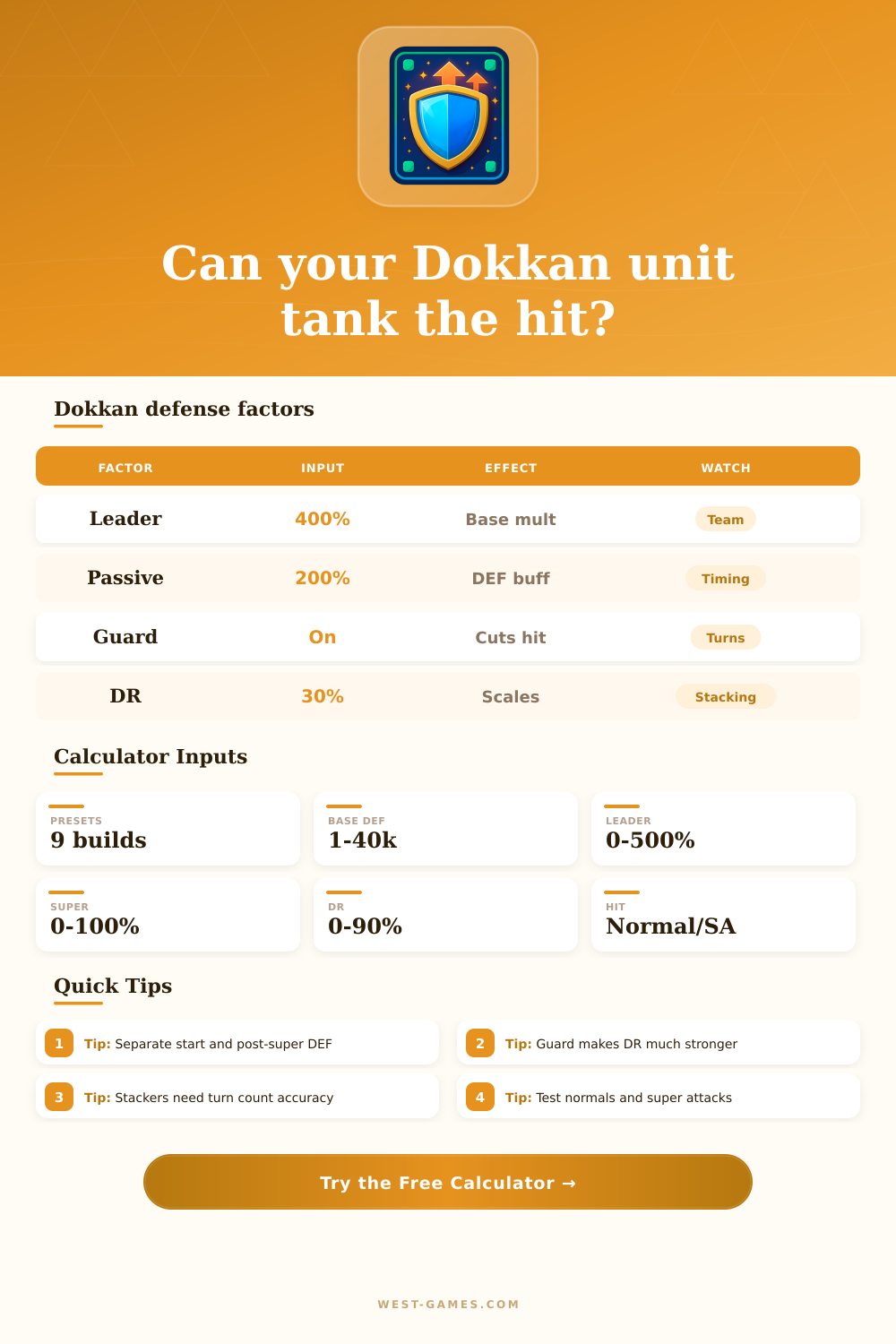
Estimate start-of-turn DEF, post-super DEF, effective DEF, and survival against normals or super attacks using leader skill, passive, links, support, stacking, guard, type matchup, and damage reduction.
| Super wording | Calculator value | Typical use | Planning note |
|---|---|---|---|
| No DEF raise | 0% | Nukers, pure damage units | Judge them mostly by start DEF, guard, and DR. |
| Raises DEF | 30% | Common modern super effect | One super is useful; multiple supers scale quickly. |
| Greatly raises DEF | 50% | Premium tanks and slot 2 units | Great for post-super tanking but weak before attacking. |
| Massively raises DEF | 100% | Short burst defense | Huge one-turn jump, especially with additional supers. |
| Condition | Tool multiplier | Effective result | Best use |
|---|---|---|---|
| Type advantage | 0.75x hit | Incoming hit reduced | Good for testing favorable boss phases. |
| Neutral typing | 1.00x hit | Baseline hit | Best default when the exact phase is unknown. |
| Type disadvantage | 1.25x hit | Incoming hit increased | Stress test risky rotations. |
| Guard active | 0.80x hit | Stacks with DR | Most important for slot 1 survival checks. |
| Boss hit size | Use as | What it tests | Safety read |
|---|---|---|---|
| 350,000-600,000 | Hard normal | Routine slot defense | Low damage means the unit handles normals. |
| 800,000-1,200,000 | Modern super | Baseline red-zone survival | Needs strong DEF, guard, or reduction. |
| 1,500,000-2,000,000 | Elite super | Endgame stress test | Often requires guard plus DR or heavy stacking. |
| 2,500,000+ | Extreme super | Worst-case planning | Only top tanks survive without item help. |
| Preset | Core idea | Defensive tools | Use this when |
|---|---|---|---|
| LR Slot 1 Guard Tank | High base DEF with guard | Guard, DR, support | Checking opening attacks before the unit supers. |
| Long Event Stacking Saiyan | Builds DEF across turns | High build-up, repeated supers | Comparing turn 3, 5, and 7 defense. |
| Support Floater Defender | Moderate DEF with team support | Links, support, lower DR | Testing third-slot units that still receive hits. |
| Cell Max Style Super | Huge incoming attack | Guard and reduction stress test | Seeing whether current HP survives a massive super. |
In the context of Dokkan Battle’s highest level events, players is not concerned with whether a unit will deal high damage to enemies, but with whether that unit can survive an attack from those enemy. Units may have high defense values display on their cards, but they may not survive a super attack from a boss monster on the first turn of an event. The defense calculator included on this page exist to help players understand the math behind a unit’s survivability.
It is possible for a unit to appear safe in game yet fail, as well as for a unit to appear fragile yet take more damage than other unit due to the interaction between guard, type advantage, and damage reduction stats. The different inputs into the defense calculator allow players to account for different aspect of Dokkan Battle’s gameplay. For instance, leader skills has an effect on a unit’s defense, as do the passive effects from the units itself.
Check if a Unit Will Survive with the Defense Calculator
Additionally, links, support, and the super attack from a boss monsters all has an effect on a unit’s defense during those battles. Finally, the defense calculator can only account for guard and type advantage, as they work to reduce the damage that that enemy deals to a unit prior to any damage reduction from the unit’s own stats. By separating these different aspect of defense, players can understand which aspects of a unit provide defense to that unit, and which aspects does not.
While many players may focus upon the defense value that is displayed at the end of the defense calculator, the true value of the tool lies in being able to observe the change to that defense value. For instance, turning guard off will reduce the defense of the unit. Increasing the attack value of the enemy will show players how much defense a unit has before that enemy can slay it with a single hit.
Additionally, comparing the defense value of that unit at the beginning of the turn versus after its super attack will allow players to understand whether a unit should go in the first slot versus after another unit in that event. Similarly, a unit may appear to be the best unit for the early turns of an event, yet be the worst for the first turn of that event. The reference tables included on this page assist players with their decision making in Dokkan Battle events.
The tables indicates the multipliers that are applied to various descriptions of super attacks. Additionally, the reference tables can be used to determine how guard interacts with damage reduction stats, as well as the difference between a normal attack versus a red zone super attack. Without these tables, a player may misinterpret the defense calculator’s results if the attack value for the enemy is entered into the calculator is less than the value represented in the tables.
One of the most common mistake with the defense calculator is treating damage reduction as if it has the same effect with guard active as inactive. Damage reduction will have a greater effect upon the health of a unit when guard is active than inactive. Additionally, many players enters the same defense values for every turn of an event.
However, early turns in an event dont have the same defenses as later turns due to the super attack raises. While the defense calculator cannot replace the need for testing a unit in an actual event, the calculator does remove some of the guesswork that players have to make regarding the math behind Dokkan Battle. The defense calculator allows players to test a units survivability prior to actually entering into battle.
For instance, a player can use the calculator to determine if a unit will survive a type disadvantage. Additionally, players can use it to determine how much defense a unit will lose when guard expires, as well as to compare strategies for when a player intends to perform a double super attack versus a single super attack. One of the aspects of the game that many players get wrong in their rotations of units are the difference between the defense that a unit has at the start of the turn versus after the boss monster’s super attack.
While it may seem as if all units are able to survive the first attack of a turn by a boss monster, the defense calculator allows players to understand which units cannot survive that first attack. Thus, players can better understand at what point in the event to utilize which units when planning their rotation. It should of been noted that the math can be tricky.
One of the most importent things is to check your values. You’ll want to make sure your not entering teh wrong numbers. Sometimes it is alot harder than it looks.
Looking at the units defense is better than just guessing. Its actualy quite simple once you use the tool. If you want to be moddern and efficient, you should of used this sooner.
You’ll recieve better results.