💎 Diablo 4 Loot Calculator
Estimate Diablo 4 farming odds from world tier or torment level, monster level, activity type, seasonal modifiers, target rates, run pace, drops per run, copies, and boss material rotations.
| Preset | Default target | Activity model | Why it fits |
|---|---|---|---|
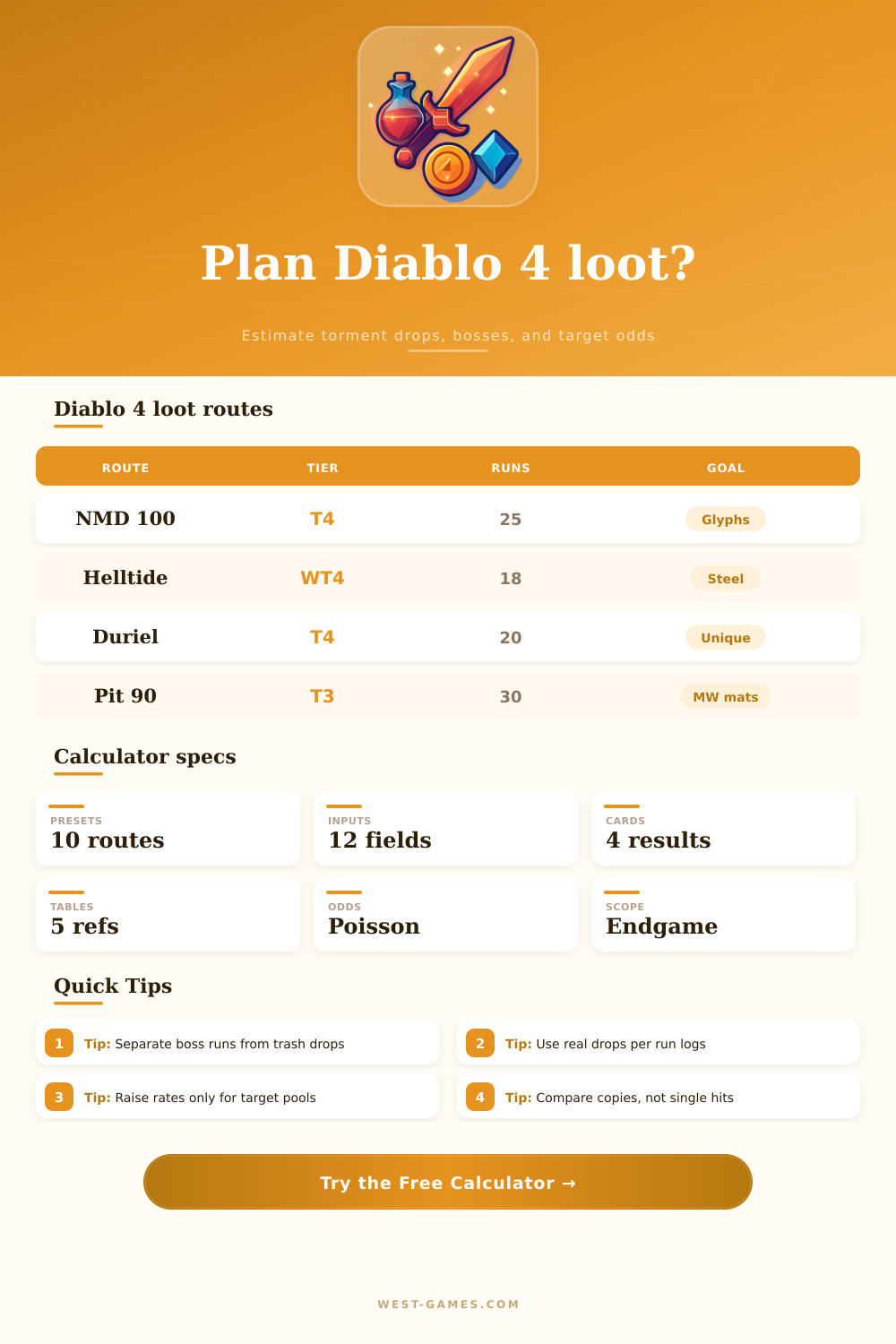
| Nightmare Dungeon 100 | Legendary aspect copy | Elite route | Many ordinary drops with useful glyph and sigil side progress. |
| Helltide Living Steel | Material and chest target | Helltide loop | Separates normal chest drops from Living Steel or boss ladder attempts. |
| Tormented Duriel | Boss unique | Duriel or Andariel table | Focused summons matter more than ordinary drops per route. |
| The Pit | Masterwork material plan | Pit guardian route | Clear speed is usually the main farming constraint. |
| Infernal Hordes | Reward chest target | Chest conversion | Reward choice and chest volume decide eligible attempts. |
Preset numbers are planning baselines, not official drop table claims. Replace them with your own route logs for serious farming.
| Profile | Loot mult | Unique mult | Use case |
|---|---|---|---|
| World Tier 3 | 0.78× | 0.70× | Early sacred farming and transition plans. |
| World Tier 4 | 1.00× | 1.00× | Baseline ancestral endgame model. |
| Torment I | 1.08× | 1.10× | Comfortable endgame clears. |
| Torment II | 1.16× | 1.22× | Better rewards if speed holds. |
| Torment III | 1.24× | 1.36× | High build pressure farming. |
| Torment IV | 1.35× | 1.55× | Top-end route planning. |
The tier multiplier is intentionally editable through the rate fields; do not treat it as a replacement for patch-specific loot data.
| Activity | Drop shape | Boss focus | Best input to audit |
|---|---|---|---|
| Nightmare Dungeon | Elite density | Low | Eligible drops per run |
| Helltide | Chest and elite mix | Medium | Chest count and materials |
| The Pit | Guardian plus rewards | Low | Run time |
| Infernal Hordes | Spoils chest burst | Medium | Chest conversion |
| Tormented Boss | Focused table | Very high | Material run count |
A route with fewer raw drops can win when its target table is narrower or its material attempts are more valuable.
| Target type | Rate band | Input field | Interpretation |
|---|---|---|---|
| Aspect or slot legendary | 1% to 8% | Legendary rate | Useful for codex upgrades and greater-affix slot goals. |
| General unique | 0.05% to 1% | Unique rate | Wide pool farming outside a focused boss table. |
| Boss target unique | 1% to 12% | Unique rate | Use when summons are known to target a smaller pool. |
| Mythic unique | 0.01% to 0.5% | Unique rate | Long-tail planning where material count dominates. |
| Boss material | 5% to 45% | Legendary rate | Good for chain-farming ladder rotations. |
When the exact chance is unknown, log several sessions and back into an observed rate instead of copying a generic number.
| Boss route | Material input | Target focus | Calculator note |
|---|---|---|---|
| Varshan | Body part sets | Starter uniques | Good warmup for boss ladder material planning. |
| Grigoire | Living Steel | Boss uniques | Helltide speed changes total rotations. |
| Lord Zir | Exquisite Blood | Specific uniques | Count summons, not just source events. |
| Beast in Ice | Distilled Fear | Unique table | Dungeon and summon time should both count. |
| Duriel or Andariel | Boss ladder sets | Mythic pressure | Material runs often dominate final odds. |
If a party shares summons, enter your actual personal eligible boss attempts rather than the party total.
| Metric | Formula | Uses | Meaning |
|---|---|---|---|
| Season factor | 1 + bonus / 100 | Magic or seasonal modifier | Raises or lowers eligible target rate. |
| Level factor | 1 + level gap / 500 | Monster level over 100 | Small reward for harder route planning. |
| Expected copies | drops x p | Normal and boss attempts | Average target count for the session. |
| Target odds | Poisson at least k | Expected copies and target copies | Chance to meet the copy goal. |
| Runs to 90% | Scale expected copies | Same pace and rates | Route volume needed for 90% confidence. |
The Poisson model is a compact approximation for many independent loot attempts with low target rates.
Diablo 4’s RNG feels like a bottomless pit. Farming legendary aspects can be like staring helplessly at a void of randomness. Kill the same elite packs over and over again. Run through the same nightmare dungeon for four hours. And yet, all you have to show for it is common junk. It’s maddening; the game masks its probability curves behind flashy loot filters and drop animations. Players are largely blind to them, accepting this as part of the genre. Grinding long enough will eventually even out the odds in our favor, most of us believes.
But here’s the problem: when you’re grinding without data, you’re only doing busy work. You don’t know if what you’re currently doing is likely to result in anything. You might be wasting your time on an activity with a low chance of success that doesn’t line up with your actual goals.
How to Farm Better Using Math
This is where the calculator takes over and does the heavy lifting, converting abstract drop rates to concrete expectations. Most farming guides completely gloss over this distinction between targeted boss summons and ordinary dungeon runs. Random elite packs are not the same as a Duriel summon. Elite packs has more types of items to find but lower rewards. A Duriel summon have fewer types of items to find but much higher rewards.
Each time you fill out a run, you’re not simply filling out a form. You’re grounding the math in reality instead of vague community averages. These averages might not represent how efficient you are on a particular route or with your particular build. Finally, the tool prompts you for your target type: Boss Materials, Unique Item, Specific Legendary Aspect. Why? Because the size of the pool varies drastically based on what you’re chasing. For example, a general unique will have a very small chance per roll but a targeted unique off of Duriel will have a much better shot since table is restricted.
It is also important to understand how your run time works. Average minutes per clear takes into account not just killing stuff but managing stashes, traveling back, looting, etc., so you don’t overestimate your per-hour yield just by being faster at combat. You might be able to kill stuff fast in a dungeon, but if it take another eight minutes to reset and manage your inventory, your real output goes way down. That’s where folks screw up. They think about their kill speed rather than their cycle time.
Because world tier modifiers will affect loot density (you’ll have more loot when playing Torment IV than you do on Nightmare), it accounts for those too. So yes, it knows this isn’t officially sanctioned Blizzard information, but it doesn’t pretend that it is. Rather, it offers a flexible model that you can adjust based on whatever bonuses and seasonal events you happen to see yourself getting.
For example, let’s look at two activities: Infernal Hordes vs. One activity is Helltide chest runs. With Helltide, the goal is to get as many red chests and elites in a certain amount of time. It’s about optimizing routes and maximizing volume. The calculator will help you approximate how much Living Steel you can expect to pick up during the event.
With Infernal Hordes, it’s a bit more of a gamble, since some runs may net you several masterworking materials while others won’t net anything at all. But there’s a big bonus at the end of each run, so that adds variance. Looking at both activities back-to-back allows you to see which has better odds of helping you achieve your goal. Maybe you’re trying to upgrade a set with a rare material, even though the boss ladder takes longer to prepare, it might make more sense.
The tool comes with a series of reference tables outlining the drop weights for each activity. So if you’re trying to get masterworked components, or glyph experience, or raw loot volume; that’s all factored into this so you know which activity to concentrate on. It’s not just about finding more stuff. It’s about finding the right stuff.
If after thirty runs you notice there’s no chance of hitting your goal, now’s the time to pivot. Did you choose the wrong seasonal modifier? Does your route contain too many non-eligible drops? Tweak those variables and the results are instant. No need to leave home to play what-if.
At its core, then, Diablo 4 is a game where you’re rewarded for thinking of farming as a puzzle, instead of a grind. And while the numbers may be depressing when you look at them initially, they is accurate. If you understand the odds, and embrace them, you’ll stop chasing ghosts and begin to improve your path. Improve it so that you have the best chance of getting the specific thing you want.
The route that makes those odds as high as possible will become clear once you’ve got the right lens on it, the calculator provides that lens. It converts hope into strategy. And in a game with such randomness, strategy is the only true way to create an advantage.