🎲 5e Character Planner
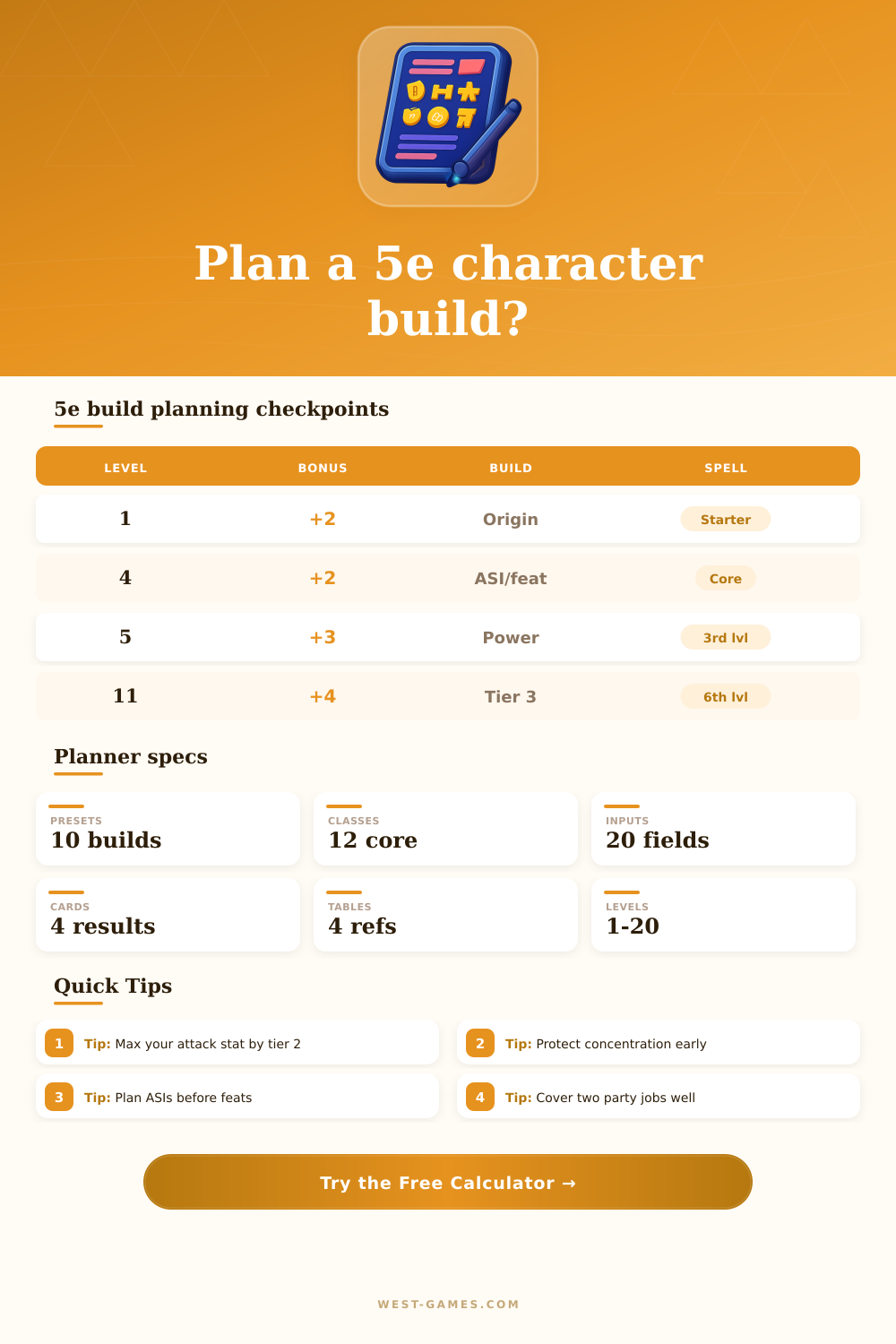
Build a fifth edition character plan with class, subclass, ability scores, ASIs, feats, proficiencies, AC, HP, spell slots, save DC, and party role balance.
| Level | Prof | Common gain | Build note |
|---|---|---|---|
| 1 | +2 | Class start | Choose role |
| 3 | +2 | Subclass common | Identity online |
| 4 | +2 | ASI or feat | Fix key stat |
| 5 | +3 | Tier 2 spike | Big power jump |
| 8 | +3 | ASI or feat | Reach 18-20 |
| 9 | +4 | Tier pressure | Higher saves |
| 13 | +5 | Tier 3 play | Major magic |
| 17 | +6 | Epic tier | Peak math |
Fighters receive extra ASI levels; this planner includes the level 6 and 14 fighter bonus when relevant.
| Score | Cost | Modifier | Use case |
|---|---|---|---|
| 8 | 0 | -1 | Dump stat |
| 10 | 2 | +0 | Neutral |
| 12 | 4 | +1 | Useful skill |
| 13 | 5 | +1 | Multiclass gate |
| 14 | 7 | +2 | Strong secondary |
| 15 | 9 | +2 | Best start |
| 16 | Origin | +3 | Focused hero |
| 20 | ASI cap | +5 | Peak stat |
Enter final scores after origin bonuses; the point-buy readout flags values outside ordinary pre-bonus planning.
| Caster level | Highest slot | Slots shape | Build impact |
|---|---|---|---|
| 1 | 1st | 2 | Starter magic |
| 3 | 2nd | 4/2 | Core utility |
| 5 | 3rd | 4/3/2 | Major spike |
| 7 | 4th | 4/3/3/1 | Control rise |
| 9 | 5th | 4/3/3/3/1 | Tier 2 peak |
| 11 | 6th | +1 high | Tier 3 magic |
| 15 | 8th | +1 high | Rare effects |
| 17 | 9th | +1 high | Epic casting |
Half-casters use their class slot table; warlocks use pact slots instead.
| Role | Strong signal | Useful stat | Check |
|---|---|---|---|
| Frontline | AC and HP | CON | Protect allies |
| Striker | Attack bonus | DEX/STR | Focus fire |
| Controller | Save DC | Cast stat | Area denial |
| Support | Slots and skills | WIS/CHA | Recovery tools |
| Scout | Skills/expertise | DEX/WIS | Stealth info |
| Face | Social skills | CHA | Negotiation |
A balanced party usually needs two characters who can cover recovery, scouting, control, and frontline pressure.
Building a character for fifth edition Dungeons and Dragons require many different decisions. The decisions you make for your character at level one will have an impact upon your character in later game sessions. Additionally, the decisions you make at levels four and eight will help to determine whether your character is likely to be powerful or merely adequate relative to the other player in the game.
Due to the importance of these decisions, many players use a planning tool for the character creation process for Dungeons and Dragons. Such a planning tool will help to ensure that the math for the character are accurate, and it will also allow the player to maintain the story that they would like to tell during their game sessions. Every character should have a specific job that they will perform in cooperation with the other member of the party.
Plan Your Dungeons and Dragons 5e Character
Characters who defend the party during combat should have a good chance of remaining standing during the conflict, characters who strike at the enemies should be able to remove those threats from the party, characters who control the battlefield for the party should have a good number of ability to extend the others in the party, characters who assist the other members of the party should have abilities that enhances the others’ capabilities, characters who explore the world and solve the problems should have the same abilities, and characters who interact with the other non-combatant characters should have good communication and social skill. The most succesful D&D characters will have a good balance of two of these job, rather than attempting to master each of the six role. The ability scores for each of the characters will help to determine which job the character will perform.
Using the D&D calculator, players can select the abilities for the character and ensure that each of their abilities fall within the cost indicated by the point buy system for D&D. Additionally, each of the ability score will impact the character in some way. For instance, the primary ability score for a character will increase the character’s attack roll, save dice, and skill checks.
The constitution score for a character will impact the character’s hit point and there use of concentration spell for each of the game’s different classes. Additionally, the dexterity score will impact the character’s initiative and armor class, but should not be entirely poured into one ability, as that will create gap in the character’s other ability scores. In addition to selecting each of the character’s ability, the character also gets a limited number of feat.
Each of these feats can increase the character’s ability scores, as well as provide new abilities to those characters. A character planning tool will assist the player in determining which level the character will spend on feats versus ability score increases. This selection will allow the player to ensure that special abilities are purchased at the right time for the character.
For example, concentration spells will prove to be more beneficial than damage in some instance. Additionally, characters who use weapon in the game can purchase weapon feats, and those who need any form of defense can purchase defensive feats. Those who use magic will have additional considerations in their selection of character feat and abilities.
Characters who fully cast spells will earn a level in their spell every few levels, and a planning tool will assist the player in selecting how many spell the character will cast at each level. Half casters and those who use pact magic will have different schedule for spell levels, but the planning tool will adjust for these difference. Additionally, any character who cast spells needs to ensure that the number of spell slots they have selected aligns with the job that they perform for the party.
For instance, a character whose job is to land saves against monsters should have a decent number of spell slot for saves. Party composition is something that many players tend to ignore until the first game session of the game. However, should three player choose to stand in the front lines of the party and two players choose to blast enemies from the back of the party, some player will have to take on the job of gathering information about the enemies and finding a way to assist those who are wounded.
A planning tool will show each player their option for roles that each character can fulfill for the party, as well as which role each player’s selected character will fill in relation to the others. Any adjustment made at this stage will prevent major problem in the game. Common mistakes with character creation are made when a player ignores the general math of the character.
For instance, a character with high damage score but low defenses can pose a threat to the other players if the monsters focus their fire on that one character. In the same way, a character that provides support to other players in the party but with weak defenses may lose spell that are crucial for the party if the enemy lands one of its hits against that character. Such mistakes will not be avoided by using a character planner, but such a tool allows the DM and the players to see these potential choice before the character sheet is written.
For players looking to build a succesful D&D party, the best builds for characters allow for the inclusion of the player’s own personality and stories. Characters that fulfill their role well can take detour from that essential job to add flavor to the story that the DM is to tell. However, each of these characters should have a solid foundation for their ability; otherwise, they may collapse during the story.
Once the players have selected which ability they will use for their characters, and after determining which role each of their characters will perform in the party, players can begin to bring their characters to life.