Crafting Tree Total Calculator
Estimate a multi-tier game recipe tree with final output goals, tier yields, subcomponent quantities, waste, craft time, and machine requirements.
Calculation Breakdown
No Waste
Deepest materials if every intermediate craft lands cleanly.
Entered Waste
Raw material requirement after scrap, failures, and overcrafting.
Half Window
Machine count if you need the same tree finished twice as fast.
Extra Yield
Final craft runs if the top recipe gains one extra output.
| Layer | Required Output | Craft Runs | Yield Used | Waste Applied |
|---|
| Production Stage | Craft Cycles | Seconds Each | Total Time | Machine Pressure |
|---|
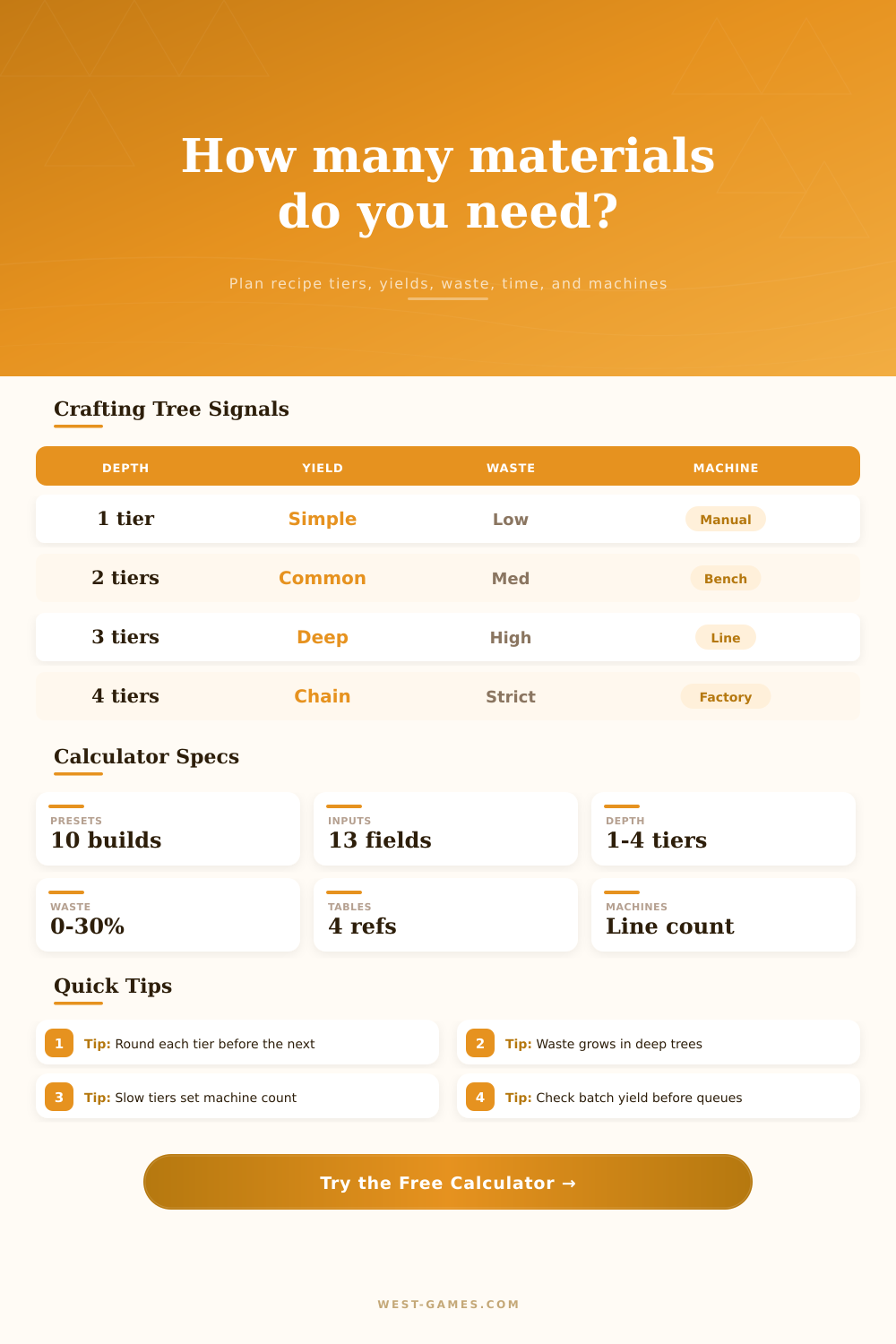
| Depth | Typical Game Pattern | Planning Risk | Best Check |
|---|---|---|---|
| 1 tier | Direct craft from raw materials | Low rounding risk | Confirm final yield and target quantity |
| 2 tiers | Processed parts feed final craft | Moderate overcrafting | Round component runs before raw inputs |
| 3 tiers | Subcomponent chain with refined bases | High waste sensitivity | Add scrap buffer at every tier |
| 4 tiers | Factory chain or advanced equipment | Machine bottleneck risk | Check the slowest stage first |
| Family | Default Depth | Waste Pressure | Machine Style | Use Case |
|---|---|---|---|---|
| Manual station | 2 tiers | Low | Workbench | Tools, gear parts, simple equipment |
| Alchemy batch | 3 tiers | Medium | Cauldron or lab | Potions, tonics, solvents, flask stacks |
| Engineering line | 3 tiers | Medium | Assembler | Ammo, traps, devices, repair kits |
| Electronics chain | 4 tiers | High | Fabricator | Circuits, modules, processors, drones |
| Shipyard fabrication | 4 tiers | High | Heavy line | Plating, hull segments, engine blocks |
| Cooking prep | 2 tiers | Low | Kitchen queue | Feasts, rations, event meals, buffs |
| Enchanting chain | 3 tiers | Medium | Rune table | Glyphs, scrolls, inks, augment stones |
| Factory assembler | 4 tiers | High | Parallel machines | Base blocks, conveyor parts, automation kits |
That’s where it all begins: with a modest request. They needs two hundred and forty iron ingots to expand the fortress. Not so bad, right? Games don’t make it easy to click “buy” and pull the final product out of thin air. There is usually a chain of dependencies hidden behind that single output number.
That produces a repeating tree of parts, magnifying the amount of work you have to do in a way that your brain simply won’t count in its head intuitivly. That makes planning less an occasional hobby and more supply chain logistics. After you plunk down your depth and yields into the calculator above, it does math for you. It spares you having to guess at how many raw chunks of ore you’ll ultimately need to dig up.
How to Plan Your Crafting
Crafting is an exponential process. That’s why it’s the single largest trap people falls into: they think of it as a linear process. Your last recipe takes three ingots? Ok, each of those take two bars of metal? Ok, each of those takes four chunks of refined ore? Boom. Math goes big real quick.
And you’re not just tripling. You’re tripling, then doubling, then quadrupling, compounding at every level. You also has to include waste in your equation, and now that number swells even more. And most people don’t remember that if there’s a seven percent failure rate at the bottom tier, you have to craft more intermediates to account for those failures. That buffer is applied automatically by the calculator.
It tells you how inefficient your process are. But the absolute speed isn’t as important than depth. So, while a two-tier chain will bottleneck at the end, a four-tier chain will typically do so further back. Why? Because in shallow chains, the “slowest” machine is often your last step, like when you’re making something in shallow trees.
Your final crafting machine are often the weak link. Deep chains shift that pressure up. Now maybe you can crank out all the stuff at the very end, but you’re starving for what feeds into that machine. The tool shows the pressure at every stage. What’s really telling is which station is limiting your output. Which machine is controlling the length of time before you make another thing?
And that’s where many players fail: assuming that assembling the gear is the problem. These ideas are based off presets. Simple things like iron tools follow a simple manual logic: low depth and low waste. Look at a recipe, such as one for circuit boards or something magical. These has deeper dependency chains, higher failure rates, and more industrial complexity.
The presets tweak the defaults so that those realities align with the game mechanics you’re probably facing. They change the speed of machines and the pressure of waste to match what you’re probably dealing with. Of course you can always over-ride them, but it’s a baseline of real-world stuff to compare against.
Your other constraint is time. Sure, maybe you have all the right materials in stock but you only have X number of minutes until your server resets or your raid begins. You can specify your production deadline, and it will tell you how many parallel machines you should of had working on it to meet that deadline. Not only will it say “this will take this long”, but it’ll distribute that time out over whatever machines you’ve got.
Need more? The tool will tells you exactly where you should be expanding. That’s what planning ahead looks like. It can also help with rounding errors which is a disaster to a carefully laid plan. Needing five components? Can’t make 1.25 batches if your yield on each are four. Got to round up to two.
This half batch accumulates as extra material. It may not seem like much, but it adds up once you have run through dozens of tier. The calculator does its rounding at every tier then feeds down to the next. When you’re all done calculating raw material it’s mindful of this granular waste. A little thing but one that will save you embarrassment when it’s time to execute.
The key to mastering production trees isn’t grinding but rather forethought. Before laying one virtual brick, you’re effectively constructing a factory inside your mind. The math becomes someone else’s problem. Your job is to strategize. Should I gather resources more quickly or should I speed up that bottleneck machine? Can I get away with producing at a higher rate of waste in exchange for faster cycle times?
These questions require seeing the big picture. Begin at the final product and work your way back from there. Having excess is always preferable to watching your hard work grind to a halt due to an overlooked component. Make the plan, let the numbers take care of themselves, and watch the production flow.