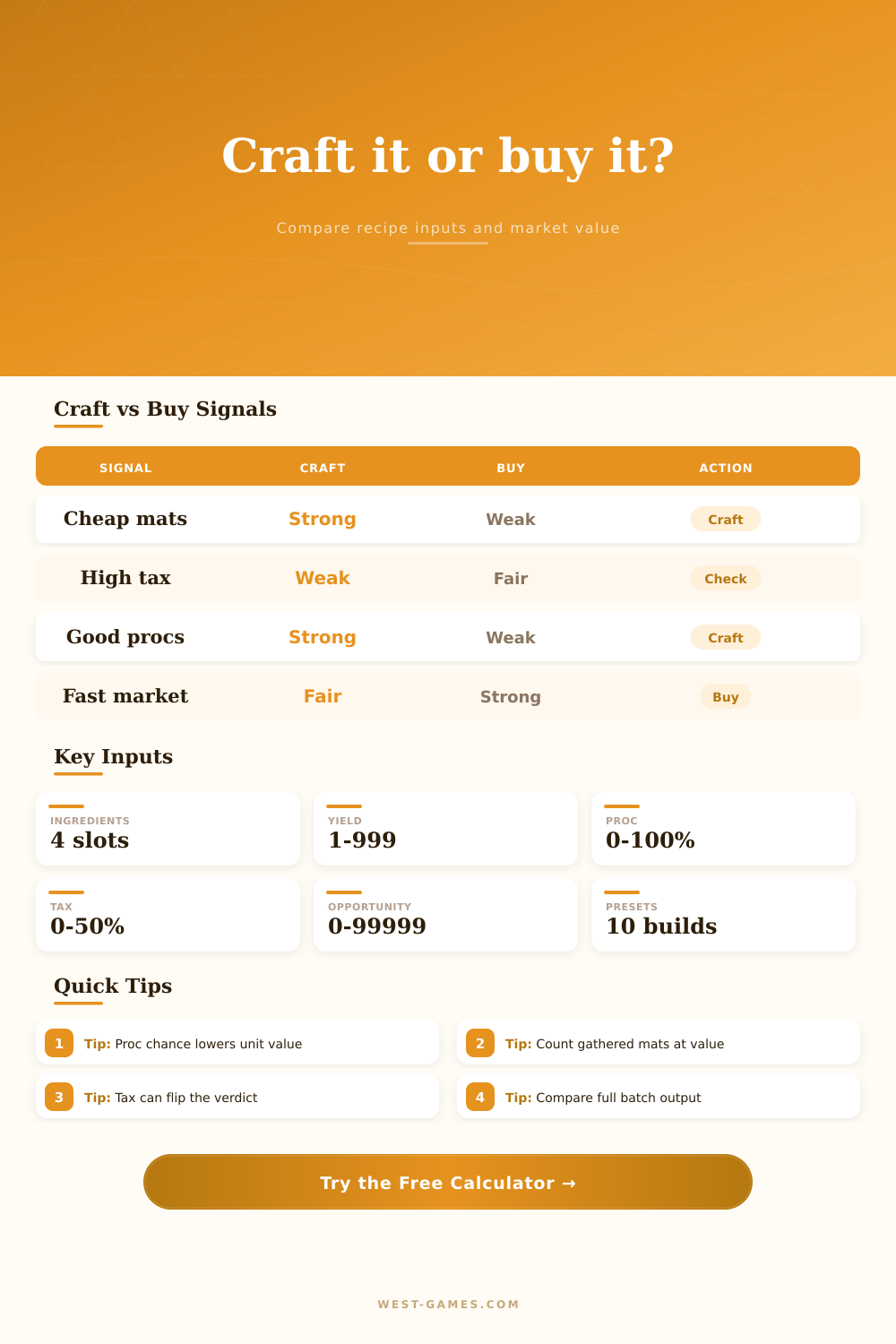
Crafting Cost vs Buy Calculator
Compare ingredient quantities, yields, proc chance, crafting tax, market buy value, opportunity value, and the final craft-vs-buy delta.
Calculation Breakdown
| Archetype | Usual Yield Pattern | Proc Sensitivity | Tax Pressure | Best Use |
|---|---|---|---|---|
| Smelting / refining | Low item yield | High | Low to medium | When raw inputs are undervalued |
| Alchemy consumable | Stack output | Medium | Medium | When procs add several extra items |
| Jewelcraft cut | Single output | Low | Medium | When finished gems move steadily |
| Tailoring material | Batch material | Medium | Low | When cooldown value is counted |
| Cooking batch | High stack yield | Medium | Low | When ingredient value is stable |
| Engineering bundle | Mixed output | High | High | When proc chance offsets station fee |
| Housing decoration | Single output | Low | High | When market buy value spikes |
| Rune or scroll bundle | Small stack | High | Medium | When rare ink value is tracked |
| Scenario | Craft Favors | Buy Favors | Watch Closely | Typical Decision |
|---|---|---|---|---|
| Cheap gathered inputs | Low material value | Fast market fills | Opportunity value | Craft if cooldown is open |
| High proc profession | More expected yield | None if buy stays low | Proc chance accuracy | Craft larger batches |
| Station fee spike | Large batch dilution | Low finished buy value | Crafting tax percent | Buy small quantities |
| Rare ingredient squeeze | Owned material stock | Lower finished listings | Ingredient C or D | Compare again later |
| Festival event trade | Bonus output | Short listing window | Failure and spoilage | Craft only with buffer |
| Raid consumable rush | High finished demand | Convenience before queue | Market movement | Craft if delta is wide |
| Step | Formula | What It Measures | Interpretation |
|---|---|---|---|
| Ingredient value | Qty x value | Resource value spent per craft | Counts bought or gathered materials |
| Expected yield | Base + proc x extra | Average finished items per craft | Higher yield lowers unit value |
| Craft tax | Material x tax | Station or system fee | Added before unit conversion |
| Opportunity value | Per craft x attempts | Alternate use of time or cooldown | Prevents free-material mistakes |
| Craft unit value | Total craft / output | Resource value per item crafted | Compare against market buy value |
| Delta | Buy total - craft total | Batch resource swing | Positive favors crafting |
| Market Movement | Decision Buffer | When It Helps Crafting | When It Helps Buying |
|---|---|---|---|
| Slow listings | 5% | Finished items are hard to find | Listing spread is wide |
| Steady listings | 2% | Inputs and outputs both update often | Small deltas are not worth risk |
| Fast turnover | 1% | Procs convert quickly into value | Buying avoids craft queue delays |
| Volatile board | 8% | You already own inputs | Finished item dips below material value |
Materials in hand, you’re standing at crafting station. You notice that finished goods gets an excellent price on market. But is it realy a profitable sale? Are there hidden fees that will eat away at your value? Or is it simply not worth the trouble when you consider time spent?
That’s where the cost of your time, station taxes, and yield variability come into play. By inputting your recipe data into calculator, it’ll handle all that for you. It’ll help you determine whether or not you’re actualy profiting, or merely benefiting from rounding errors.
How to Calculate Your True Profit
The time value of resources you get yourself. Many players undervalue what they gather. “It is free! I didn’t pay for it.” Yes, but you paid with time. Any hour you spend mining are an hour you didn’t do something else. That’s the opportunity cost you need to enter into calculator to correct that mistake.
Enter how much you could of gotten from someone if you sold that ore or leather rather then using it yourself. You’re assuming your time is worth nothing. It isn’t. In a live economy, that’s almost never true. You think your profit margin look better than it is.
When it comes to probabilities, human intuition is often wrong. “A recipe that doubles some items sounds great. But then you look at how often and find it’s an eight-percent chance.” Which means it massively increases cost of each item. You will over-estimate what you make if you think you’ll get the bonus.
Below is a reference table showing how different profession react to yield variance. Jewelcrafting is very luck based; smelting tends to be fairly consistent.
Friction is another factor to consider. Anything that decreases your margin before you list it are friction: costs for making items, station fees, etc. These are multipliers of your input cost. They don’t seem like much, say you have a 3% fee, but they compound very fast if your margins is thin. High tax rates can turn a profit into a loss, if the markets decline slightly.
Market speed sets the decision buffer and creates a safety margin. There are times when it’s best to buy things finished Buying stuff isn’t a bad thing. It doesn’t hurt anything if crafting something is more expensive than what you can buy. Time is money. Convenience is worth something.
If the math indicate you’re getting a better deal by buying it, then spend your resources somewhere else. Rest to prevent burnout. Raid. Trade for other things. Those could give a greater return on your investment.
It’s all well and good to have numbers in your head, but it’s interpretation of those numbers that matters. How far are you willing to go? If you’re a merchant, then you’re looking for price differentials. If you’re a gatherer, then you need to convert excess materials into cash. Maybe you’re trying to save some coin on your equipment. If so, you’ll need to know if the margin is high enough to account for mistakes. You also need to know if it’s tight enough that split-second decision making are required. Know your role and know whether it aligns with where you are now.
Making crafting a strategic choice Should you be crafting? That’s a question of strategy, not habit. When you analyze cost per item vs. Yield (variable), you control your economy. You make decisions on data, instead of reacting to short-term price fluctuations. Making that transition is what distinguishes casual gamers from consistent money maximizers. No matter how you acquire items, good analysis will always give you the best bang for your buck.