Auction House Profit Margin Calculator
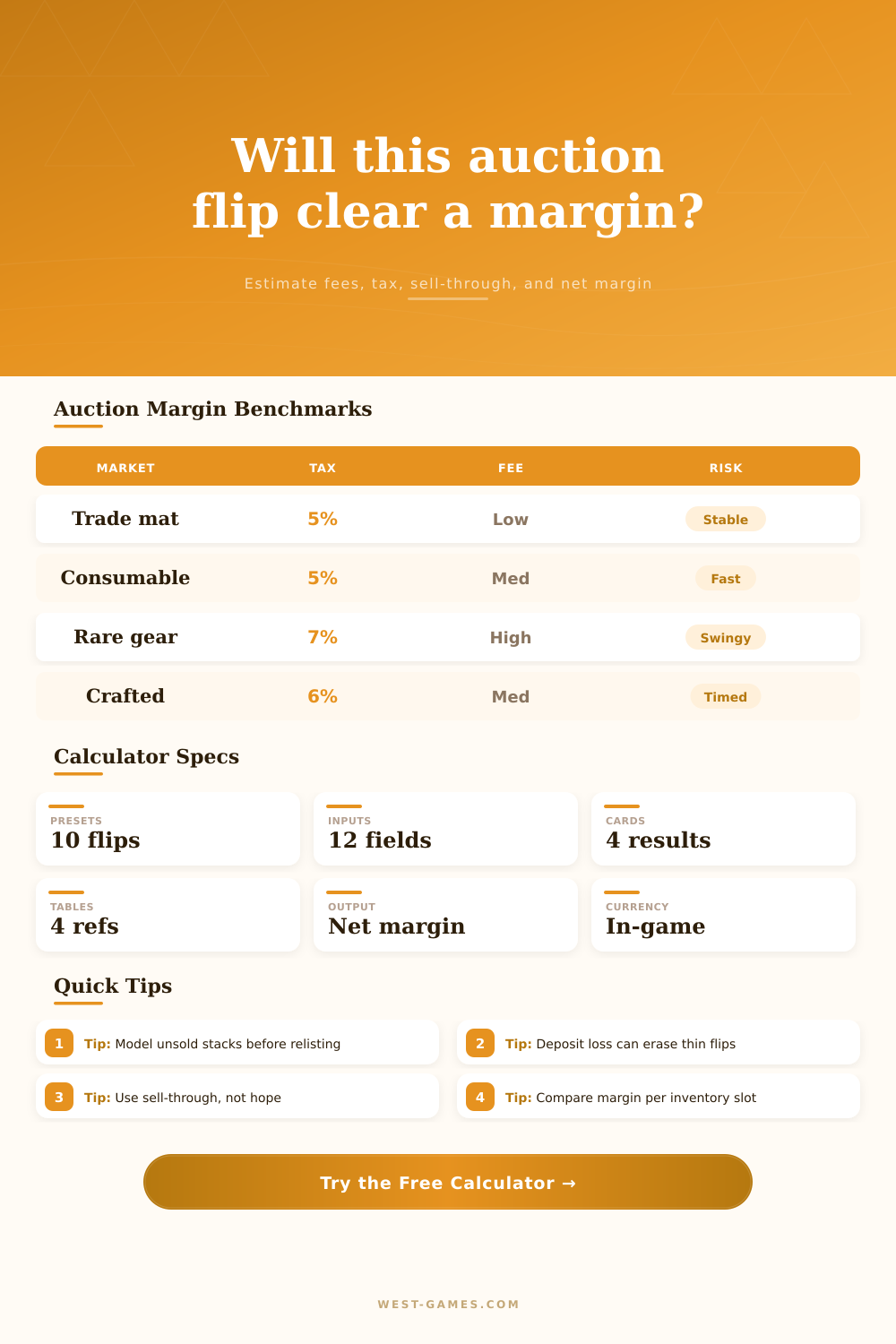
Estimate an in-game marketplace flip after buyout, sale price, listing fee, tax, possible deposit loss, stack size, relists, and sell-through chance.
Calculation Breakdown
Current Plan
Uses your active stack count, sell-through, tax, fee, and deposit loss assumptions.
Full Sellout
Models every listed unit selling on the first pass with no extra deposit loss.
Low Sell-Through
Shows the same listing if market demand is 20 percentage points weaker.
One More Relist
Adds one extra relist attempt so deposit pressure is easier to compare.
| Market Type | Typical Stack Behavior | Fee Pressure | Sell-Through Pattern | Margin Note |
|---|---|---|---|---|
| Trade materials | Large stacks, many buyers | Low per unit | Steady during crafting hours | Small spreads can work if volume is high |
| Consumables | Medium stacks before raids | Medium | Spiky near group content | Timing often matters more than list length |
| Crafted gear | Single items or small lots | Medium to high | Slower and stat dependent | Deposit loss must be modeled carefully |
| Enhancements | Small stacks, repeat buyers | Low to medium | Fast when gear upgrades are common | Tax and undercuts shape the true margin |
| Cosmetic items | Single listings | High relist exposure | Slow but occasionally strong | High spread can still fail if deposits pile up |
| Rare collectibles | Single listings | High | Very slow and volatile | Sell-through estimate is the deciding input |
| Selling Strategy | Sale Adjustment | Sell-Through Bias | Relist Exposure | Best Use |
|---|---|---|---|---|
| Fast undercut | Lower sale value | Higher | Lower | Commodities with deep demand |
| Steady market listing | Baseline sale value | Neutral | Medium | Most repeatable flip checks |
| Premium patience | Higher sale value | Lower | Higher | Rare items with patient buyers |
| Market reset | Higher sale value | Mixed | Medium | Short supply windows and high demand |
| Slow shelf item | High headline value | Low | Highest | Cosmetic and collectible listings |
| Factor | Calculator Role | If It Rises | If It Falls | Check First |
|---|---|---|---|---|
| Buyout per unit | Sets acquisition basis | Margin tightens quickly | More spread room | Compare recent lows, not one listing |
| Sale per unit | Sets gross return | Margin expands after tax | Break-even moves closer | Watch active undercuts |
| Listing fee | Applies to every stack and relist | Slow items get riskier | Thin flips become viable | Scale fee by stack count |
| Auction tax | Reduces successful sale return | High spreads need more buffer | Net sale improves | Use the house rate for that item |
| Deposit loss | Charges unsold and relisted stacks | Unsold inventory hurts more | Relisting is safer | Estimate likely failed cycles |
| Sell-through | Weights expected sold quantity | Expected gain improves | Unsold risk dominates | Base it on volume, not wishful listings |
| Preset | Item Pattern | Stack Setup | Sell-Through | Planning Read |
|---|---|---|---|---|
| Herb Stack Flip | Trade material | 3 stacks of 200 | 82% | Volume carries a moderate spread |
| Weekend Ore Reset | Bulk commodity | 5 stacks of 100 | 76% | Strong when weekend crafting demand appears |
| Raid Flask Batch | Consumable | 4 stacks of 20 | 88% | Timing can make fees feel small |
| Glyph Slow Relist | Enhancement | 12 single listings | 38% | Watch deposit loss across relists |
| Crafted Belt Listing | Crafted gear | 2 single listings | 46% | Good spread still needs sale confidence |
| Rare Mount Watch | Rare collectible | 1 listing | 18% | Big spread, very sensitive to deposits |
The auction house interface opens up and you notice a profitable-looking spread. The market price is high; the buyout price is low. Easy peasy! Until you realize the invisible costs.
Every transaction incur a deposit, tax, and fee from the game. Those expenses cut into your profits when selling something. To protect yourself from losing money, estimate your margins beforehand. Use a calculator to prevent falling victim to mental math mistakes. Plug in your acquisition cost and anticipated sale price. The calculator will display how much listing fees and taxes takes out of your profits. They’re tiny when applied to a single item but they add up when applied to many items.
How to Calculate Your Real Profit
Don’t forget about deposit loss either. If you don’t sell something, you’ll forfeit the deposit you paid to list it. That amount can accumulate if you repeatedly relist the same non-sold items. To model this risk correctly, use a sell-through percentage as an input for the tool.
Players often view the buy/sell price gap and think “I’ll get 20% back.” The reality is that even with a large spread, your item could languish in an inventory for days or weeks without selling. If it doesn’t sell, you lose all that money from the deposit penalty. You must account for speed at which the item sells.
Food/flasks are consumable, so raid groups purchase those every day. Those items will turn over quickly. Crafters constantly restock trade materials. Those items will sell consistently.
Rare gear: While each piece may give significant returns individually, those items won’t sell very quickly. They’re vulnerable to changing markets, and the longer an item sits unsold, the more deposit penalties you incur. That leaves less money at risk of being lost from deposits, while freeing up that money to use elsewhere.
The goal with a premium patience strategy is increased margins, at the cost of fewer sales (lower sell-through rate). That’s fine if you’re selling something rare; just be careful when modeling out your relist attempts. It’s unrealistic to assume everything will sell the first time around. You can use comparison grids within the calculator to see what happens to net gain if demand falls short, or if there are relists needed.
It is not just about profit per transaction. Profit per transaction and inventory efficiency are also key. There’s only so many slots in your bag for your character. The more you fill up with junk that doesn’t sell, the less room there is for something else. Margins should of been calculated in terms of gold earned per inventory slot over time. Maybe that stack of herbs won’t earn as much gold as that rare item you got at a discount which took forever to sell off. But that stack of herbs turns over your capital three times faster. In general, quick turnover will lead to more total wealth because your money works harder, moving fast from one transaction to another.
Static tools also fail to anticipate market timing, which further complicates matters. Demand for herbs and ores increases temporarily during weekends as players craft in bulk. Before the weekend ends, these surges allow sellers to command better prices. Event items are governed by a separate set of rules where hype replaces utility. To know when to list, you pay attention to player behavior. You see who’s listing items and how fast they dissapears once prices drop. And you adjust accordingly.
Trading isn’t just about making money; it’s also about reducing risk. It protects you from taking massive losses by modeling worst-case scenarios. It teaches you which flips succeeds and which flips fail. It allows you to create a sustainable trading habit that can weather market shifts. It makes the auction house something you can manage through calculation rather than guesswork. It prevents you from chasing spreads and enables you to earn margins. It transforms simple flips into dependable sources of in-game wealth.