Gravity Fall Time Calculator
Estimate seconds to impact for game jumps, drops, knockbacks, and platform falls with gravity scaling, terminal velocity, air drag, landing slow, and fall damage thresholds.
Physics model: the no-drag path uses constant acceleration. The drag path solves vertical distance against a terminal-velocity curve, then applies landing slow before checking the fall damage threshold.
No Drag
Constant acceleration estimate. Useful for engines that ignore air resistance or cap only extreme speed.
Drag Model
Terminal velocity and drag strength stretch airtime most on tall drops and glide-like falls.
Threshold Gap
Shows how far the slowed landing speed sits below or above the damage breakpoint.
Health Result
Estimated health after threshold damage using the current damage scale.
| Profile | Gravity | Terminal | Use case |
|---|---|---|---|
| Standard arena | 1.00x | 55-65 m/s | Most shooters and action games. |
| Heavy sim | 1.30x | 65-85 m/s | Weighty movement or vehicle games. |
| Low gravity moon | 0.35x | 35-50 m/s | Long float arcs and jump puzzles. |
| Floaty platformer | 0.65x | 28-45 m/s | Readable midair control windows. |
| Underwater zone | 0.20x | 8-16 m/s | Drag-heavy vertical traversal. |
| Drag state | Strength | Effect | Best read |
|---|---|---|---|
| Disabled | 0% | No speed cap | Clean physics sandbox testing. |
| Light air | 15-30% | Slightly longer falls | Action games with subtle caps. |
| Normal drag | 35-55% | Caps very tall drops | Open worlds and BR towers. |
| Glide drag | 65-85% | Strong time stretch | Parachutes, cloaks, hover boots. |
| Liquid drag | 90-100% | Near terminal quickly | Water shafts and gel fields. |
| Threshold | Feel | Damage behavior | Mode fit |
|---|---|---|---|
| 10-14 m/s | Strict | Small drops can hurt | Survival or sim-heavy games. |
| 18-24 m/s | Readable | Medium drops become risky | Adventure and RPG movement. |
| 25-32 m/s | Forgiving | Only tall drops matter | Hero shooters and arena games. |
| 40+ m/s | Very soft | Damage is rare without cliffs | Arcade traversal systems. |
| Disabled | No damage | Use 0 scale or huge threshold | Creative or practice modes. |
| Modifier | Reduction | Typical source | Impact |
|---|---|---|---|
| No roll | 0% | Hard landing | Full damage speed checked. |
| Landing roll | 10-25% | Parkour perk | Often saves medium drops. |
| Heavy armor | 5-15% | Impact dampening | Small but consistent cushion. |
| Glider cancel | 45-70% | Late slow-fall input | Large threshold swing. |
| Perfect tech | 80-95% | Timed landing skill | Nearly removes speed damage. |
| Preset | Height | Gravity | Terminal | Drag | Threshold |
|---|---|---|---|---|---|
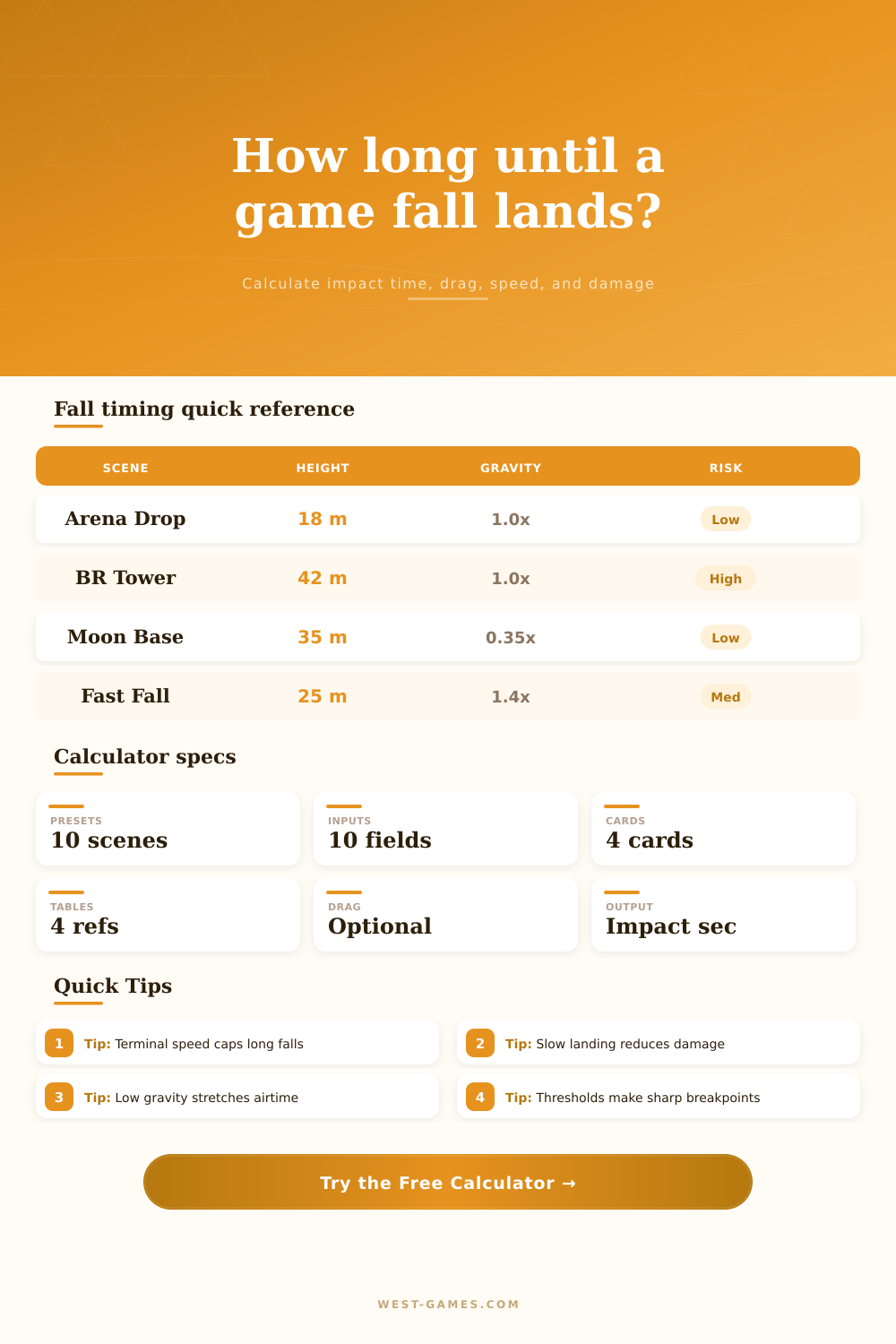
| Arena Ledge Drop | 18 m | 1.00x | 58 m/s | 35% | 24 m/s |
| Battle Royale Tower | 42 m | 1.00x | 60 m/s | 45% | 23 m/s |
| Moon Base Hop | 35 m | 0.35x | 42 m/s | 25% | 22 m/s |
| Glider Cancel Drop | 95 m | 0.85x | 18 m/s | 85% | 20 m/s |
| Fast-Fall Tech | 25 m | 1.40x | 72 m/s | 20% | 26 m/s |
The math of jumping off a ledge. When you jump off something and miss the landing, that’s drama in platformers, but it’s also math. It’s the interplay between gravity, drag, and the precise millisecond your character hits the ground. Luckly, the calculator above figure out those physics for you. So you don’t need to do any calculus or differential equations during level design.
People imagine that fall time increases at the same rate as height. Drop from ten meters, and it will take so much time. In realistic movement systems, however, characters aren’t as heavy or responsive as pure vacuum physics. They use air drag and terminal velocity to cushion long falls.
The Math Behind Jumping in Games
Tweaking gravity multiplier changes how quickly things fall. It changes rhythm of the whole game loop. Make it a heavy simulator, and it’ll be steeply accelerating, grounded. Reduce that downward pull, and it’s a floaty platformer that gives player time to think mid-air.
Terminal velocity is the input that serves as a speed limit. If you didn’t have a limit on speed, then if a character jumped off of a building they’d hit the ground so hard their own bones would break. Setting a cap, typically anywhere from 50-80 meters per second in most shooters; sets a worst-case-scenario that’s easy to predict when calculating damage.
The Drag Strength Slider controls how fast your character reaches its top speed. If drag is high, then after jumping, the player will approach terminal velocity very quickly. That’s awesome for precise landings, but awful for using momentum to traverse an area.
Speed vs. This is about control. It’s a tradeoff that gives movement its feel. The goal shows through in the landing modifiers. They aren’t just aesthetic flourishes, a glider cancel isn’t just a roll with a little extra flare. It’s a mechanical safety net.
It slows you down ahead of time and lessens how hard you land. Depending on your survivability (the distance you can fall without dying), certain percentage reductions will protect you from a lethal blow. With a twenty meter per second threshold for taking damage, maybe a fifteen percent slow from rolling might be all the difference between life and death. Without a modifier injury is guaranteed.
That means player can express skill and learn the safe areas of a level instead of needing to memorize them. You can tune a drop to feel like it’s both fair and dangerous. It rewards careful technique while punishing haste. But it’s not just a numbers game; context is key. Low gravity on a moon base is different than an entirely story. The airtime means that even brief falls will turn into lengthy ones; leaving plenty of time for players to adjust their horizontal positioning.
To make jumps easier to read, platformers frequently reduce gravity. Drag can be turned up in an underwater area to create a sense of resistance. Suddenlly, moving up and down becomes deliberate and sluggish. That environment also calls for adjusting all the other variables. Maintaining the same damage thresholds under low gravity can mean that players will never recieve fall damage. They lack the chance to reach enough speed before impact.
Risk assessment gets its own concrete metric: health output. It tells you whether a specific drop is survivable with your current loadout or perks. Which drops are survivable given your gear loadout? That is the kind of feedback loop that lets designers find the middle ground. They can find the right amount of risk so falling isn’t frustrating but still matters. You want players to be threatened when they fall … even if they live. That creates tension that leads to engagement.
This tool boils down all those factors (damage scales, drag, gravity) into one window showing just how much health survives a simulated impact. The math is hidden by the feeling of good movement design. It should of not take the player seconds to calculate the impact. They should feel the weight of their character in their fingertips. From a precise parkour run to a high stakes battle royale drop, nailing these variables down turns abstract physics into real gameplay. Tweaking these unseen coefficients can mean the difference between a satisfying jump and a clunky one. You tweak them till it feels just right.