Armor Calculator 5e
Build a defensive profile for D&D 5e armor, shields, Dexterity, cover, magic bonuses, hit odds, stealth tradeoffs, and expected damage avoided.
🎯Descriptive 5e Armor Presets
🛡Armor and Attack Inputs
⚔Current Defensive Snapshot
📘5e Armor Reference Table
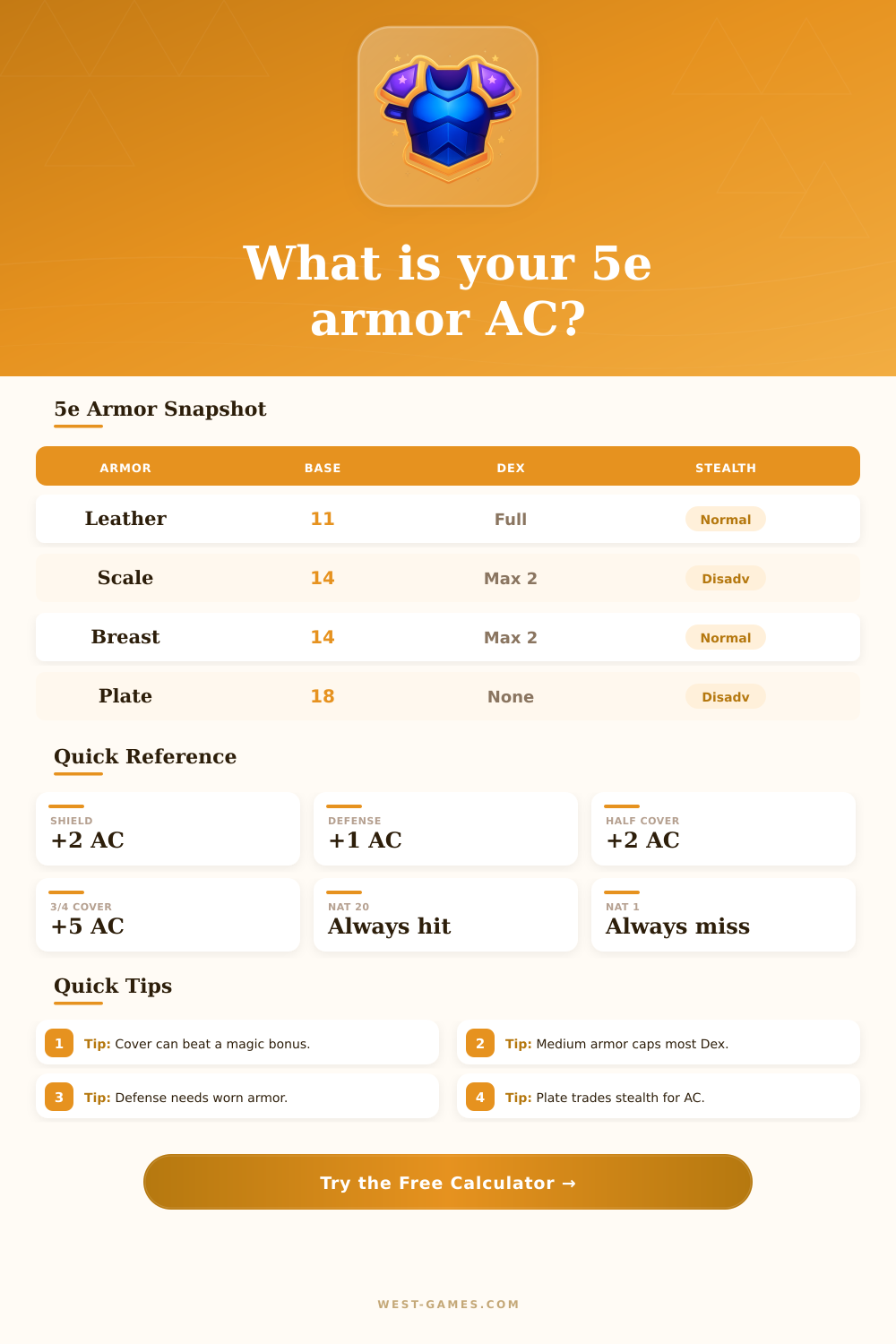
| Armor | Category | AC Formula | Dex Handling | Stealth |
|---|---|---|---|---|
| No armor | Unarmored | 10 + Dex modifier | Full modifier | Normal |
| Padded | Light | 11 + Dex modifier | Full modifier | Disadvantage |
| Leather | Light | 11 + Dex modifier | Full modifier | Normal |
| Studded leather | Light | 12 + Dex modifier | Full modifier | Normal |
| Hide | Medium | 12 + Dex modifier | Max +2 normally | Normal |
| Chain shirt | Medium | 13 + Dex modifier | Max +2 normally | Normal |
| Scale mail | Medium | 14 + Dex modifier | Max +2 normally | Disadvantage |
| Breastplate | Medium | 14 + Dex modifier | Max +2 normally | Normal |
| Half plate | Medium | 15 + Dex modifier | Max +2 normally | Disadvantage |
| Ring mail | Heavy | 14 flat | Dex ignored | Disadvantage |
| Chain mail | Heavy | 16 flat | Dex ignored | Disadvantage |
| Splint | Heavy | 17 flat | Dex ignored | Disadvantage |
| Plate | Heavy | 18 flat | Dex ignored | Disadvantage |
🧮Modifier Reference Table
| Modifier | AC Effect | When It Applies | Calculator Handling |
|---|---|---|---|
| Shield | +2 AC | When a shield is equipped and usable | Added after armor formula |
| Defense fighting style | +1 AC | Only while wearing armor | Ignored for no-armor setups |
| Magic bonus | +1 to +3 AC | Magic armor, shield, or similar AC item | Added as one combined bonus |
| Half cover | +2 AC | Obstacle covers at least half the target | Included in defensive AC |
| Three-quarters cover | +5 AC | Obstacle covers about three-quarters | Included in defensive AC |
| Medium armor cap | Dex max +2 | Most medium armor AC formulas | Cap can be raised to +3 by selected feature |
🎲Hit Chance Reference Table
| Attack Bonus vs AC | Needed Roll | Normal Hit Chance | With Advantage | With Disadvantage |
|---|---|---|---|---|
| +5 vs AC 13 | 8+ | 65% | 88% | 42% |
| +5 vs AC 16 | 11+ | 50% | 75% | 25% |
| +5 vs AC 18 | 13+ | 40% | 64% | 16% |
| +8 vs AC 20 | 12+ | 45% | 70% | 20% |
| +10 vs AC 24 | 14+ | 35% | 58% | 12% |
🗂Comparison Grid
| Setup | Example Inputs | AC Before Cover | Stealth Tradeoff | Best Use in Calculator |
|---|---|---|---|---|
| Unarmored scout | Dex +4, no shield | 14 | Normal stealth | Baseline for agile characters without armor |
| Leather archer | Leather, Dex +3 | 14 | Normal stealth | Light armor comparison with full Dexterity |
| Studded duelist | Studded, Dex +4, shield | 18 | Normal stealth | High-Dex shield build math |
| Breastplate ranger | Breastplate, Dex +2, shield | 18 | Normal stealth | Medium armor without stealth disadvantage |
| Half plate bruiser | Half plate, Dex +2, shield | 19 | Disadvantage | Maximum common medium armor AC |
| Plate guardian | Plate, shield, Defense | 21 | Disadvantage | Heavy armor defensive benchmark |
💡Armor Math Tips
Choosing armor in Dungeons & Dragons 5e involve calculating how armor interacts with attack. Armor affects how often attacks connects with you as a character. Armor also affects how much damage you take from attacks that connect with you.
Characters that need to move silently need a different type of armor than characters that stand in the front line of the battle. Armor has a base value based off the type of armor. Light armor allow you to add your Dexterity modifier to the Armor Class.
How to Choose Armor in D&D 5e
Medium armor permits only a portion of your Dexterity modifier to be added to the Armor Class. Heavy armor dont permit you to use your Dexterity modifier. Each type of armor is for a specific role for the character.
Characters with high Dexterity can use light armor to permit the full use of there Dexterity modifier. Characters with high Strength can use heavy armor even though they have to give up the use of Dexterity. Shields and fighting styles adds to the Armor Class.
The shield increases the Armor Class and isnt dependent upon you movement. The Defense fighting style permits a character to have an increased Armor Class but is only useful if you are wearing armor. Magic bonuses permit the enemy to have a higher target number to hit you.
These bonuses are additive to the Armor Class which your armor provides. Cover based on your environment provides an increase to your Armor Class. Some armor provides greater benefit than magic items.
However, cover require positioning. You can calculate the benefit of a shield compared to cover using a calculator. Your Dexterity modifier can interact with your armor in different ways.
Medium armor permits only part of the Dexterity modifier. You can use a feat to increase the Dexterity modifier. However, you must select the specific feat.
The Dexterity contribution change based on whether you have taken the feature. The calculator automatically change the Dexterity contribution if you take the feature. Stealth can be affected by armor choice.
Some armor choices make noise when you move and give the enemy advantage on stealth attacks. Other armor does not have this disadvantage. Stealth is important because many encounters will reward characters that sneak up on enemies.
However, a failed stealth attack might turn an ambush into a different type of fight. You calculate your Armor Class to determine your hit chance and the damage you will take. The enemy must roll a number on the d20 to determine if they will hit your Armor Class.
Advantage and disadvantage will change the chance that the enemy will hit you but will not change your Armor Class. Knowing your Armor Class and the damage you will take per hit will allow you to calculate the total damage that you will take during an encounter. The Armor Class calculator will calculate these attacks and allow you to determine if increasing your Armor Class is more worth the cost of losing stealth or speed.
Many people will make mistake in calculating Armor Class. One mistake is treating all Armor Class bonuses as equally valuable. For instance, a shield with half cover will give you a two-point bonus to your Armor Class, but the shield is a permanent item and half cover is situational.
A magic item will work every encounter, but cover may not work every round. When you calculate your Armor Class, you must decide if it is better to spend your gold on armor or to search for better position to use cover. The tables on this page provide the Armor Class base formula for each type of armor and the Dexterity modifiers for each armor.
The tables will allow you to quickly determine your assumptions. These tables will give you an idea of how armor types will fare against the same attack bonus. The goal of Armor Class is not to provide the highest Armor Class for your character.
It is to reduce the total amount of damage you will take during the game. In some instances, it is better to have a lower Armor Class to have better Dexterity and stealth. In other instances, it is better to have a higher Armor Class even if you must give up some of your movement or stealth.