Diablo 4 Armor Cap Calculator
Plan gear armor, skulls, aspects, paragon armor, enemy level targets, missing armor to cap, physical mitigation, and the elemental resist split in one build sheet.
Calculate first
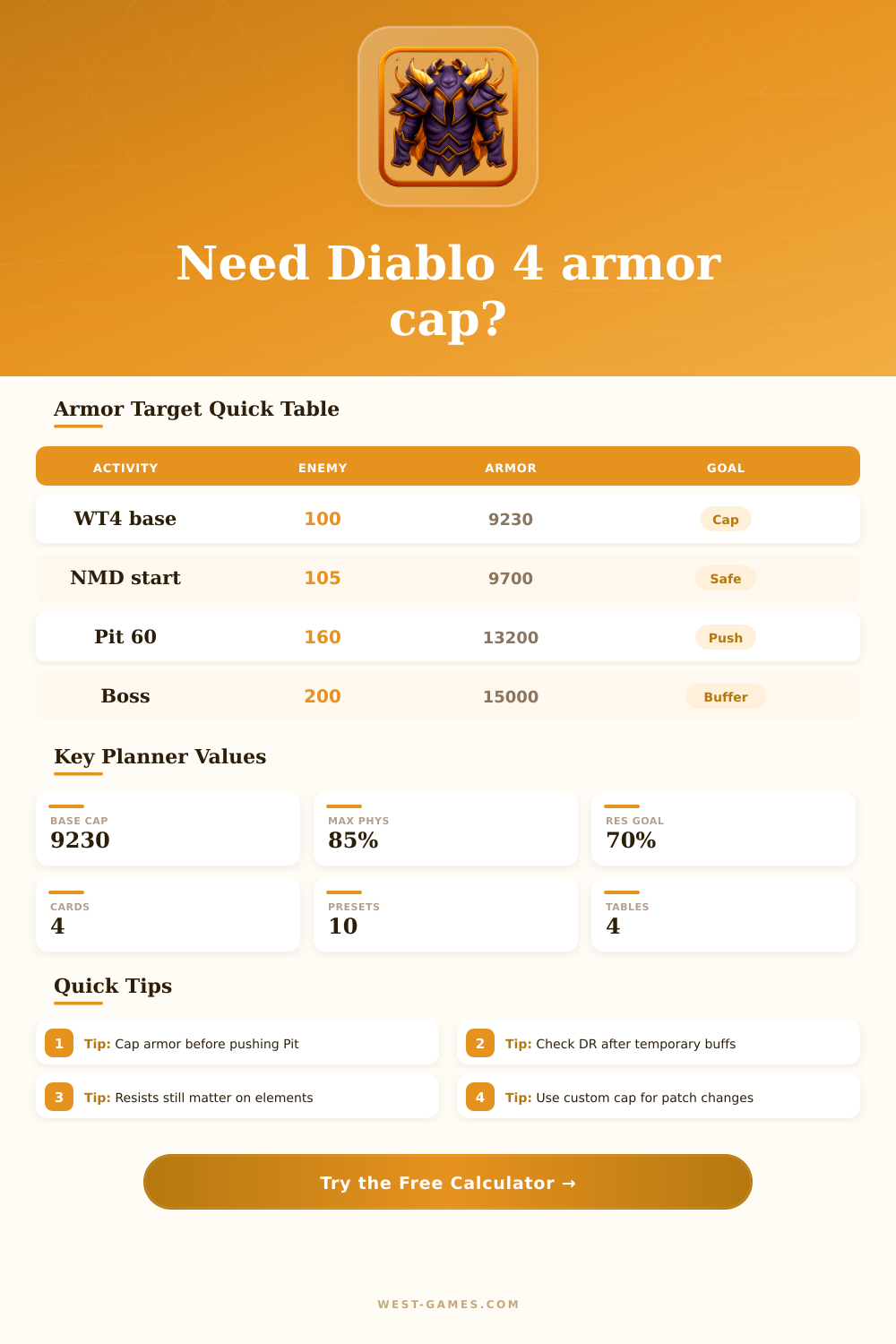
| Activity | Enemy level used | Planner armor target | When to use it |
|---|---|---|---|
| World Tier 3 leveling | 70 | 6,500 | Early sacred gear, fast leveling, and low nightmare tiers. |
| World Tier 4 baseline | 100 | 9,230 | General ancestral gear check for endgame open world play. |
| Helltide / Blood Maiden | 100 | 9,230 | Good default when farming dense physical and elemental packs. |
| Nightmare Dungeon glyph farm | 105 | 9,700 | Small buffer for elite affixes, suppressors, and ranged packs. |
| Pit 30 starter push | 130 | 11,200 | Useful target when moving from farm gear to push gear. |
| Pit 60 armor check | 160 | 13,200 | Survival audit for mid-push builds with harder monster scaling. |
| Pit 90 survival audit | 190 | 14,400 | Stress test for glass cannon builds that need armor rolls back. |
| Tormented boss prep | 200 | 15,000 | Large buffer target for burst windows, boss adds, and mistakes. |
| Armor source | Calculator field | Best use | Planner warning |
|---|---|---|---|
| Chest, pants, helm, gloves, boots, amulet | Armor from gear tooltip total | Permanent baseline armor for every dungeon pull. | Do not include temporary aspect stacks twice. |
| Royal skulls or armor gems | Flat armor from skulls / gems | Fastest way to close a small armor gap. | Check if the slot is competing with life or resistance. |
| Paragon nodes and skill passives | Flat armor from paragon / skills | Stable armor when gear affixes are already tight. | Some nodes are conditional; enter only active armor. |
| Defensive aspects and stack effects | Temporary armor from aspects / procs | Shows whether the build is capped only during combat. | If uptime is low, compare with the no-temp card. |
| Elixir, incense, shrine, party buffs | Elixir, incense, or shrine armor | Useful for boss attempts or one-time push keys. | Do not rely on it for normal farming comfort. |
| Total armor percent affixes | Total bonus armor percent | Amplifies every flat armor source in the sheet. | Too much percent armor wastes value over your target. |
| Incoming profile | Physical split | Resist priority | What the calculator shows |
|---|---|---|---|
| Melee dungeon packs | 65% to 80% | Moderate | Armor drives most of the mixed DR result. |
| Helltide events | 45% to 60% | High | Armor and elemental resistance both matter. |
| Poison, fire, shadow elites | 25% to 45% | Very high | Low resists can sink mixed DR even at armor cap. |
| Boss burst window | 40% to 70% | Build dependent | Other DR has a large effect because hits are spiky. |
| Barrier or fortify tank | 50% to 65% | Moderate | Armor cap plus extra DR compounds strongly. |
| Preset | Typical armor state | Target pressure | Common adjustment |
|---|---|---|---|
| Fresh WT3 Leveling | Below cap but acceptable for campaign cleanup. | Low | Add armor gems if deaths are physical. |
| WT4 Entry Gear | Usually short of 9,230 until ancestral swaps land. | Medium | Prioritize chest and pants armor rolls. |
| Helltide Chest Farmer | Comfortable when baseline is near 9,230. | Medium | Balance armor with elemental resist caps. |
| Nightmare Glyph Runner | Needs a small buffer over open world targets. | Medium high | Audit temporary armor uptime. |
| Pit Push Presets | Often capped only with procs or incense active. | High | Compare current, no-temp, and target cards. |
Armor is one of an critical component of survival in Diablo 4, and there are many different game mechanic related to armor. Armor dont work on its own; it interacts with resistance value, the physical damage type that enemies deal, and temporary armor buff. The armor planner is a tool that display armor performance against a specific target.
The inputs for the armor planner include the stats that goes into building a character. Factors like gear armor and flat armor from skulls or paragon node contribute to armor. Temporary armor from aspects and procs also contribute to armor values, but only while fighting enemy.
How to Use the Armor Planner
If a character have temporary armor but enters a new room or is revived from death, they can be exposed to enemies. The armor planner allow you to see if armor is truly at the cap by factoring in gear and temporary armor separately. Enemy level and activity target value are essential for the armor planner.
As a character can feel safe from enemies in the open world in World Tier 4, the same character may die from a higher level of enemy or activity with more damage. The armor planner allows change the activity target. Players can use the armor planner to test custom armor cap in response to changes in the game patch for armor values.
Using the armor planner to test different activity and enemy targets can prevent characters from putting too much armor into their build for enemies they do not fight often. The output of the armor planner allow players to see how many gem or affix swap are needed if the character is missing armor. It displays the physical damage that armor reduce before other game mechanics come into play.
The value of mixed damage reduction include the resistance values and physical damage split for characters to see if they have an advantage in reducing elemental damage. If the no-temp comparison shows a large drop in armor value when comparing two scenario, that means that the armor build rely on temporary armor. This information is useful when preparing to enter higher tier of content.
Players focus on getting armor values to reach 9230, the armor cap. However, armor past the cap have diminishing returns. If a player reach the armor cap, it is more beneficial to invest in life and resistance stats.
There are reference table for how much armor is needed for each activity. The split table allow players to see how different damage type impact the value of armor. The split table also display that armor is more valuable in dungeon that use melee damage over those with poison damage.
This is because poison damage require more resistance stats. The best way to use armor planner is before swapping gear. The character should insert their gear stats into the armor planner, run the calculation, and try to test the suggest gear change.
If the player find that the missing armor value has decreased without relying on temporary armor, the gear swap will be a good idea. However, if the missing armor value only go down when temporary armor is active, there is a weakness to that armor build that must be fix before combat. By using the armor planner to check gear before swapping, players will not waste time trying to swap gear only to die during combat.
The armor planner allow players to see what trade-off exist between armor stats. For example, adding more percentage armor can cause a player to go past the armor cap. Going past the cap waste armor point that could of gone into life or resistance stats.
Using elixirs and shrines for armor works for a specific boss fight. However, it is not effective for long fight where elixirs and shrines cannot be use. The no-temp comparison let players see how much armor they have to survive without temporary armor bonus.
Armor planning is not about the number armor players should have. However, armor planning is about understanding the different type of armor available to players. The armor planner make it easier for players to make their armor and gear choice more deliberate than reactive.