Encumbrance Calculator
Estimate carried weight, carry capacity, armor load, stamina drain, movement penalty, dodge tier, and overflow for RPG builds.
Encumbrance Results
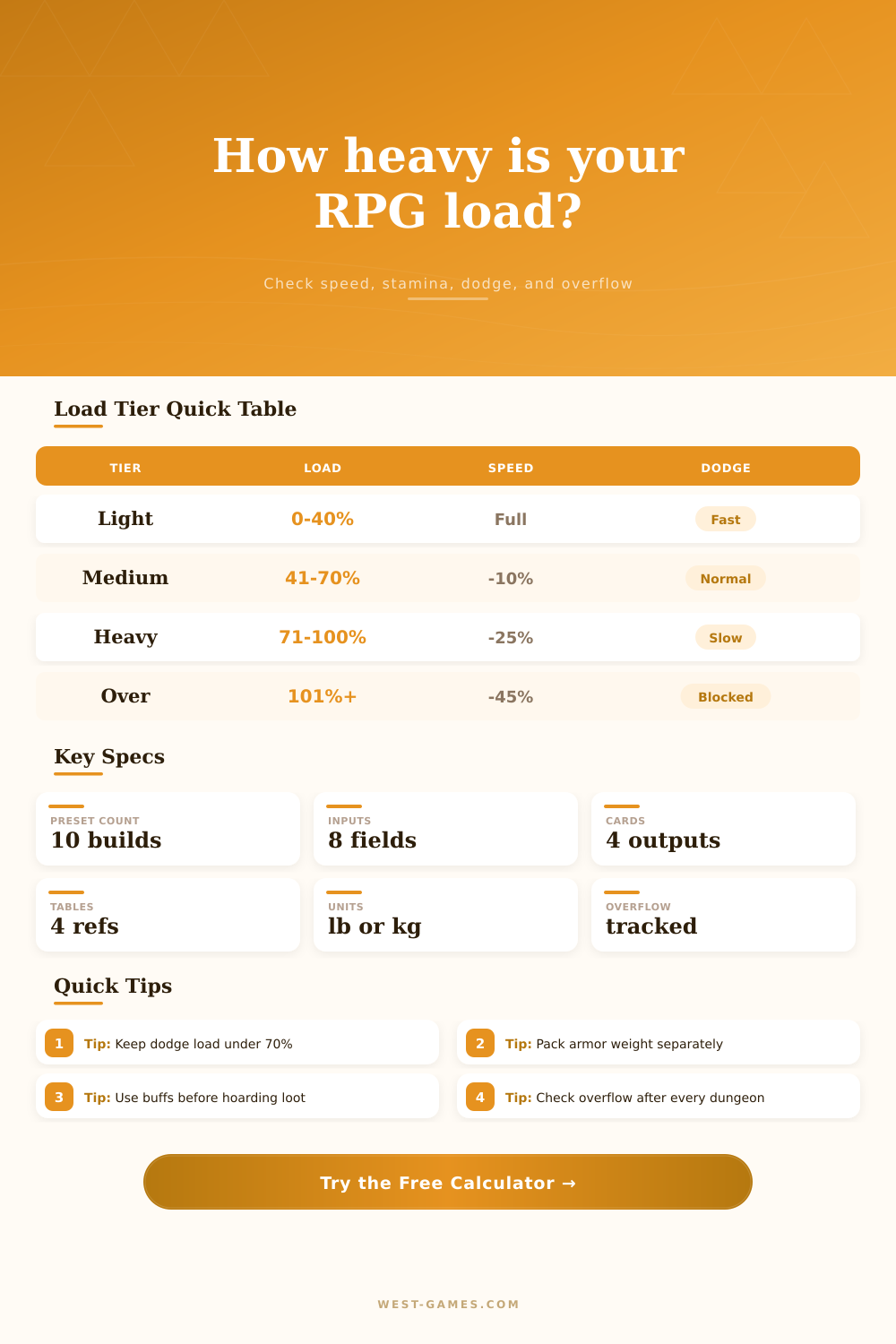
| Tier | Capacity Used | Movement | Dodge Behavior |
|---|---|---|---|
| Light Load | 0% to 40% | No speed penalty | Fast roll, quick dodge, best recovery |
| Medium Load | 41% to 70% | About 10% slower | Normal roll with moderate recovery |
| Heavy Load | 71% to 100% | About 25% slower | Slow roll, long recovery, louder movement |
| Overloaded | 101% to 130% | About 45% slower | Dodge blocked or heavily delayed |
| Crushed | Above 130% | Movement barely functional | No roll, sprint, or jump in strict rules |
| Armor Type | Weight | Armor Burden | Typical Build |
|---|---|---|---|
| Cloth Robes | 6 lb / 2.7 kg | Very low | Caster, healer, stamina-focused runner |
| Leather Set | 14 lb / 6.4 kg | Low | Rogue, archer, early-game scout |
| Chainmail Set | 28 lb / 12.7 kg | Moderate | Balanced fighter, dungeon explorer |
| Scale Armor | 38 lb / 17.2 kg | High | Frontline melee with endurance investment |
| Plate Armor | 52 lb / 23.6 kg | Very high | Tank, greatshield guard, boss soak build |
| Tower Shield Kit | 68 lb / 30.8 kg | Extreme | Fortress style guard or raid anchor |
| Powered Exo Suit | 44 lb / 20.0 kg | Assisted | Sci-fi heavy build with reduced stamina tax |
| Rule Profile | Capacity Scaling | Armor Weighting | Best Use |
|---|---|---|---|
| Classic RPG | Balanced strength scaling | Standard armor burden | General fantasy load planning |
| Soulslike Dodge | Lower carry ceiling | Armor strongly affects rolls | Dodge threshold tuning |
| Survival Craft | High pack bonus value | Consumables add more fatigue | Long routes and resource hauling |
| Tactical Party RPG | Generous stat scaling | Armor burden is predictable | Grid movement and action economy |
| Action Adventure | Moderate carry ceiling | Speed penalty matters most | Open-world travel builds |
| Hardcore Sim | Strict carry ceiling | Armor and loot both punish stamina | High realism inventory rules |
| Build | Target Load | Stamina Goal | Recommended Adjustment |
|---|---|---|---|
| Competitive Duelist | Under 40% | 0% to 8% extra drain | Drop backup weapons before arena fights |
| Dungeon Explorer | 50% to 70% | 8% to 18% extra drain | Leave room for keys, ammo, and boss loot |
| Shield Tank | 75% to 95% | 18% to 30% extra drain | Use carry buffs before equipping tower gear |
| Resource Hauler | 90% to 115% | 25% to 45% extra drain | Plan a direct route to storage or camp |
| Hardcore Survivalist | Under 65% | Under 20% extra drain | Split food, tools, and crafting parts by route |
After filling your inventory, you can’t move as fast when picking up treasure. That’s not some animation bug, that’s what happens when you’re encumbered. Encumbrance forces you to balance moving around and being safe within the game system. Players tend to forget about it until they’re locked in a dungeon.
Using the above calculator will crunch through your stats, so you no longer need to guesstimate whether or not you need to drop that sword for more speed.
How to Use the Weight Calculator
There is a reason why the calculator break down armor weight separately from other gear weight. Armor on your person saps stamina at a higher rate then any herbs in your pockets. Cloth lets you get around easily without too many penalties, whereas heavy plate slows down your ability to recover from being hit because it restricts movement of your joints. Knowing this will allow you to create a character who stays nimble even by level five.
Your load capacity represent your base carrying amount. Your endurance represents how far you can haul that load before you drop. They’re distinct functions in survival, which is why games model them as separate tools. Having high strength could allow you to pick up more weight, but having low endurance would mean you’ll run out of steam before making it to the door. Rule profiles outline these constraints.
Because dodge thresholds are fixed in soulslike games, understanding when you cross from nimble to teetering on the edge is critical. The page’s reference tables makes that clear, give yourself a visual sense of what happens once you cross the threshold.
Some players don’t pay attention to speed penalty because they are looking at damage output. In many open world and tactical RPG games, it is not about landing a critical hit. It is about positioning, and you are paying dearly for that mistake. When you max out beyond seventy percent capacity, your speed take a big dip. If enemy creatures is chasing after you, you won’t be able to kite them anymore. With the calculator, you can see the tradeoff visually before going full steam ahead on a build.
How far will you go with consumable items before eating into your dodge window? There’s pack bonuses and buffs that can keep your character out of red zone. If you know you’re going to need some heavy gear on a raid ahead, equip it with a temporary buff or a strength potion so you don’t get hit with such harsh overload penalties.
How you carry resources matters just as much as how many you carry. Don’t find yourself stranded on the edge of the map only to find you don’t have room for a rare gem. Load planning is the most difficult aspect off this game. You have to figure out what not to bring. Each object has weight. This weight leads to higher penalties for things like sprint speed, which goes down 10% if you carry too much. Do you need those spare healing potions? Maybe, but probably not. With the calculator, you can confidently decide when to take them instead of regretting it later. It tells you before you overflow so you can switch items or change strategy.
Freedom is key to managing encumbrance. When you’re light on your feet and prepared to respond to what comes in the game, you’ll find yourself feeling good. Staying aware of load level allows you to prevent the frustration of having too much and moving slower than you’d like.
The catch? You have to figure out what’s getting counted. It is not so much about how much stuff you carry. It is about how it impacts your movement, fighting skill, and chances of staying alive. Try a light load, push the boundaries, and tweak accordingly. When it’s crunch time and you should of gotten out of trouble, you’ll be more efficient.