Power Grid Balance Calculator
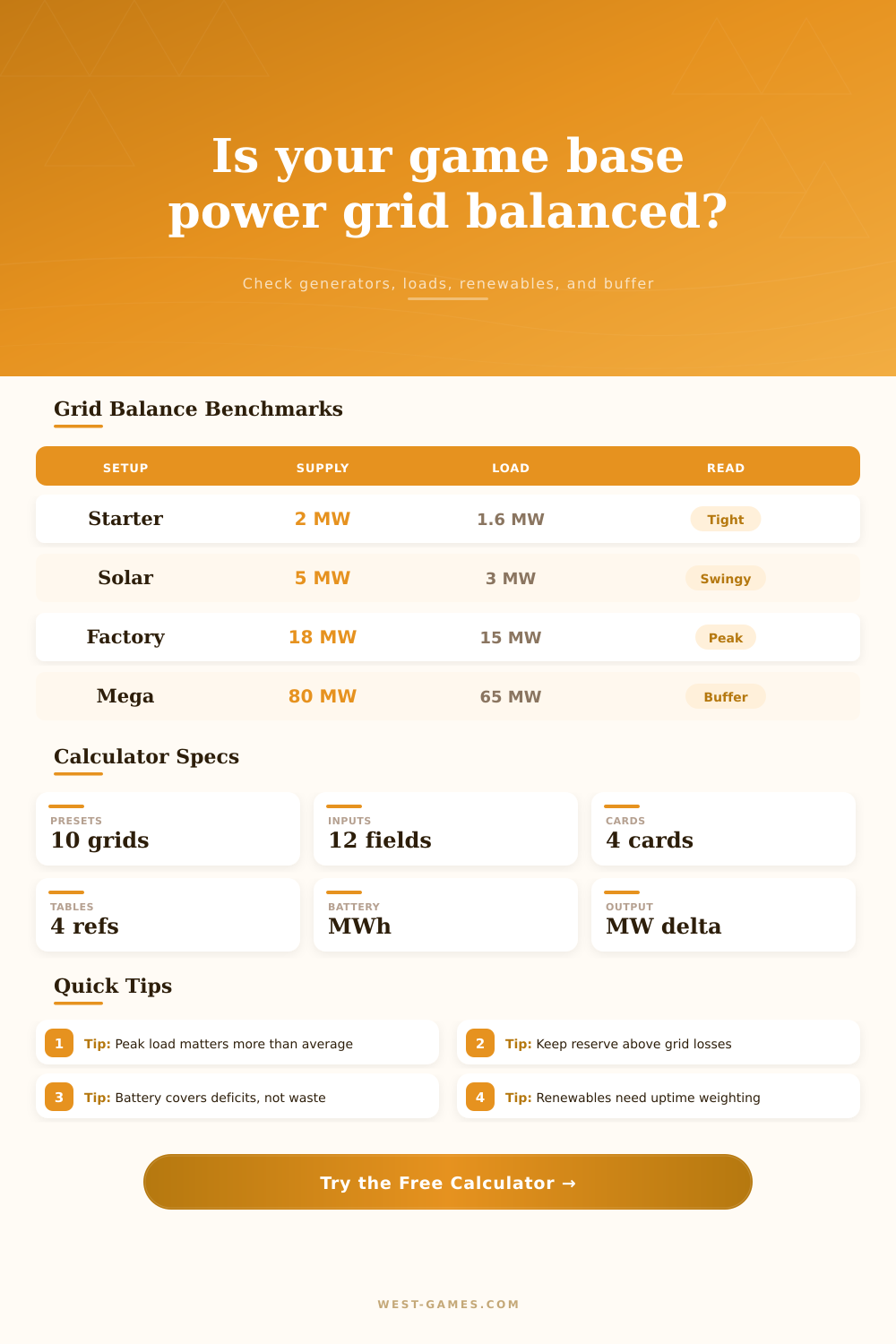
Balance a game-base electrical grid by weighting generator MW, consumer duty cycles, solar and wind uptime, peak load, battery buffer, reserve margin, and grid losses.
Calculation Breakdown
Current Plan
Uses all generator, renewable, duty cycle, loss, reserve, and battery inputs.
No Renewables
Shows the grid delta if solar and wind go fully unavailable.
Peak Event
Applies the selected peak multiplier to consumer demand.
+1 Generator
Adds one dispatchable unit with the same rating and duty cycle.
| Generator Type | Typical Rating | Useful Duty Cycle | Grid Planning Note |
|---|---|---|---|
| Biomass burner | 1 to 3 MW | 55% to 75% | Starter bases need manual fuel or extra buffer. |
| Diesel generator | 3 to 8 MW | 75% to 90% | Good backup source when fuel routing is reliable. |
| Coal turbine | 5 to 12 MW | 85% to 96% | Strong midgame baseline with steady belt or pipe feed. |
| Gas turbine | 10 to 25 MW | 82% to 94% | High output, but fuel chain interruptions matter. |
| Geothermal plant | 8 to 18 MW | 90% to 100% | Reliable if the map node or vent is continuous. |
| Nuclear reactor | 40 to 120 MW | 92% to 99% | Large reserve swings demand clean logistics. |
| Fusion core | 100+ MW | 88% to 98% | Late-game grids still need reserve for peak starts. |
| Consumer Group | Typical MW Each | Duty Cycle Range | Peak Behavior |
|---|---|---|---|
| Habitat support | 0.05 to 0.30 MW | 80% to 100% | Usually steady and should be protected. |
| Mining drills | 0.20 to 0.90 MW | 70% to 95% | Peaks when storage clears or belts restart. |
| Assembler line | 0.25 to 0.80 MW | 55% to 90% | Recipe changes can spike draw across a block. |
| Smelters and furnaces | 0.50 to 1.80 MW | 75% to 98% | Large heat or startup loads need reserve. |
| Turrets and shields | 0.30 to 2.50 MW | 20% to 85% | Low average, dangerous raid-night peaks. |
| Research labs | 0.80 to 3.50 MW | 50% to 95% | Batch research creates synchronized demand. |
| Logistics network | 0.10 to 1.20 MW | 45% to 85% | Drone and robot charging can arrive in waves. |
| Renewable Pattern | Solar Uptime | Wind Uptime | Practical Limit |
|---|---|---|---|
| Clear day cycle | 35% to 50% | 0% to 25% | Solar needs batteries for night periods. |
| Dust or eclipse map | 15% to 35% | 10% to 35% | Use a lower solar factor for storm seasons. |
| Windy ridge | 20% to 40% | 45% to 70% | Good for hybrid support, not guaranteed peak. |
| Calm biome | 25% to 45% | 10% to 25% | Dispatchable generation must carry peaks. |
| Mixed renewables | 30% to 45% | 30% to 55% | Battery sizing decides whether swings are safe. |
| Reserve Gap | Grid Read | Battery Role | Action Signal |
|---|---|---|---|
| +25% or more | Comfortable surplus | Covers long renewable dips | Safe for expansion or peak events. |
| +10% to +25% | Stable | Handles short duty-cycle overlap | Good normal operating target. |
| 0% to +10% | Tight | Protects against small outages | Add reserve before adding machines. |
| -1% to -15% | Brownout risk | Buys limited runtime | Reduce peak load or add generation. |
| Below -15% | Deficit | Battery drains quickly | Grid will fail under sustained demand. |
| Preset | Generator Plan | Consumer Pattern | Balance Concern |
|---|---|---|---|
| Starter Outpost | Biomass with small solar | Habitat and early drills | Manual fuel and night buffer. |
| Coal Factory Block | Coal turbines online | Assemblers with steady duty | Peak starts after storage clears. |
| Solar Colony | Diesel backup plus solar | Habitats and logistics | Battery hours during low sun. |
| Defense Night | Gas backup | Turrets and shield bursts | Peak multiplier dominates average load. |
| Hybrid Megabase | Nuclear with renewables | Mixed factory bus | Reserve margin before next expansion. |
If one miner on your factory line idles, then whole line shuts down, and you know how frustrating that can be. You have this problem if you assume power are unlimited. You are thinking of it as an unlimited resource rather than a physical limitation. Power is about overlap and timing, and it’s about unseen drains on what you thought was a surplus. Grids is built based off average load, and average load hide reality. Your grid calculator do the math for you, but knowing the numbers avoids brown outs.
Now, dispatchable generators aren’t always running at max capacity. For example, say you have a six-megawatt turbine: it might produce 5.4 megawatts due to maintenance cycles or fuel issues. That’s the logistical/mechanical fact of heat and logistics, called duty cycle input. That means you shouldn’t plan for maximum theoretical output (it won’t work). Reserve margin capture those slips so blackouts don’t happen.
Why Your Power Grid Needs Extra Buffer
On the other hand, renewable energy pose other dilemmas. Wind turbines don’t spin in calm weather; solar panels generate nothing in darkness. These intermittent resources requires help to fill the blanks. That’s where that battery buffer comes into play. The battery input isn’t designed to make energy, but rather save it for future use. When you’ve exhausted your batteries’ storage during a storm, well, then you’d better have generators as backup. You can never outpower physics with an additional row of panels.
The problem with most grids: They fail at peak load. When a factory line is idle, it uses minimal electricity; however, when everyone jumps on the assembly line together there’s a huge demand, up to 3X the normal rate of use. The tool include these surges and calls them the peak multiplier, which also considers multiple demands at one time. If you don’t account for the surge, your grid will be great on paper but won’t function well in real life.
Here is a table of headroom required by various types of machine.
Think about your grid as an ever-changing system, not just a fixed circuit. How much surplus do you need? Do you need enough to cover worst case while minimizing wasted fuel? What happens when you add more generators? What if renewables fails? See how it changes in the comparison section. Those tweaks expose weak balances. Five percent reserves can feel secure. Then along comes a storm that wipes out wind power and leaves you uncovered.
Extra buffer is costly fuel today. It’s also insurance against downtime tomorrow. A power grid is a balancing act that relies heavily on uncertainty. What time does the sun go down? When will production cease? What you do have control over is how much slack you introduce into the system to absorb those shocks.
Leave enough. Respect gaps between demand and supply; that is where your strategy comes in. Batteries should of be sized to handle the longest night. Reserves must remain healthy. Manage the peak, not the average, and the lights stays on. The tool is just the math.