⚙️ GTNH Crafting Calculator
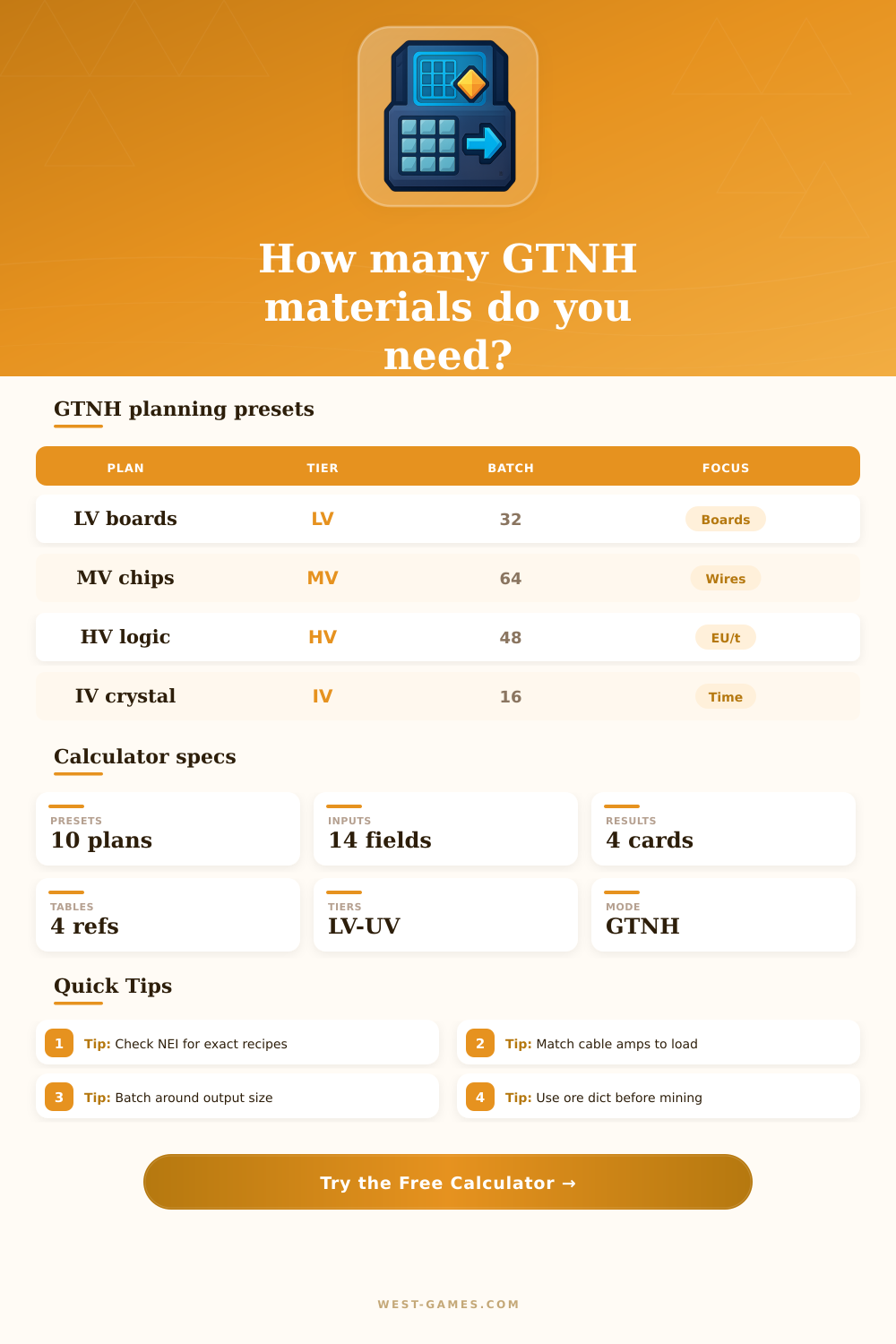
Plan GregTech New Horizons circuit and machine crafting with voltage tier, amperage, EU/t, processing time, ore dictionary substitutions, batch size, multiblock parallels, and raw material trees.
| Tier | Voltage | 1 amp | 4 amps |
|---|---|---|---|
| LV | 32 EU/t | 32 EU/t | 128 EU/t |
| MV | 128 EU/t | 128 EU/t | 512 EU/t |
| HV | 512 EU/t | 512 EU/t | 2,048 EU/t |
| EV | 2,048 EU/t | 2,048 EU/t | 8,192 EU/t |
| IV | 8,192 EU/t | 8,192 EU/t | 32,768 EU/t |
A lower-tier machine should not receive a higher-voltage packet. Use the selected machine tier as the packet ceiling.
| Family | Tier | Base EU/t | Base time |
|---|---|---|---|
| Electronic board | LV | 24 | 6s |
| Basic circuit | MV | 96 | 8s |
| Good circuit | HV | 384 | 10s |
| Advanced circuit | EV | 1,536 | 14s |
| Elite circuit | IV | 6,144 | 18s |
Defaults are planning profiles. Replace them with the NEI value for your exact board, circuit, or machine recipe.
| Mode | Raw factor | Use case | Watch point |
|---|---|---|---|
| Strict | 1.00x | Exact recipe | No substitutions |
| Standard | 0.93x | Common plates and wires | Check circuit tiers |
| Broad | 0.86x | Dusts, ingots, foils | May hide rare items |
| Recycle | 0.78x | Uses stock first | Needs inventory audit |
Ore dictionary planning estimates substitution pressure. It does not override hard recipe locks or cleanroom requirements.
| Machine | Parallel model | Overhead | Best fit |
|---|---|---|---|
| Single block | 1 recipe | 0% | Early circuits |
| Processing Array | Machines entered | 4% | Repeated parts |
| Large Circuit Assembler | 2 per slice | 8% | Midgame boards |
| Assembly Line | 3 per slice | 12% | Late circuits |
| Mega line | 6 per slice | 18% | Factory batches |
The calculator caps effective parallels at the number of recipe operations still needed.
| Category | Represents | Typical substitutions | Batch risk |
|---|---|---|---|
| Boards | Printed, plastic, epoxy, fiber boards | Board families, coated boards | Cleanroom or chemistry chain |
| Wires and foils | Copper, annealed copper, gold, fine wire | Wiremill, bender, foil recipes | Hidden plate conversion losses |
| Chips and wafers | Integrated logic, SMDs, wafers | Equivalent circuit parts | Tier-gated cleanroom output |
| Solder and fluids | Soldering alloy, molten tin, glue | Fluid assembler recipes | Cell and pipe leftovers |
| Casings and plates | Machine hulls, plates, screws, rods | Ore dictionary metal forms | Different bending ratios |
Use the breakdown below the result cards to see the estimated tree for the currently selected circuit recipe.
The ultimate circuit recipe (Gregtech New Horizons) is one such example that causes a certain type of anxiety when you look at it. This is not so much due to the collection of ingredients but because of what lies behind them: a web of connections that stretches from the initial ore veins you mine to the last component used to build this contraption. How many hours do your machines requires? What amount of energy does every step consume? Do you even possess sufficient amperage to power these machine without tripping your grid?
Once you specify the configuration of your machines and target output, the calculator above do the math for you. You no longer have to trace through every sub-recipe manually or calculate voltage tier conversions by hand.
How to Use the Calculator Tool
Now, first off, we must understand that power in this mod is not something free. Power is a constrained resource governed equally by voltage AND amperage. For example, even with a huge battery buffer, if your cable isn’t rated for the amperage it takes to power a high end overclock, your machine won’t turn on OR run efficient. Using this tool, you’ll be able to plug in the tier of machine you want and how much amperage is available to ensure that your power delivery can keeps up with what you’re trying to process.
Most players think that all they need is “enough” eu. They neglect the fact that the delivery method is just as important than the source itself. You could be tasked with producing a recipe that needs 3k EU per tick, however you only have 2 amps of cable capacity and need 4 amps to run the machine. You’re either going to waste your time with low-tier machines or wait to come and fix it yourself.
The other area where intuition is likely to let you down as a player are in overclocking. Higher tier machines does more than just work faster; they change the fundamental energy cost per operation while reducing the duration. It makes operations faster and changes the energy cost per operation. The calculator lets you select either perfect overclock profiles or the normal GregTech overclocking logic which will show this variation. This makes a huge difference when planning how you want your midgame to progress.
For example, if you have a Processing Array set up with several slots in parallel then the speed boost compounds very rapid. But so does the energy demand. You have to ensure that your power generation can covers the peak draw required for those parallel operations. To help with this, the page contains a reference table that shows the different voltage tiers and their associated EU per amp value. From here you can quickly find out if the machine tier you’re considering match your infrastructure.
The real trick comes with material substitution. The game’s ore dictionary system enable substitutions among various materials and metals in recipes based off what is available. That seems useful… until you consider that swapping copper out for gold in a wire recipe will affect all the processing upstream from there. All of a sudden you have to build an entirely new electrolyzer line, or maybe find a whole new planet to mine, to produce a single batch of circuit board.
Switching the substitution mode from broad, to standard, to strict can help you figure out when you’re going to run out, and what exact materials you’ll need to start mining right now to get back on track. That way it isn’t this abstract feeling of “oh no I don’t have enough stuff!” but instead a clear list of things you’re missing.
The last lever is parallelization; running multiple batches at once. An assembler with eight circuits look efficient. But it needs eight times more power burst, eight times as many ingredients all at once. To account for this, enter how many slices or machines you want to run at once. Then it’ll adjust the estimate of materials and overall time needed for the whole process. You avoid the trap of planning a batch and finding 30 minutes later that you are short on soldering alloy because you failed to multiply that need as well.
In the end, making things in GTNH isn’t so much about pushing buttons as it is managing logistics. You’re building a factory: all the gears need to be turning together. If you spend some time with these tools planning how materials flow through and when your energy will run out before digging into the ground, you won’t waste time with production lines grinding to a halt. And you don’t do this because you want to make the thing. You do it because you want to make it efficienty and on time. You also wouldn’t of want to break your own bank in the process.
Once you get a handle on the mathematics of the machines, what was once so overwhelmingly complex starts feeling less like work than like a puzzel with an answer that you can figure out.