🏹 OSRS Nex Mass Drop Rate Calculator
Estimate your personal Nex mass unique odds from team size, damage contribution, MVP status, kill count, target unique weight, and completion pace.
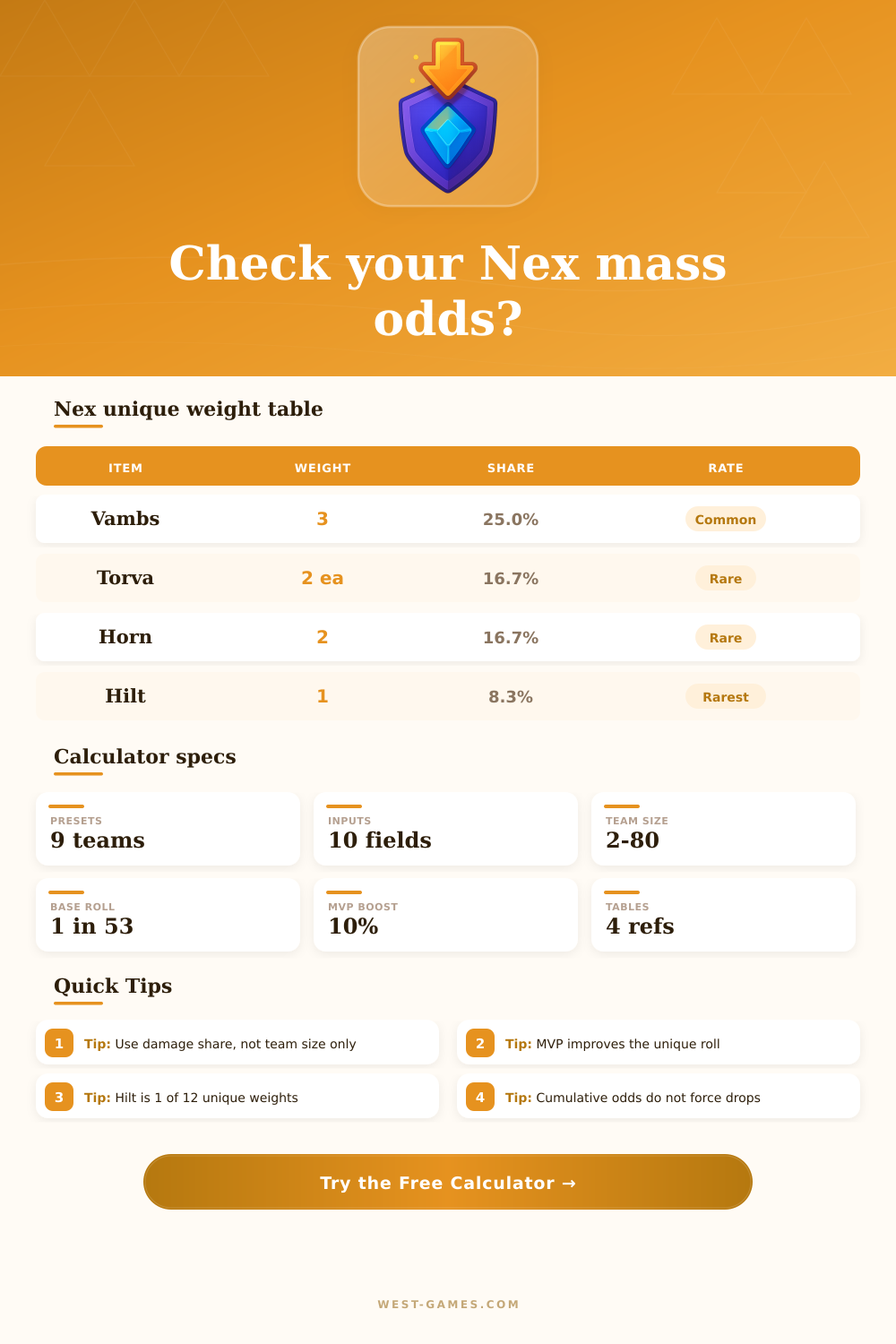
| Target | Weight | Share |
|---|---|---|
| Zaryte vambraces | 3/12 | 25.00% |
| Torva full helm | 2/12 | 16.67% |
| Torva platebody | 2/12 | 16.67% |
| Torva platelegs | 2/12 | 16.67% |
| Nihil horn | 2/12 | 16.67% |
| Ancient hilt | 1/12 | 8.33% |
The target item chance is personal unique chance multiplied by the selected item's weight share.
| Scenario | Share | Any unique |
|---|---|---|
| Even 80 player mass | 1.25% | 1 in 4,240 |
| Even 60 player mass | 1.67% | 1 in 3,180 |
| Even 25 player mass | 4.00% | 1 in 1,325 |
| Even 10 player team | 10.00% | 1 in 530 |
| MVP with 22% share | 22.00% | 1 in 217 |
| Model | Formula | Use |
|---|---|---|
| Normal | share / base | Most non-MVP kills |
| MVP | share / (base x 0.9) | Big bones player |
| Target unique | unique x weight / 12 | Specific item odds |
| Cumulative | 1 - (1 - p)^kills | Long-run chance |
| Preset | Team | Typical use |
|---|---|---|
| World mass | 80 | Fast access, thin share |
| Stable mass | 40 | Better contribution visibility |
| FFA team | 10 | Personal DPS matters more |
| Small split | 6-8 | High variance, strong share |
If you’ve ever been grinding out a Nex mass for hours only to see somebody who had half your damage total recieve the Zaryte vambraces, you might be upset. But I’m here to tell you it’s not personal, it’s math. The RNG in loot table isn’t maliciously rigged against you, but it do work on pure numbers. It’s not that luck doesn’t exist, but it is based off math.
How much you spend on gear won’t affect your chances either, nor will how many times you click per second. Those variables doesn’t matter at all. What matters is a simple fraction which most player fail to understand until it’s too late: your share of total team damage divided by the entire team. To get those numbers into the calculator (above) simply enter your actual contribution amounts. No need to guess if you’re making a dent in the damage or just adding another small part to the team damage.
How Loot Drops Work
People spend way too much time worrying about team size, because they assume bigger teams mean automatic dilution. Technically yes, but they miss more relevant variable. Sometimes a smaller team with well-balanced damage will give you better odds then one giant world event with eighty players where you do minimal damage yourself. Mass versus ten isn’t just about speed. When the boss go down, it’s about how big of a piece of the total pie is yours.
To understand what these numbers mean, you need to know about structure of the unique table. Even when you’re killing unique monsters, there’s no guarantee that you’ll get the item you want, or any unique at all. It has 12 total weights on the table (which means your specific item is just one part of those twelve possible outcomes). Vambraces are most likely unique, with a weight of three out of twelve. Conversely, the Ancient hilt hold just one weight, making it the rarest item on the unique table.
What does this matter? This changes how much time you realisticly expect to spend. If you’re targeting the hilt specifically, you should of been prepared to roll lots of other stuff before you get it. The tool takes this into account by separating the chance of rolling your specific unique from general chance of rolling any unique. This gives you a better idea of what is reasonable to expect after a hundred kills or a thousand.
That being said, being the MVP changes things quite a bit, not as much as some people think. It increases your chance of getting a special item by 10%, which helps the math a little, but it doesn’t fix main problem of having low damage share. Even if you’re the MVP, you can still have lower odds than another player without an MVP bonus who did twice as much damage. Why? This is because your share of your team’s total damage matter greatly to this. It’s the only thing that keeps the number grounded in reality instead of aspiration.
Now, when folks say “expected kills” they conflate that with “what’s gonna happen.” But it’s not a guarantee. If the calculator tell me I need 3k kills for a 50% chance to get my thing, that doesn’t tell me I’ll get it on kill #3k. It just tells me that, after 3k kills, half of all people like me would’ve gotten theirs while the other half wouldn’t have. That’s why cumulative probability comes into play. Rather than fretting over whether or not you’re going to be lucky today, you can choose based on how much time you’re willing to put into it until you feel confident enough. Do you want a 90% chance? A 40% chance? Whatever makes you comfortable. It shouldn’t be based on the game systems, but on you.
It’s laid out clearly in reference tables on the page. You can very easily see how each scenario compares and how much better you’re doing when you go from casually mucking around in a mass to actively working with a small group of people. Your chance for success as an individual goes way up. It is not because you get the stuff quicker, it is because you get more out of the minutes spent there.
The more people you play with (up to a certain point), the smaller slice of the pie you get back, even if the speed of the kills increase. And the more crowds you play in, the faster it will come, but you’ll only ever get a tiny sliver of it. There isn’t a right or wrong answer here. There are just trade-offs.
Knowing the trade-offs is what makes a successful loot chaser different than everyone else. You don’t need to be lucky. You just need to understand where your luck is actualy coming from. All you have to do is understand where you were lucky.