🌙 Bloodborne Summon Range Calculator
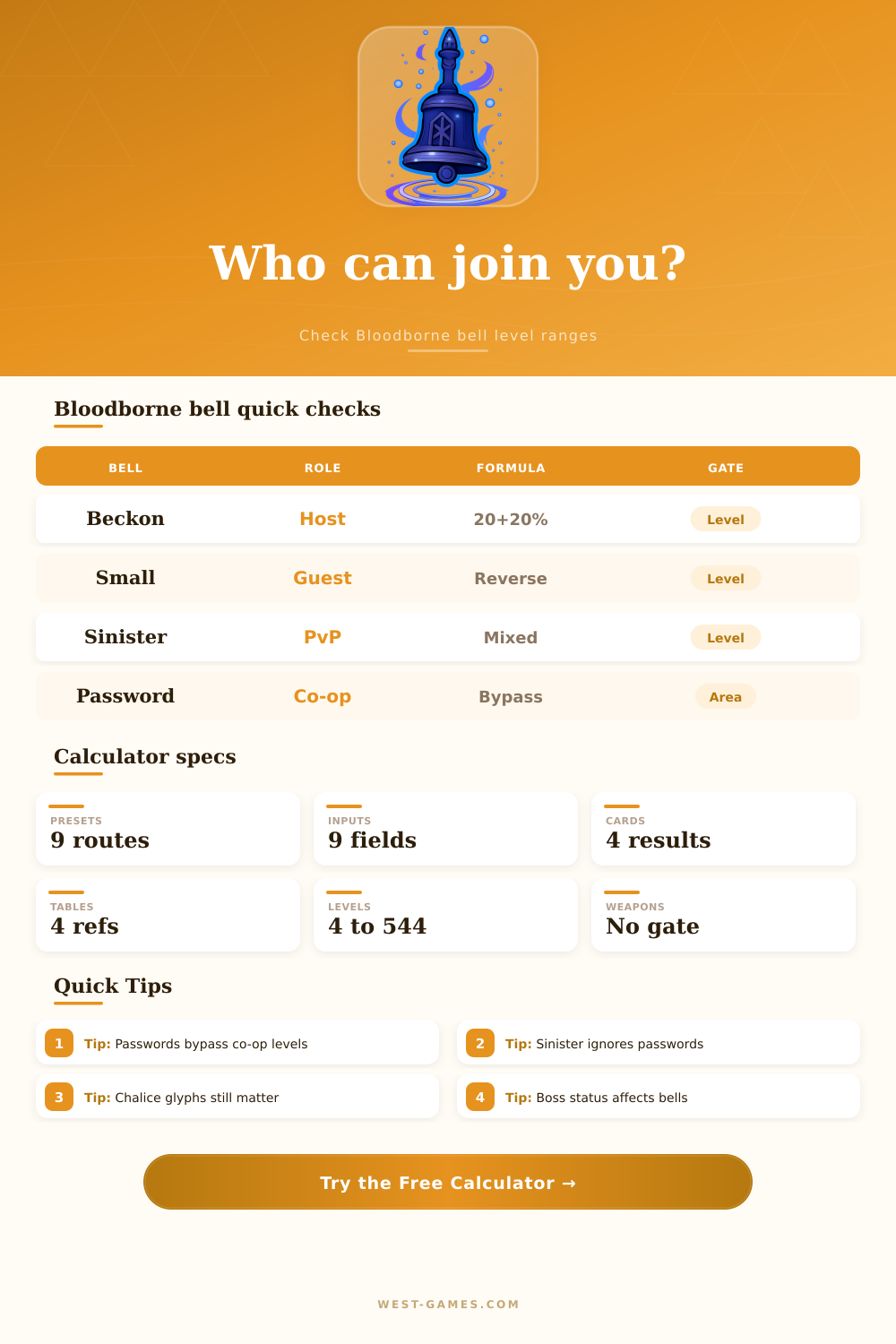
Check hunter level brackets for Beckoning Bell co-op, Small Resonant Bell help, Sinister Bell invasions, password co-op, chalice dungeons, and target-player matching.
| Mode | Basis | Lower edge | Upper edge |
|---|---|---|---|
| Beckoning co-op | Host BL | Host - 20 - 20% | Host + 20 + 20% |
| Small Resonant | Host BL | Reverse co-op | Reverse co-op |
| Host invaded | Host BL | Host - 20 - 20% | Host + 10 + 10% |
| Invader search | Host BL | Reverse PvP | Reverse PvP |
| Password co-op | Area | Bypassed | Bypassed |
Edges are rounded down after the percentage math. The calculator brute-force checks reverse host and invader perspectives from BL 4 to BL 544.
| Area or route | Typical BL | Bell focus | Activity note |
|---|---|---|---|
| Central Yharnam | 10-25 | Beckoning | Early help |
| Cathedral Ward | 25-45 | Small bell | Open gates |
| Forbidden Woods | 45-70 | Co-op | Long route |
| Nightmare Frontier | 60-90 | Sinister | Forced maiden |
| Mensis | 75-110 | Sinister | High PvP |
| Meta duels | 100-150 | Sinister | Planned PvP |
These are practical activity bands, not separate matchmaking rules. Boss state, region, and active players can move real wait times.
| Setting | Level gate | Extra gate | Result |
|---|---|---|---|
| No password | Active | Same area | Random pool |
| Co-op password | Bypassed | Same area | Friend co-op |
| Root chalice | Active | Glyph access | Shared dungeon |
| Short Root | Active | Open privacy | Search pool |
| Sinister bell | Active | Bell maiden | PvP pool |
Password co-op can connect large level gaps, but the higher-level guest may be scaled down when joining a lower-level host.
| World state | Beckoning | Small bell | Sinister risk |
|---|---|---|---|
| Boss alive | Available | Available | Can occur |
| Boss defeated | Blocked | Can help | Limited host |
| Co-op active | Active host | Joined host | Maiden may spawn |
| Nightmare zone | Available | Available | High risk |
| Opposed oath | May connect | May connect | Hostile risk |
Kill the Bell-Ringing Woman to stop invasion searches in many areas; forced nightmare zones are more PvP-prone while online.
When you ring the Beckoning Bell and nobody answers, you can get upset. You might feel this way when you’re low on health, stuck fighting a boss, and there seems to be no one online. It’s never personal, usualy. But more times than not, you just fell out of Bloodborne’s mathematical bounds for matchmaking. The game do not match players randomly across the entire spectrum of power levels. Rather, it has a rigid hunter level bracket system depending on if you have a password, what bell you ring, and so on.
To understand this bracket system, you need to know what tier or level you are and then compare yourself to others on the list. So as a host, default bracket is twenty levels below you plus a twenty percent buffer, and those higher than you plus twenty levels and another twenty percent (with another cushion). What does that look like? Here’s what that looks like. That’s a narrow band which doesn’t allow someone who’s level 100 to casually help out their lowbie pal at level 20 unless they use a password. It’s a balance thing.
How Bloodborne Online Matching Works
It also means that if you don’t know exactly how many people is allowed in your bracket, coordinating can be tricky. You just input your bell type and role, and it does the rest of the math for you; no more trying to figure out what conversion or coefficient means what.
The logic for handling Sinister Bells and Beckoning Bells is split into two parts. The first part is the invasion math, which determines who can invade you., versus the beckoning bell logic, who can I call? This is important when using this for PvP matchmaking, as a different formula apply for the upper limit so hosts aren’t swarmed by higher-level invaders in one go. You also want to know your lower bound if you’re hosting so you know whether or not your friend can be reached. It works the other way if you are looking for someone to help: use the reverse range to find worlds that is accepting connections.
Level gates change all of this. They don’t exist if you’re sharing a password. The game doesn’t care that one player is 10 levels above another when they enter with the same code. That means you can help a lower level buddy beat some tough spots, which is nice, but there’s an unintended consequence. Guests who have higher levels than their host will be brought down to host’s level. Your stats won’t matter as much and your weapons might feel weak. You get in, yes, but you also lose what makes your character tick. It is a small sacrifice, maybe, but it should of been significant when you’re building toward a certain style or mastering a weapon.
The other wrinkle most hunters aren’t considering is invasion ranges. The Sinister Bell brings any invader into your space, but only at a range appropriate to yours. For example: If you are Lvl 10 and there is a Lvl 20-30 player nearby, no invasion happens; however, if someone else kills the area boss, then a new maiden are spawned (typically from killing one random enemy). From that point forward, late game areas becomes sanctuaries except when people actively seek out PvP. Use this page’s tool to confirm if an invader is within the allowed range for your standing. This will help you tell the difference between random quiet nights and periods of total chaos.
The other factor that changes things with Chalice dungeons is that you have shared root codes and glyphs to contend with as well. The pool of potential players is still small, there aren’t many who explore these depths, and since it’s a smaller group, it tends to be more focused. If you’re looking for assistance in a level 150 chalice dungeon, good luck finding someone in your range, but patience will pay off eventualy.
The key to understanding Bloodborne’s online system is learning not to expect much from it. If the math makes it impossible to find someone without passwords, you can’t force a connection. If you’re in a tight bracket, you can’t expect immediate assistance. Checking your own limitations ahead of time spares wasted time waiting on ghosts; it will find people who fit. And while there’s always fog waiting at that next gate, having learned how to walk through it as a team makes the darkness more tolerable.