🛡 WoT Win Rate Calculator
Estimate World of Tanks PC win rate, target battles, solo and platoon pace, recent form, and a WN8-like performance read from tank-specific inputs.
| Preset | Tier | Class | Planning read |
|---|---|---|---|
| IS-7 Heavy Anchor | X | Heavy | Armor trades, late brawls, stable platoon value. |
| Progetto 46 Session | VIII | Medium | Autoreloader burst, flexible farm, good recent checks. |
| EBR 105 Scout | X | Light | Spotting and survival swing the projection sharply. |
| Rhm.-Borsig Sniper | VIII | TD | Damage can rate high while win impact needs map control. |
| Class | Key input | WR signal | Watch point |
|---|---|---|---|
| Heavy | Damage + survival | Wins lanes and holds HP | Early overtrades flatten WR. |
| Medium | Damage + assist | Flexes to weak flanks | Late rotations matter. |
| Light | Spots + assist | Creates team damage | Deaths before first reset hurt. |
| TD | Damage + frags | Deletes pushes | Camp damage may not convert. |
| SPG | Assist + stuns | Supports focus fire | Map dependence is high. |
| Tier | Expected damage | Typical pressure | Model note |
|---|---|---|---|
| V-VI | 650-900 | Fast mistakes | Small samples jump quickly. |
| VII-VIII | 1,150-1,650 | Credit grinds | Premium tanks need class context. |
| IX | 1,950 | Strong carry tier | Stock modules can distort form. |
| X | 2,250+ | High skill density | Small WR gains take many games. |
| Account size | Current gap | Best use | Warning |
|---|---|---|---|
| Under 1k | Moves fast | Learning goals | Do not overread one session. |
| 1k-5k | Moderate | Class practice | Bad grinds still show. |
| 5k-20k | Slow | Tank focus | Target WR needs patience. |
| 20k+ | Very slow | Long-term tracking | Recent WR is more actionable. |
You know that feeling when you have ten more games left in your premium timer and you are absolutely convinced that matchmaking system is out to get you? If you’re a player with a win rate hovering around 50%, this probably makes sense to you. Small improvements gets lost when large sample sizes are involved, and the math gets ugly.
It’s nice to know where you stand rather then hope you’ll find some good teammates. After plugging in your stats, the calculator do its thing. You no longer have to wonder: Is this slump real? Or am I just on a bad run of luck?
Why You Should Use This Calculator
Lifetime win percentage is what most player rely on. But lifetime percentage isn’t always reliable. If two people has a 52% win rate, and one of them has two thousand battles while the other has twenty thousand battles, the second person’s profile are going to be more stable. Recent sessions is weighed heavier than historical ones. Three thousand games from several years ago, when the game was in a different patch, aren’t as good an indicator of your current skill level as your last hundred games.
That makes a difference, since tank classes has different statistical variance. Heavy tanks has a steadier win rate because they anchor positions and make people trade. Win rates for light tanks swing more based off initial spotting success. When you start putting in average spot count and damage, it is accounting for class specific contribution. That is looking at things other than kills which can still win a match but are often out of sight.
The data is split by platoon and solo as well. You’ll notice many account have higher wins in platoons due to coordination, which reduces random error. Overestimating skill from that are an issue. The calculator will ask for your solo and platoon win rate expectations independently. Then it blends them based on how you actualy play. That gives you an accurate, projected adjustment rather than a vanity stat.
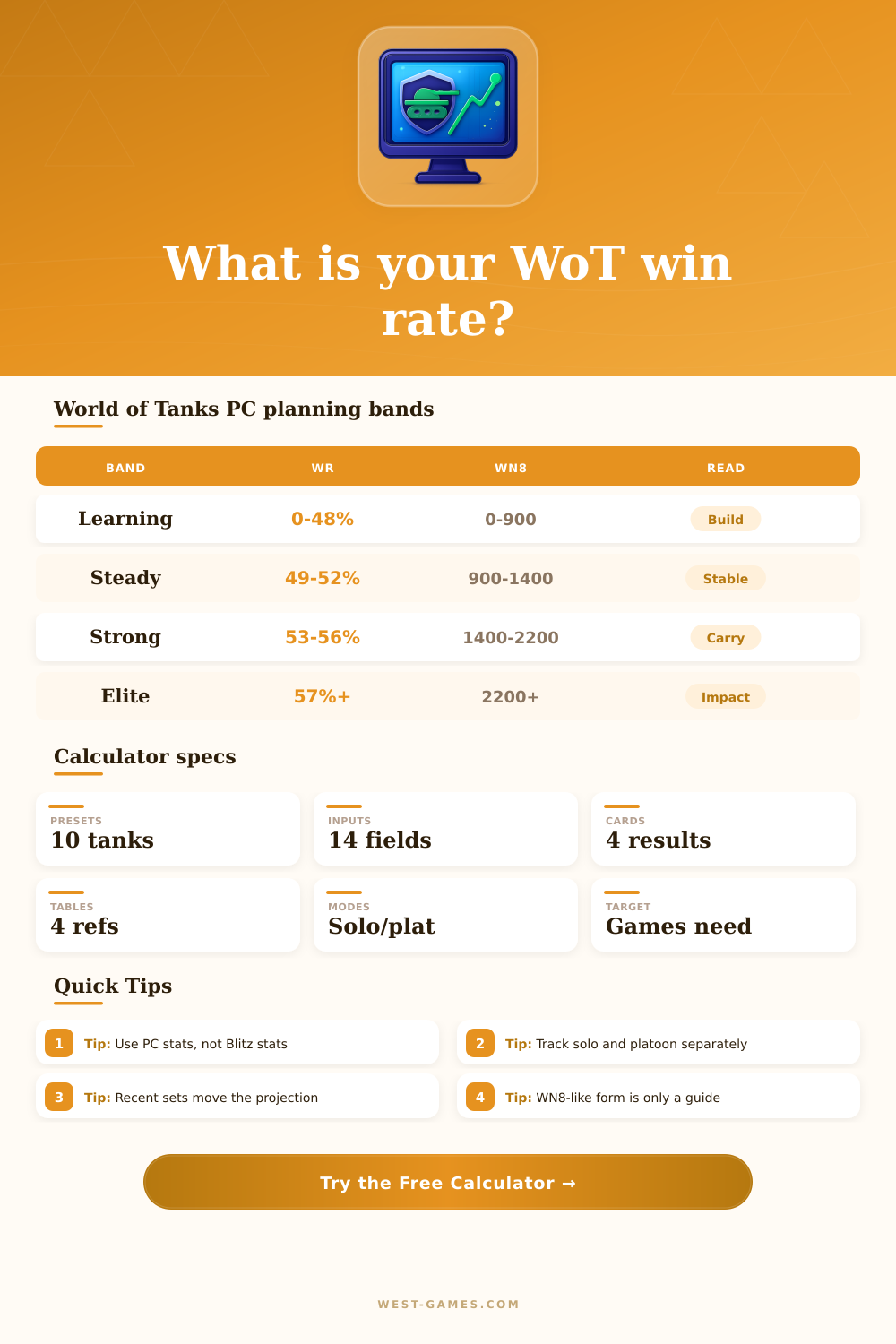
It makes you evaluate whether or not you can carries games with nine complete strangers yourself. These numbers get context through reference tables in the interface, which break down performance bands from learning stages to elite impact. Five percent up at high tiers is much harder to achieve than it is at mid-tiers. Higher skill density mean mistakes are punished harder at tier ten, where a win rate change from 55-60 percent may take hundreds of games. Knowing that helps avoid frustration if you feel like progress are slow.
Another critical metric is the form score, which is similar to WN8. Essentially, it’s a mix of survival, spots, frag, and damage. If your win rate is bad, but the form score is good, then it might not be due to poor performance; rather, maybe you just got unlucky. Low survival, high damage usually indicates that you are out-extending yourself and dying before you can assist the team. This isn’t something that would of improve through server matchmaking adjustments. Instead, you’ll see improvements quicker by adjusting how you play.
This makes it less about guessing and more about strategy. You’ll see what’s working, what isn’t (higher survival? More assist damage?), and know how to improve. This means you don’t just want to win more, but also want to understand why you’re winning or losing. Blaming the game won’t clear the path ahead of you like analyzing your inputs will. Study the stats from your last few sessions; these will tell you where you go from here.