🛡 WoT Blitz Win Rate Calculator
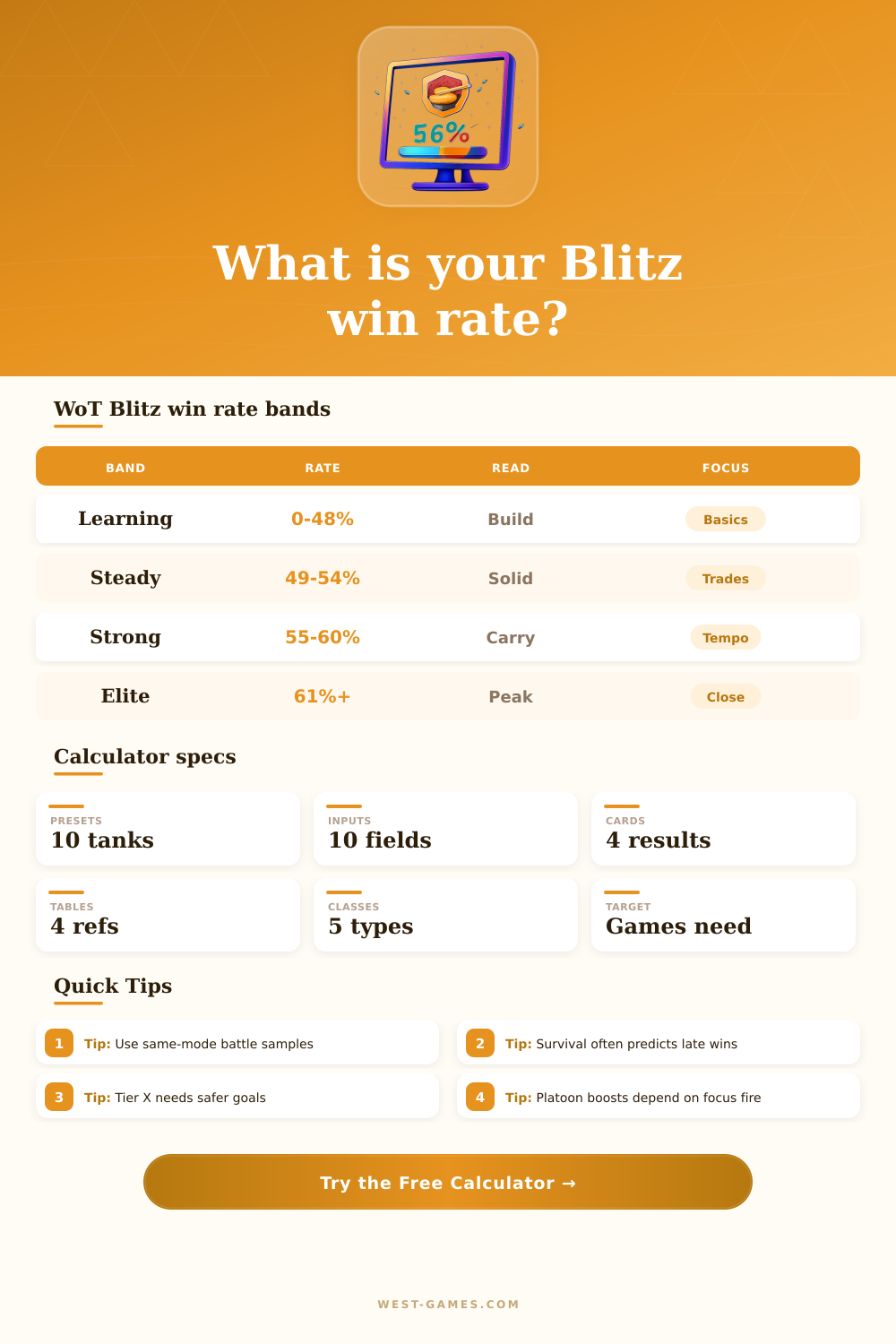
Estimate your World of Tanks Blitz win rate, tank class pressure, tier difficulty, survival and damage influence, platoon modifier, target games needed, and session pace.
| Class | Map role | Model weight | Win cue |
|---|---|---|---|
| Light | Spotting and tempo | Volatile | Survive first minute |
| Medium | Flex and crossfire | Positive | Trade while rotating |
| Heavy | Lane anchor | Stable | Hold HP for late push |
| TD | Damage support | Damage-led | Fire lanes plus relocation |
| Hybrid | Tank-specific role | Neutral | Use the tank gimmick safely |
| Tier | Pressure | Sample | Planning note |
|---|---|---|---|
| I-IV | Low | 20-50 | Learning swings are common |
| V-VII | Medium | 50-100 | Good band for stable stats |
| VIII | High | 75-150 | Premium and event tanks vary |
| IX-X | Very high | 100+ | Use conservative target goals |
| Preset | Tier | Class | Typical input profile |
|---|---|---|---|
| T-34 | V | Medium | Learning medium, 54% target, 1.05 damage ratio |
| Cromwell B | VI | Medium | Fast flanker, high tempo, strong platoon value |
| Tiger I | VII | Heavy | Stable lane tank, survival-led close-outs |
| IS-3 Defender | VIII | Heavy | Armored burst trader with focused platoon boost |
| T-54 ltwt | VIII | Light | Scout tempo with high survival sensitivity |
| T49 | VIII | Light | Volatile burst light with wider outcome range |
| Progetto 46 | VIII | Medium | Flexible autoreloader with steady damage ratio |
| Grille 15 | X | TD | Damage support, lower survival margin |
| Maus | X | Heavy | Anchor tank, high HP preservation impact |
| Sheridan | X | Light | High-tier light with aggressive spotting pressure |
| Current | Target | At 1,000 battles | At 5,000 battles |
|---|---|---|---|
| 50% | 52% | 43 perfect wins | 214 perfect wins |
| 54% | 55% | 23 perfect wins | 112 perfect wins |
| 56% | 58% | 48 perfect wins | 238 perfect wins |
| 60% | 61% | 26 perfect wins | 129 perfect wins |
Perfect-wins math solves (wins + x) / (battles + x) = target. Larger accounts move slowly because every new battle is diluted by the existing sample.
| Metric | Low | Solid | Strong |
|---|---|---|---|
| Survival | Under 30% | 35-45% | 50%+ |
| Damage ratio | Under 0.90 | 1.00-1.30 | 1.45+ |
| Recent sample | Under 25 | 50-100 | 150+ |
| Platoon lift | None | 1-2 points | 3+ points |
Until now, your win rate was the ultimate judgment on how well you were doing. But then you remember, it’s really just a reflection. It could be good or it could be bad. But it’s way more nuanced than a single percentage lets on. What does your stat line say? That’s where this thing comes in.
It filters out the noise and tells you how your style of play can be seen from your stats. How much do they reflect your damage efficiency, team synergy, and survival? Why? Because 90% of people considers their win rate a static characteristic of their hero instead of a dynamic outcome of certain choices. This all comes back to context.
Understanding Your Stats Better
Positioning as a scout in Tier VIII is very different from parking a heavy on top of a hill. This is why the calculator change how it balances damage against survival based on your class. If you play a medium tank that trades then your survival will be lower but maybe your overall contribution will be higher. Your adjusted win chance will change different than it would if you were playing a heavy tank that takes damage while waiting for an enemy to get close enough to kill.
That’s the difference many folks don’t understand when they look at their numbers compared to online average or even friends. Unless you are both doing the same job with the same pressures on maps, you aren’t comparing apples to apples.
Survival rate is often a silent driver of success in Blitz. You’d think that getting more kills would translate into more wins, but in reality, being alive at the end of the game determine the outcome of close battles. Those who live through initial encounters can get the key finishing blows that determine victory. This fact holds true in the model as well, which heavily favors survival over other metrics, particularly with high damage rates.
Getting kills doesn’t matter if you’re not alive during the push. Staying alive and doing some damage is better than getting kills quickly only to die right after, because you need to be there for the final moments.
There’s another wrinkle that no solo stat can account for: team dynamics. Playing in a coordinated platoon or duo feels noticeably different than going it alone, whether it’s the crossfire setup or focused fire of teammates. A portion of that is accounted for by the calculator’s modifier. When you’re playing with people you know won’t screw up, each engagement has a different set of risks. There’s less need to take an unneeded trade and you can hold positions for longer if you know that someone has your back.
If you’re playing by yourself without any communication, however, you’ll often find yourself fighting a losing battle against well-coordinated teams. Recognizing that element explains why your win rate may vary wildly based on who is in your lobby.
Most improvement plans go awry in target setting. In their haste to jump ahead players often aim for unrealistic jumps that demoralize them when progress feels slow. The tool includes reference tables to show how much you need to play before seeing real improvement. These tables outline exactly how many matches in a row you would of have to win to change your overall percentage by a single point. Knowing these math facts keeps the frustration down and the patience up.
It’s about incremental improvement, not instant improvement. In the end, this is all about fine tuning habits, not hitting some random number goal. It doesn’t matter if you’re grinding Tier V mediums or pushing to high tier rated battles. The lessons apply. Position yourself so you stay alive longer to make contributions. Find the trades that allow you to be aggressive without being foolishly risky. Then use what you’ve learned to figure out where you might be giving up chances with your play style. When you begin to see win rate as feedback instead of a judge of your worth, each and every battle can teach you something instead of simply contributing a data point to a graph.