Crit Chance Expected Damage Calculator
Estimate expected DPS from base damage, bonus damage, hit rate, crit chance, crit multiplier, attack speed, uptime, variance, and the breakpoint needed to reach a target.
Damage model: each attack can miss, hit normally, or crit. The calculator applies additive damage, percent modifiers, mitigation, hit rate, attack speed, uptime, random damage spread, and crit variance to estimate expected DPS.
Expected Damage Breakdown
Variance And Breakpoint Read
Current Build
Uses every active field, including hit rate, uptime, mitigation, spread, and crit multiplier.
No Crits
Sets crit chance to zero so the value of your crit package is easy to isolate.
More Crit Chance
Adds 10 percentage points of crit chance, capped at 100%, for quick stat comparison.
More Flat Damage
Adds 10% more base-plus-bonus damage to compare crit investment against raw damage.
| Crit chance | Expected DPS | Crit DPS added | Variance read |
|---|
Rows keep your hit rate, attack speed, multiplier, mitigation, and uptime fixed.
| Multiplier | Expected DPS | Gain vs current | Use case |
|---|
Higher multiplier can be efficient, but it usually makes output more bursty.
| Scenario | Hit rate | Speed | Expected DPS |
|---|
Misses remove both normal and crit outcomes, so hit rate often sets the first breakpoint.
| Target DPS | Needed crit | Needed multiplier | Needed flat damage |
|---|
Impossible means that knob alone cannot reach the target under the current caps.
| Preset | Combat profile | Crit pattern | Calculator use |
|---|---|---|---|
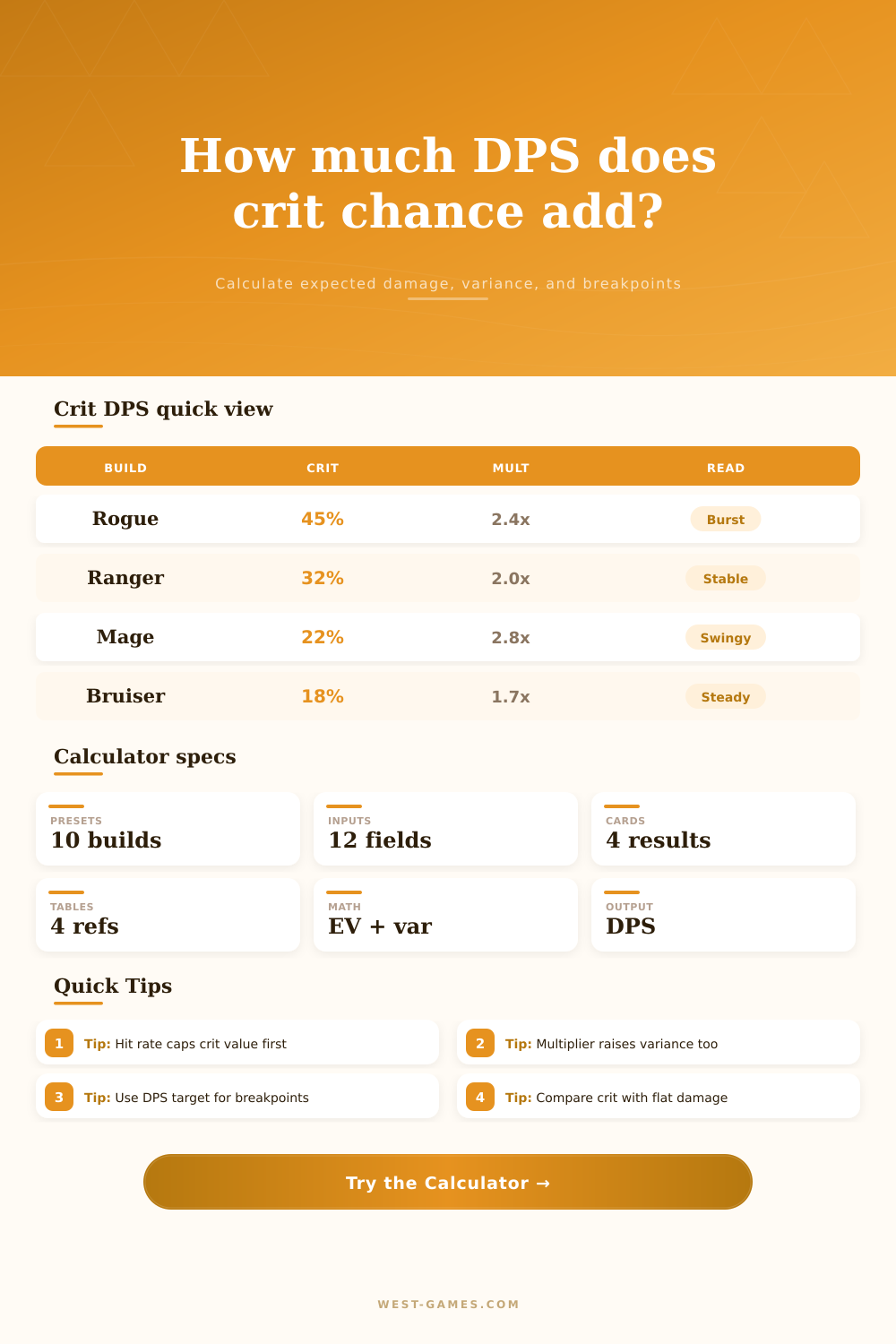
| Backstab Rogue | Fast melee, high uptime pressure | High chance, high multiplier | Tests burst build reliability |
| Bow Ranger | Medium speed ranged attacks | Moderate chance and multiplier | Compares flat damage and crit value |
| Fire Crit Mage | Slow spell casts with big hits | Lower chance, large multiplier | Shows swingy crit variance |
| Great Axe Bruiser | Slow melee with heavy base damage | Lower chance, lower multiplier | Checks whether crit beats raw damage |
| Dual Daggers | Very fast attack stream | High chance, steady crit flow | Tests speed scaling and hit rate loss |
| Looter Shooter SMG | Many shots with partial uptime | Medium crit with high spread | Useful for proc and weak point models |
In an RPG, you’re frequently faced with staring at two sets of gear, neither of which are obviously superior. “This one does so much damage.” Sure it does, but look over here: “this one has a high crit rate.” Players get mad when they can’t see what the tooltip says (because the tooltip shows potential); it doesn’t show results. Builds fail because there is a huge difference between optimal performance in a perfect vacuum and actual combat performance. Bridge this gap, by examining expected damage, not maximum numbers.
In many games, players will obsess over their critical strike chance like its the only relevant statistic. They’ll pursue big numbers on percentage without paying attention to hit reliability or multiplier. That’s a problem. A 60% crit rate sounds impressive. Right up until you realize your hit-rate isn’t great and/or your attack speed are sluggish. After all, if you’re missing a lot of attacks, then critical strikes won’t happen. So while you’re weighing the size of the multiplier versus its frequency, you’re also considering how likely this will occur in total.
How to Choose Better Gear for RPGs
High multipliers comes with variance, and you must be okay with that. First is the base damage and any flat bonuses; next are the modifiers. Your floor is establish by these three figures. Next are factors on top of this foundation: the critical chance and critical multiplier. You can raise your critical multiplier and leave your critical chance low, which means your average output probably won’t see a significant change. But it will make the swings in performance extreme. You’ll be awesome for ten seconds then struggle to hurt the enemy for the following thirty.
In long fights stability is just as important as burst potential are in short fights. All this is fed into a single model in the calculator. It tells you exactly what the DPS should of be across all variables, such as attack speed, hit rate, target mitigation, and uptime. It’s an overall solution which doesn’t let you optimize something at the expense of whole picture. Stacking crit past its diminishing returns hurts your overall DPS and wastes a bunch of gear slots which could otherwise have been used for consistent, flat damage/death avoidance bonuses.
The reference table shows scaling of various builds compared to one another under equal circumstances. Take for example archetypes of mages and rogues. Rogues rely on relatively high crit chances alongside their high speed to consistently apply pressure, while Mages tend to run lower hit values but much larger critical multipliers when they does connect. Neither is better or worse. Depending on what you’re fighting, one will trump the other.
Against a resist-heavy boss, maybe raw damage do more. Against fast-clearing mobs, perhaps it’s all about speed and uptime. Whatever it is, you should be adjusting your expectations based off the encounter rather than sticking to a set stat priority.
The other variable is variance. Variance is your measure of consistency. If you do high-variance damage, you’ll see big numbers one minute and nothing for two minutes. If you’re doing low-variance damage, you’re getting the same thing every time. It’s more predictable. Raid environments where there’s less healing output can be unforgiving of high variance; when you spike all at once, it overwhelms healers. The theory may say that you have a higher average, but without delivering that in a way that’s usable by the rest of the team, it hurts them. Knowing this helps you identify what kind of gear fits into your role on the group comp.
Finding the sweet spot between power and effectiveness isn’t just something that gives you maximum points in a spreadsheet; it’s best for your playstyle. You don’t necessarily need the most critical chance, but you still want it high enough that your damage feel good, without being so unreliable that you’re not sure when a blow will hit.
Try out minor adjustments, such as changing which skills you put into rotation or replacing one piece of equipment with another. Then, use the tool to see where you change from one breakpoint to the next. How does that affect the expected damage? What happens if you switch this? Now you know. Each tweak has an impact on the whole picture, and now you kno exactly what it is.
Build with a purpose.