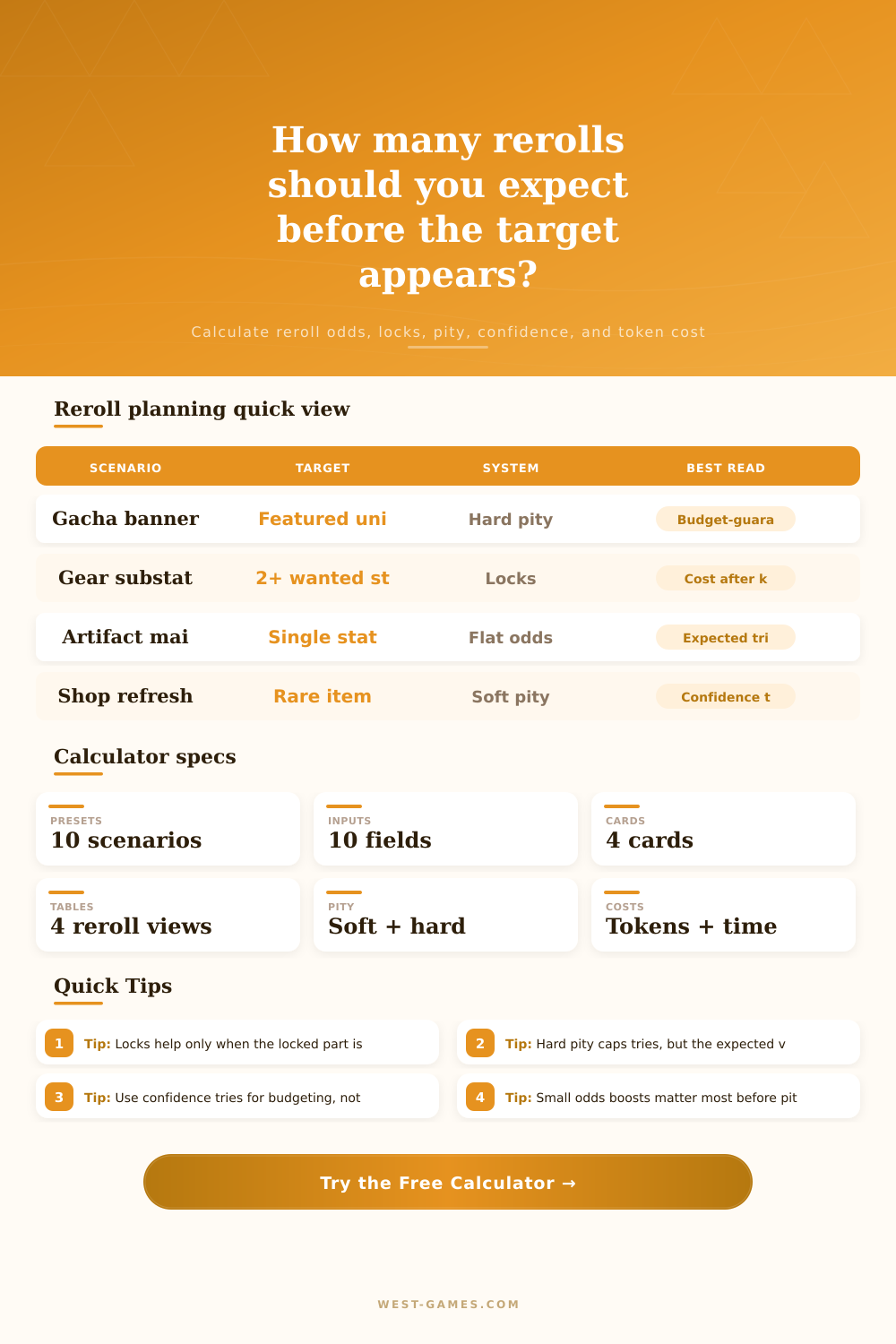
🔁 Reroll Expected Attempts Calculator
Estimate the chance of hitting a reroll target, how locks change the effective odds, how pity or guarantees cap bad streaks, and how many tokens you should budget.
Reroll model: each reroll is treated as one independent attempt unless a soft pity or hard guarantee is entered. Locks reduce the number of still-random slots, which raises the chance of finishing a multi-slot target.
Reroll Breakdown
Confidence Meter
| Rerolls | Flat chance | With pity / guarantee | Expected successes | Resource cost |
|---|
| Confidence | Attempts needed | Token cost | Flat no-hit risk | Planning note |
|---|
| Locked slots | Open slots | Per-reroll success | Expected attempts | Budget chance |
|---|
| Checkpoint | Hit chance by then | Still missing target | Tokens spent | Read |
|---|
Flat Odds
Chance over your planned rerolls if every attempt keeps the same probability and no guarantee exists.
Pity Model
Chance over the same reroll budget after soft pity and hard guarantee rules are applied.
Lock Value
Extra per-reroll success probability gained from keeping already-correct target slots.
Budget Gap
Additional rerolls needed to reach your selected confidence target from the current plan.
It’s a ticket, or a gem, or some other resource that you hold in your hands. Its weight is meaningful, and you’ve crunched the numbers in your brain. You realize there’s only a two-and-a-half-percent base chance of winning. And you’re aware that you have forty more pulls left until time runs out. Your gut tells you to win one soon (but probabilities don’t care about guts).
Each pull are an independent event. What happens now has no bearing on what happens next. That’s where the calculator above comes in: it clears away the mental muddle, and turns abstract probabilities into real-world budget lines.
How to Plan Your Spending in Games
Most player typically view expected attempts as deadlines. The math says it should of take me forty tries on average, so I figure it’ll work out after that point. That’s wrong. Expected value represent the statistical center; it doesn’t mean it will happen. You could roll double and get squat. That’s another pitfall.
You want confidence intervals, because those allow you to properly plan. How many attempts do you need to feel confident that success has occurred with a 90% probability? Let the calculator reverse the probability curve to answer. What you learn is that achieving high confidence usually take far more effort than the average implies. Vague hopes become concrete numbers, numbers you can either accept or reject.
Complicating those easy equations is that you’re rerolling some affixes and preserving others on locks and slots. Every slot preserved alter the effective odds. Now instead of rolling for four stats, you’re rolling for one. That’s why calculator also changes denominator to account for that. Basically, it increases your chances of success without altering rarity of the item itself.
Deciding if spending gold on a lock is worth it is a mechanical point that matter. You have to calculate how much the lock will save in rerolls versus how much it costs.
Beyond straight up probability there’s another level of distortion: the pity systems. Hard pity means that you’re guaranteed a win at some capped level. Soft pity means that your odds improve if you’ve had a streak. These make bad luck less likely and flatten out the risk. However, they distort expected cost. If two systems is equal in their long-run average cost, they may be wildly different in terms of risk profile. You’re trading away volatility for predictability. When saving toward a big milestone, that can be helpful. The page breaks down exactly how each safety net affect your budget. It turns a gamble into a fixed cost and you’ll use it to save for something big.
The problem with clean data sets in the real world is they don’t come without an emotional cost. When resources vanish, there is a price to pay. It is a goal and reason to get started. An urge that says “close enough” to tempt another try. This repeats until no money remain.
The calculator asks: what is the line where emotion takes over? It looks at the cost in tokens required for 95% confidence. It shows price of almost certainty. And if that total costs triple your current stash… you’re walking away right now. You should walk away before rolling a one-in-a-thousand shot and blowing it all.
The bundled presets do apply to a range of typical situations: artifact systems with multiple stat slots; gacha banners with soft pity. But they’re jumping off points. The beauty is in adjusting them for your own constraints. Twenty rerolls? Temporary double-base-rate luck boost? Plug those in, see if that little boost make any difference at all. See if it gets you across the gap between what you’ve got to spend and what the odds really require.
You should expect the unexpected. Planning for randomness isn’t about beating the system; it’s about planning ahead for what you cannot change. There are no guarantees when it comes to drop rates. However, by understanding the amount of risk that you’re taking, you can choose how much you spend on the hope of getting something. That way, you won’t overextend yourself because of unrealistic expectations. Instead, you’ll have a line item that can be easily managed and understood. With this, you’ll close out the tab with an empty wallet (or a full collection) and know exactly why. Whether you succeed or fail, it’s clear how you got there.