🎮 Smite MMR Calculator
Estimate ranked Smite MMR from Conquest, Joust, or Duel mode, visible rank, hidden MMR clues, team and opponent averages, result, streak, party size, role, and god impact.
| Rank band | Low | Mid | MMR read |
|---|---|---|---|
| Bronze | 700 | 900 | High volatility |
| Silver | 1050 | 1200 | Reset pressure |
| Gold | 1350 | 1500 | Stable middle |
| Platinum | 1650 | 1800 | Lobby gap clear |
| Diamond | 2000 | 2150 | Tighter swings |
| Masters+ | 2350 | 2600+ | Small edges |
The bands are readable planning anchors. Real Smite MMR can diverge from visible division during resets, streaks, and uneven lobbies.
| Factor | Raises gain | Lowers gain | Use in model |
|---|---|---|---|
| Opponent average | Higher enemy | Lower enemy | Win chance |
| Result type | Clean win | Close loss | Score value |
| Streak | Same direction | Mixed recent | Pressure |
| Party spread | Even stack | Wide stack | Noise range |
| Sample state | Placement | Stable queue | K factor |
An upset win against a stronger lobby moves the estimate more than beating a lower-rated opponent your team was expected to beat.
| Role signal | Strong clue | Weak clue | MMR effect |
|---|---|---|---|
| Jungle | Map pressure | Late rotations | Medium |
| Support | Peel/setup | Low saves | Low-medium |
| Mid | Damage/control | Low pressure | Medium |
| Carry | Objective DPS | Late farm | Medium |
| Duel | Matchup control | Pick gap | High |
Role and god impact should adjust confidence and small pressure, not replace team average, opponent average, and match result.
| Queue context | Signal | Range | Best input |
|---|---|---|---|
| Solo | Clean | Tight | Own MMR |
| Duo even | Good | Medium | Team avg |
| Wide duo | Noisy | Wide | Lobby avg |
| Joust trio | Stacked | Medium | Trio avg |
| Five-stack | Shared | Wide | Enemy avg |
When party spread is high, calculate several matches instead of trusting one result. Smite team average can hide one player's personal trend.
But you look at your division, Gold III, and ask yourself why the heck are you getting matched against Diamond-level players all the time? Your stomach sinks slightly because you realize there’s more to it than just what you see. A secret score called Matchmaking Rating (MMR) is the engine driving each match you participate in.
This is how that number changes, you learn to play with purpose again instead of wallowing around in “bad luck” victimhood. Enter your most recent match information into calculator above. It will calculate an estimate for your current hidden rating and predict how that rating will change after your next match.
How MMR Changes Your Rank
Why? Because who you play against depends on MMR. You might be showing up as Gold, but if your actual MMR is Platinum, you’ll keep getting stomped by more skilled players until they both catch up. It tries to even out the playing field based off skill level, not just division icons.
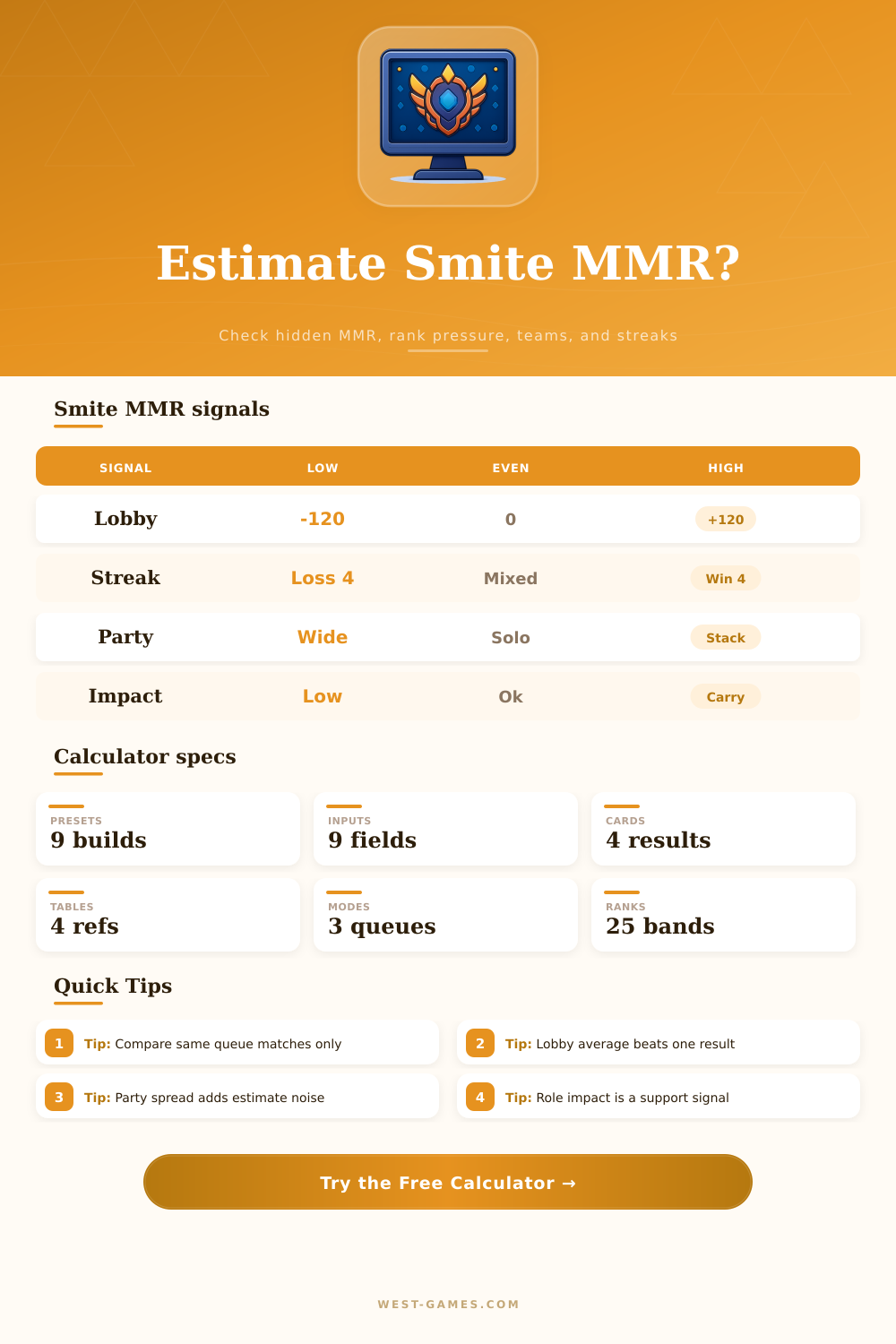
Let’s begin with the lobby averages. This one matter the most: the combined rating of the enemy team versus your own. This is the combined rating of your team. If you’re facing a higher-averaged MMR squad, great; expect to jump up pretty high. Facing a weaker squad? Penalty stings harder.
Most players mess this up. They over-analyze their personal KDA or objective-based numbers. But matchmaking algorithm only really cares if you beat a better team than you (on your side) or not. And it also cares how big that win/loss margin is. A blow-out win says “these guys are dominant,” while a close win says the teams were nearly identical and it could of gone either way.
There is more: Streaks. If you’re on a winning streak, it’s assumed that you’ve been underrated and the system ramps up how quickly you’ll rise in the ranks. It rewards consistency. If you’re on a skid, then the system recognizes it as defensive, and it will slow your fall but not let you snowball yourself out. You need some momentum to rank up, so sometimes it can feel like a boulder being pushed uphill. This tool factors that in, and adjusts your expected gain/loss accordingly if you’re riding a hot hand or sinking in the mud.
Party size is noise in the equation. Your performance is isolated and solo queue gives you the cleanest signal. Grouping up, particularly with a wide range of MMR… Forces the system to make a best guess as to where you individually fall on the skill scale compared to those around you. That five-stack can feel like an unstoppable force, but if one person’s dragging down the average, it’ll still stick you up against teams matching the weakest link. It feels unfair until you understand its balancing averages, not individuals.
God choice and role are softer signals. If you’re playing a high-impact comfort pick, then your game will reflect actual skill instead of being situationally lucky. Playing jungle shows early map control and is a strong sign of higher MMR potential. But what if you play an off-role god and aren’t doing well? The system may discount that loss somewhat as it sees the mismatch. That tweaks the confidence interval around its estimate, but doesn’t drive the entire calculation.
This can lead people to freak out about their rank when they see it drop after season resets, even though their MMR remains fairly consistent under the hood during that period. They’ll appear as one thing (like Silver) but play at another (Gold). This disparity puts pressure on them. Their higher hidden MMR means harder lobbies and they will rank up faster. Lower hidden MMR means they’ll land in easier matches to ease themselves into the adjustment. This balances the player pool without taking away anyone’s progress.
You’ll notice trends over time if you use it regularly. You are in a calibration phase if your visible rank bounces around while the estimated hidden MMR stays steady when you run it after every win/loss in the same mode. Your visible rank will bounce, but the estimated hidden MMR will remain consistent. Eventually, the gap will close. At that point, your matches will become more fair because they’re matching your actual skill level different than your current, temporary division status. You can trust the process because the system’s collecting data to lock in your true tier.
At the end of the day, though, MMR is a number looking for a place to settle down. It’s a reflection of your consistency, of your ability to beat up on more powerful competition and of your capacity to adjust when the chips are stacked against you and the streak has cooled off. The headline? Your rank is what we all see. The article? It is the unseen rating. And while you may tune out the noise of one-off poor performances and check the deeper stats, it’s whether your overall performance is trending upward that matters, that’s where the real progress lies.