Energy Regen Time Calculator
Estimate when stamina, energy, resin, action points, or idle-game fuel will refill. Add regen bonuses, overflow caps, next activity cost, and your check-in window to build a practical schedule plan.
Model note: Most games regenerate one energy at a fixed interval until max energy. This calculator can also model bonus regen, overflow storage, and activity spending so you can plan the next useful login instead of only seeing a full-timer.
Calculation breakdown
Current energy meter
| Window | Energy before spend | Suggested action | Energy after spend | Cap risk |
|---|
The schedule assumes steady natural regeneration and applies your selected spend behavior at each check-in window.
No bonus
Full time if VIP, pass, guild, rested, and event boosts are removed.
With bonus
Your current settings after the bonus regen multiplier is applied.
After one run
Full time if you spend the next activity cost right now.
Overflow target
Time to the overflow cap when your game keeps regen above max energy.
| Preset | Typical max | Interval | Common bonus | Use case |
|---|---|---|---|---|
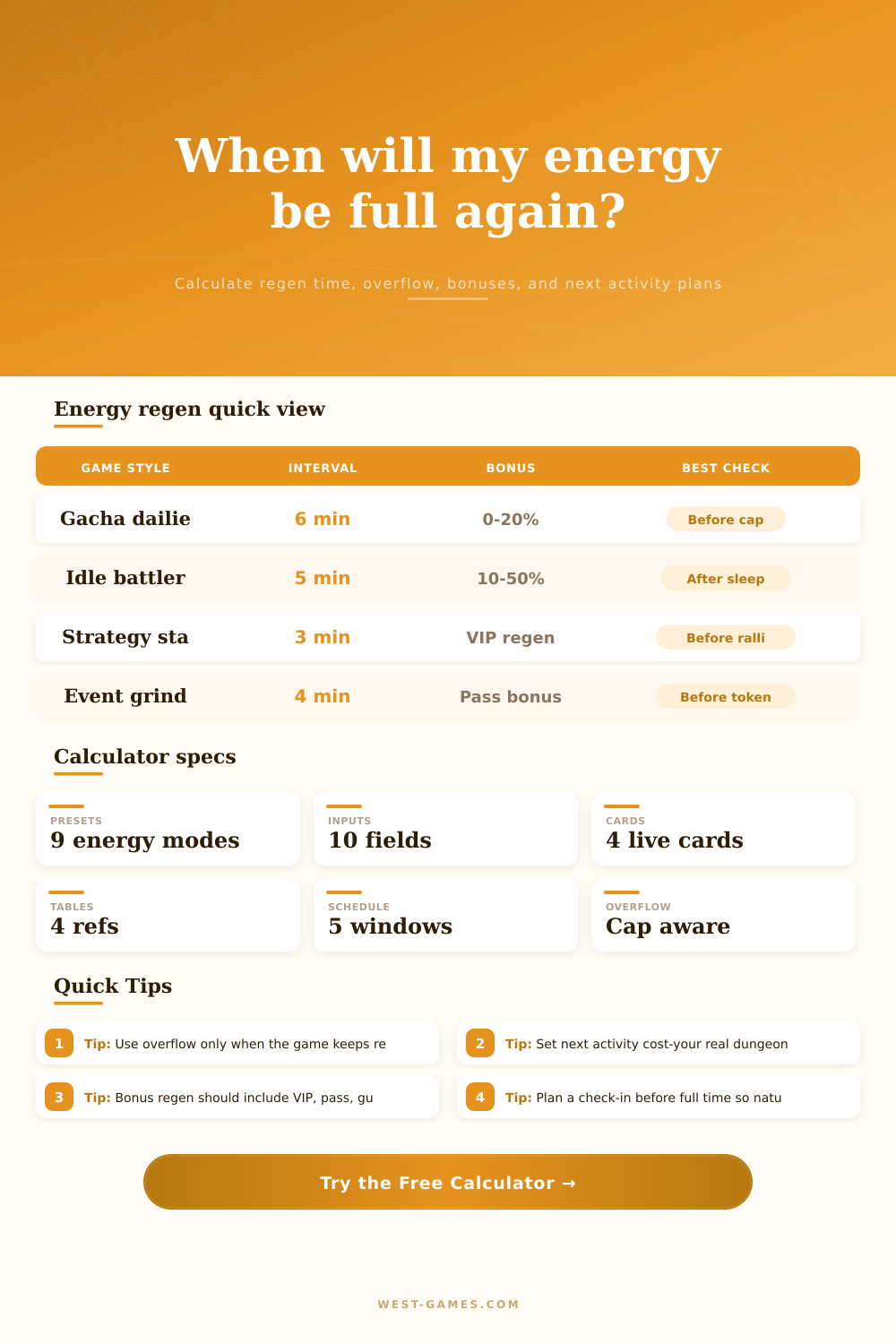
| Gacha stamina | 120-240 | 5-8 min | Monthly pass | Daily domains, stages, sweeps |
| Idle battler | 80-160 | 4-6 min | VIP or guild | Campaign pushes and auto-battle fuel |
| Strategy AP | 100-300 | 2-5 min | Research or commander | Rallies, scouting, monster hunts |
| Mobile MMO vigor | 200-400 | 3-10 min | Rested or premium | Gathering, crafting, dungeons |
| Arena tickets | 5-10 | 30-120 min | Pass refresh | PvP entries and ranked attempts |
| City builder stamina | 50-150 | 3-6 min | Alliance tech | NPC attacks and resource raids |
| Puzzle lives | 5-9 | 15-30 min | Team gift | Retry planning without coin spend |
| Event grind | 100-200 | 4-8 min | Event pass | Token stages and limited shops |
| Overnight idle | 180-360 | 5-10 min | Offline perk | Sleep planning and morning dumps |
Preset values are practical starting points. Replace them with the exact energy interval and cap shown in your game.
| Minutes per energy | Energy per hour | Time for 40 energy | Time for 120 energy | Planning read |
|---|---|---|---|---|
| 2 min | 30.0 | 1h 20m | 4h 00m | Fast strategy or event fuel |
| 3 min | 20.0 | 2h 00m | 6h 00m | Good for day-long check-ins |
| 5 min | 12.0 | 3h 20m | 10h 00m | Common idle and gacha pacing |
| 6 min | 10.0 | 4h 00m | 12h 00m | Twice-daily login rhythm |
| 8 min | 7.5 | 5h 20m | 16h 00m | Easy to cap overnight |
| 15 min | 4.0 | 10h 00m | 30h 00m | Ticket or life systems |
Bonus regen effectively shortens the interval. A 20% bonus turns a 6 minute interval into 5 minutes per energy.
| Activity type | Common cost | When to run it | Calculator setting | Watch for |
|---|---|---|---|---|
| Daily stage | 10-20 | Whenever near cap | Low cost, many planned runs | Small spends may not delay full time enough |
| Boss or raid | 30-60 | Before a long idle window | Use exact entry cost | Party schedules and reset windows |
| Resource sweep | 20-40 | When skipping manual play | Run as many as possible | Daily sweep limits may end first |
| Event token stage | 15-50 | Before shop deadline | Use planned runs target | Boost windows can change efficiency |
| PvP ticket entry | 1 ticket | Before ticket cap | Set max to ticket cap | Long intervals need a different start time |
For ticket systems, treat one ticket as one energy and set the interval to the ticket refresh time.
| Offline window | Energy gained at 6 min | Energy gained at 5 min | Best use | Schedule note |
|---|---|---|---|---|
| 1 hour | 10 | 12 | Short break | Usually not worth spending premium items |
| 4 hours | 40 | 48 | Work or class block | Spend one medium-cost activity first |
| 8 hours | 80 | 96 | Sleep window | Push below cap before logging off |
| 12 hours | 120 | 144 | Twice-daily login | High max energy helps prevent waste |
| 24 hours | 240 | 288 | Low-maintenance account | Overflow or mail storage matters here |
Compare these gains to your missing energy. Any gain beyond the active cap is wasted unless your game has overflow storage.
This energy regen time calculator helps mobile, gacha, idle, strategy, MMO, and ticket-based games answer the same practical question: when should you come back before natural regeneration stops?
Enter current energy, max energy, regen interval, bonus regen, overflow cap, next activity cost, planned runs, check-in window, spend behavior, and start time. The calculator returns full time, effective interval, next activity readiness, cap risk, and a schedule plan you can use before sleeping, working, or starting an event grind.
When you’re sitting in a meeting and your stamina is already full, you start to panic. Like you don’t have a towel nearby, you see water spilling out. Energy systems makes artificial scarcity. They gets you spending money or logging in at inconvenient moments.
The calculator do the math for you, letting you plan instead of guessing. It converts vague anxiety into a concrete schedule. Know when you need to login again.
How to Plan Your Game Energy
What most people overlook is that they’re generating all this wasted energy. They have a max amount of energy, sure. If you log on once a day, you regenerate one point every six minutes. This means you leave behind hundreds of points that goes nowhere while you sleep. That’s where the bonus regen input comes into play. Monthly passes and VIP levels reduces the interval between ticks. It might not seem like much (a 20% increase sounds minor), but it’s about two more runs per night of sleep. Why not use it to top off your cap before waking up? You’re paying for the pass already.
The tool also handles the messy reality of overflow caps. Some games allows you to have excess energy over the cap. Others will only go up to the cap. With no overflow, you know how long to run right before bed. Run until your cap has exactly one tick of regen left when you wake up. Spend any less and it’s wasted run potential. Spend any more and now you wait a full tick.
Averages are in the reference table, but your specific numbers is far more important. People forget about the other layer of activity costs. What happens when your dungeon cost 30 energy and you only have 10? You’re planning with a full cap but won’t be able to run until then. How do you chain runs effectively? When does it make sense for you to act?
The answer isn’t when you’ll be full. It’s when the next activity cost is set. That closes the gap between having resources and acting on them. It’s what sets optimized players apart from casual player. Optimized players view their schedule as a shift change.
The calculator can’t capture the psychological side of it, though. Events makes it very easy to be tempted to spend money on premium currency to top up immediately. In most cases, though, especially with daily stuff, spending money doesn’t make sense unless you’re chasing after something like a time limited reward or a place on the leaderboard. For the former, just wait out the timer. As for the latter, the calculator is there to help you fight the urge to spend money. It shows you that 40 minutes of waiting will get you exactly the same thing as spending five bucks.
Your gaming account need sleep hygiene too. Check in naturaly during natural lulls in your day. Your logins becomes easy rather than frantic. You have a routine in the mornings and evenings that makes you efficient. This means you’re dealing with a resource that acts as if it were savings in your bank account. Except instead of interest, you’re measuring energy. You are not measuring energy now, but energy at the moment you glance back on the screen.
The loop gets more complicated during event seasons. More often, there are stages with limited time that need to be cleared. This is where your run input come in handy. See what days you hit the wall again and then run a simulation of a day of spending big and see if you have enough left over for the rest of the week. Run hard on days off and coast lightly on the weekdays.
If you’re always full, it’s just wasting full energy. Instead, you want to be full only when you absolutely must be. That balance turns an annoying mechanic into a manageable system. Regen times aren’t something you master by becoming a better gamer; they’re something you master by learning how to manage your time.
There is always a clock ticking and you are negotiating with it. Understanding the caps, the bonuses, and the intervals let you seize control of the beat rather than let the beat steal your mood. Instead of fearing and compulsively checking the app every half hour, you learn to check it only when the math tells you it matters. That’s an entirely different way of experiencing it.
Instead of chasing refills, you should of take control of your schedule to make sure you don’t waste any stamina while getting on with your life.