⚔ Dota 2 MMR Calculator
Estimate ranked MMR change, medal progress, role queue pressure, solo or party weighting, opponent average impact, streak volatility, calibration confidence, and double-down risk.
| Medal group | Model range | Star step | Progress note |
|---|---|---|---|
| Herald | 0 to 616 | 154 | Early climb |
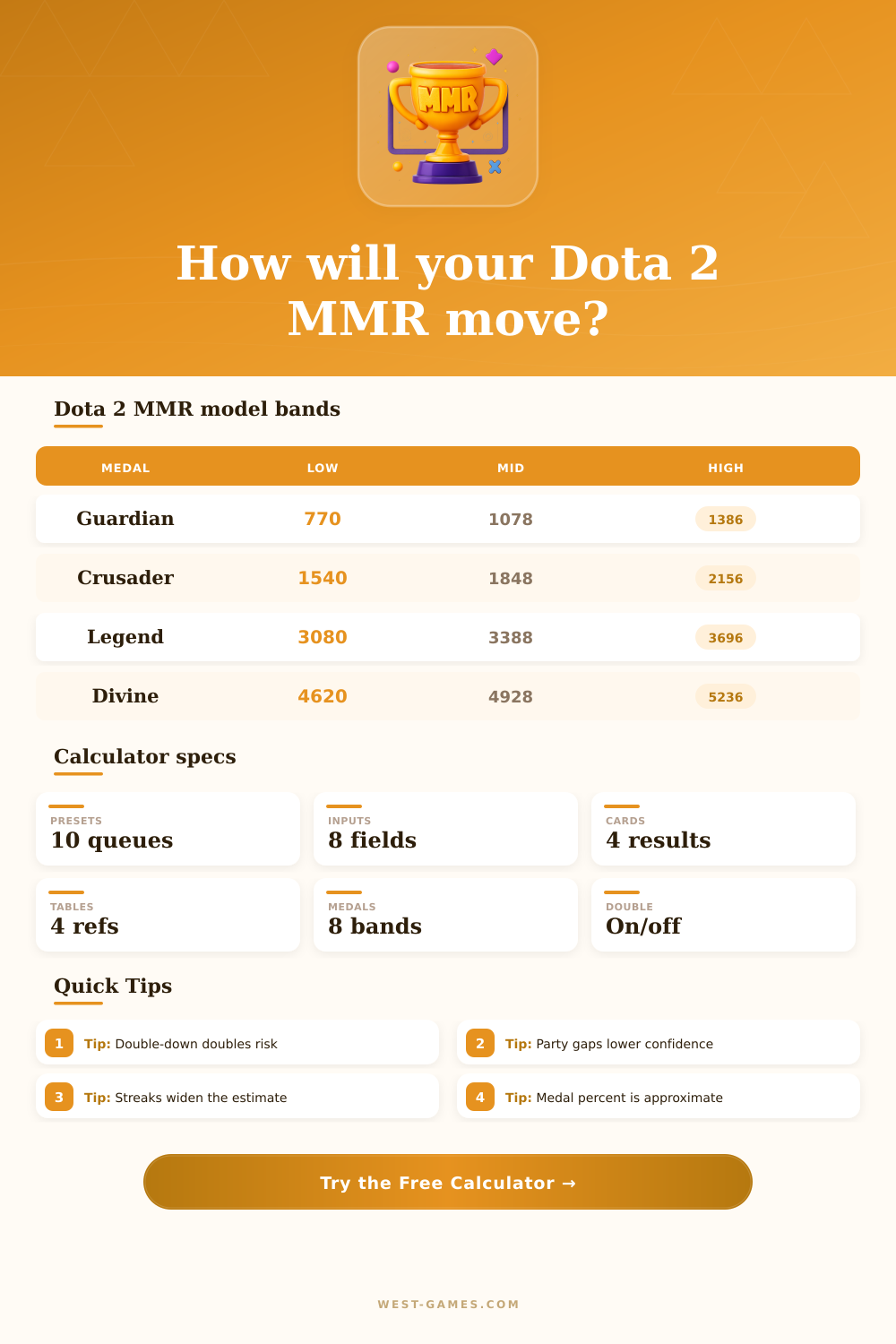
| Guardian | 770 to 1386 | 154 | Basic medal |
| Crusader | 1540 to 2156 | 154 | Core habits |
| Archon | 2310 to 2926 | 154 | Stable middle |
| Legend | 3080 to 3696 | 154 | Macro tested |
| Ancient | 3850 to 4466 | 154 | Draft matters |
| Divine | 4620 to 5420 | 160 | High pressure |
| Immortal | 5620+ | Ranked | Leaderboard |
These are approximate planning anchors; Dota 2 medals, confidence, and regional behavior can vary.
| Opponent gap | You are | Win value | Loss risk |
|---|---|---|---|
| -500 | Heavy favorite | Low | High |
| -200 | Favorite | Softer | Firm |
| 0 | Even | Normal | Normal |
| +200 | Underdog | Strong | Softer |
| +500 | Heavy underdog | Very strong | Low |
Opponent gap means opponent average MMR minus your current MMR before the match.
| Input | Signal | Confidence | Use case |
|---|---|---|---|
| Solo | 100% | High | Strict solo |
| Duo | 96% | Good | Close pair |
| Trio | 92% | Medium | Small stack |
| Five even | 88% | Medium | Stack games |
| Five wide | 78% | Low | Mixed ranks |
Role queue changes reliability by a little; party spread changes reliability by more.
| Setting | Multiplier | Range | Meaning |
|---|---|---|---|
| Settled | 0.95x | Tight | Many games |
| Normal | 1.00x | Normal | Active queue |
| Recalibration | 1.35x | Wide | Uncertain rank |
| Returning | 1.18x | Wide | Long break |
| Double-down | 2.00x | Risky | Token used |
The model applies confidence first, then doubles the final change when double-down is on.
Today’s multiplayer games hide behind complicated algorithms for their matchmaking systems. It make them seem mysterious. In Dota 2, however, it works the same way. You go into a match, you win or lose and; boom! You either get a new medal or you do not. What did that meant? Did you improve? Or was it just luck?
The goal of system is to strike a balance between progression and fairness. But from Guardian to Immortal, the road are never linear. Instead it’s a series of tiny steps forward and backward that hinge on things outside than winning a game. The math is done by the calculator, but the process is driven by this.
How Dota 2 Ranking Works
The model bases itself on your existing number of star and medals. If you’re currently an Archon 3, then that’s where the model thinks your skill sits. It will make a guess about what your MMR should be centered on. That becomes anchor point the system uses to make judgements. That anchor point matters as it control the amount of risk the system will take with your rating. Veteran accounts won’t get very big changes because they’ve got a place; new ones will as the system has less information about them.
The adjustment curve is also heavily influenced by queue type. If you’re playing solo, the result of a match are nearly completely reflective of your own performance. Your confidence interval is narrow; you understand how you perform. Put yourself in a random five-stack party with friends who range in MMR and that sense of clarity dissapears. Since the lobby was already imbalanced before it started, the system can’t pin the wins or losses on your own skill so it slows down your progress to make up for that uncertainty. That’s why it sometimes seems like climbing with friends is slower then going solo.
These estimates are also largely dependent off opponent strength. You don’t get much if you beat someone much lower-ranked because the system thought you were going to win. However, you’ll be rewarded more for beating someone who’s stronger since it was against the odds. The stomp factor help account for those games in which the outcome didn’t match the skill difference, and pushes the estimate closer towards reality. That comes into play when attempting to explain why your rating didn’t go up much after a comfortablewin.
There’s also the factor of streaks and confidence settings. It wants to push your rating up after several consecutive victories to see if you deserve to be ranked higher. On the other hand, it has a buffer from losses that prevents it from dropping too quickly. This is why losses sting so much, the system is attempting to compensate for overestimating your skill in the past. With a double down, you double your last bet to go all or nothing on a single match (for the risk-takers).
The results take some time to read through, and it’s important to remember that any given game isn’t necessarily indicative of your complete picture. In other words, a single match has far too small of a sample size. You want to look at the trend across a dozen matches to get a good sense of your true MMR landing spot. From there, look at the reference table which outlines the point range associated with each medal band. This will help you better understand your progression.
Don’t focus on gaining/losing stars here and there. It’s about gradual improvement, not trying to chase a particular result which may or may not be an exception. Your MMR is a number that’s attempting to measure how good you are at this exact moment. However, it lags behind your actualy improvement because it needs data to prove you are more skilled now than you were.
Play regularly and don’t let your downswings get you down. Trust the long-term trend instead of the short-term noise. Soon enough, your ranking will catch up with your skill, even if it does not seem consistent on the way there.