📈 Idle Game Growth Rate Calculator
Model active idle progression with compounding income, upgrade cost scaling, prestige resets, doubling time, production slope, and next milestone ETA.
Production increase from purchased upgrades during the selected run window.
Active compoundingUpgrade cost scaling compared with income gain per upgrade.
Upgrade balanceAverage production-per-second increase gained per active hour.
Pacing signalHow strongly the prestige bonus helps the next active run recover.
Prestige fit| Checkpoint | Income per second | Currency bank | Upgrades bought | Growth vs start |
|---|
Timeline values model active production and reinvestment inside the selected run window. Offline accrual is intentionally excluded.
| Upgrade | Cost | Income after buy | Payback time |
|---|
Payback time compares upgrade cost against the production added by that upgrade.
| Reset state | Production | Milestone ETA | Use case |
|---|
Prestige preview applies permanent bonus to the starting income of the next run.
| Doubling time | Feel | Design read | Typical fix |
|---|---|---|---|
| Under 10 min | Explosive | Great for tutorial bursts, risky for economy balance | Raise costs or add soft caps |
| 10-45 min | Fast | Strong early idle loop with frequent decisions | Add milestone variety |
| 45-180 min | Steady | Works for midgame automation and prestige buildup | Use clear unlock previews |
| 3+ hours | Slow | Can feel stalled without events or burst bonuses | Add boosts, cheaper tiers, or prestige |
A good idle curve often moves through multiple bands as the player unlocks new systems.
| Preset | Income gain | Cost scale | Prestige role |
|---|---|---|---|
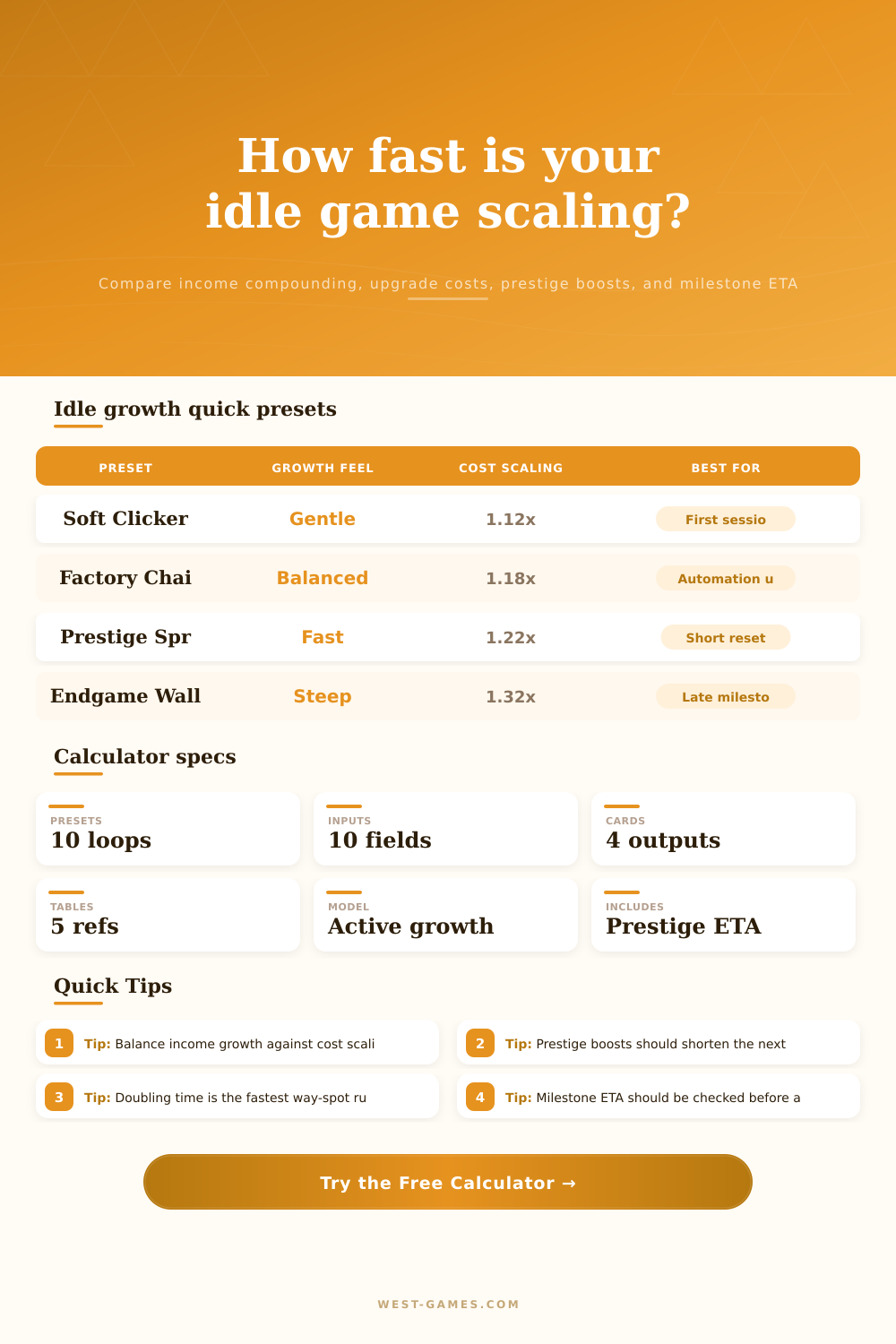
| Soft Clicker | 10% | 1.12x | Optional boost |
| Factory Chain | 18% | 1.18x | Automation recovery |
| Prestige Sprint | 28% | 1.22x | Main loop driver |
| Incremental RPG | 24% | 1.24x | Build reset reward |
| Endgame Wall | 20% | 1.32x | Wall breaker |
Use these as economy shapes, then adjust around your own upgrade tiers and milestone rewards.
It’s that point in an idle game where you’re no longer making headway with numbers; it’s now a dismal reflection of your failure at arithmetic. Your income went up a smidgen because you upgraded something, but it cost three times as much to get the next thing. Impatience replace satisfaction. And this isn’t just boredom. The curve of growth has become broken.
To understand what makes the game feel stalled out, step back from icons for a moment and look to see how cost relate to production. The thing that most people forget about is what happens to those costs as they scale. It’s half of the equation. Half the battle are how quickly costs escalate.
How Idle Game Costs and Rewards Work
If your upgrades gets twenty percent more expensive with every purchase but only increase production by ten percent, you’re fighting against increasing resistance. You’re fighting against increasing resistance. The rate at which you earn money grow further and further behind the rate at which you spend money… Eventually grinding to a halt. How that balance plays out is what turns a session into a slog or a sprint.
After plugging in the cost multipliers and income rate, this calculator crunches the complicated compound math for you (above). It models which upgrade you’ll be able to afford over what timeframe, taking the guesswork out of it. There’s no need to fiddle with numbers and figure out the exponential decay on each upgrade. It let you test whether your proposed strategy withstands real-world pressure.
If you think about it, that’s a prestige sprint versus a steady automation chain. You’re after a predictable return with a slow builder. One point twelve doesn’t sound like much, but it work well when your costs increase slowly enough to keep player engaged without causing panic. With a fast-paced game built around lots of reset, costs might jump by 30% or more at each tier. That’s a steep curve and it’s by design.
Before the player reaches a hard wall, i.e., they can no longer afford upgrades for several weeks, the game will make them reset. The preset progression loop on page shows the effect of changing scaling factors and lays out these presets. Beyond just income tracking there’s also a layer of prestige mechanics that are equally complicated.
Prestige mechanics gives you a permanent bonus currency/multiplier and take away what you have currently. It only matters if the reset gets you to the same milestone(s) in less time than they would of taken without resetting. Anytime I feel punished by a prestige, it means that the time saved wasn’t meaningful enough to make up for what was lost. Ideally, every loop should be shorter and more effective then the previous loop.
One of the more helpful metrics for measuring this efficiency is doubling time: How long does it take for your production rate to double? If your doubling time is less than 10 minutes, then the game can seems like it’s broken and chaotic; the numbers inflate far too fast to keep up with them. If your doubling time is three hours, then players probably won’t stick around long enough to notice anything different on their screen. Usually, the sweet spot lands somewhere in-between; the progress constantly feel like it’s increasing without being overwhelming.
These are all things that game designers change without knowing how far-reaching those changes will be. A single percentage-point increase on an upgrade gain may not feel like much at first glance. But when you repeat it hundreds of times over hundreds of purchase, that little bit can make a world of difference, it is the difference between a satisfying endgame experience and a frustrating dead end. You could try out what happens before it’s too late.
The art of striking an idle game’s balance lies in expectation management. On one hand, we want those numbers ticking upwards, yet on the other we wish for them to mean something. Uniformly scaling everything kills off the feeling of accomplishment. Build a curve that models how the interplay of cost inflation, income gain and prestige rewards will keep player happy without burning them out. The sense of momentum from the beginning returns: every click matters as opposed to staring at a progress bar slowly crawl ever forward while your costs spiral beyond it.