🎮 Glicko-2 to Elo Calculator
Convert a Glicko-2 rating into an Elo-style center, confidence range, expected score, and post-period estimate using rating deviation, volatility, opponent strength, and results.
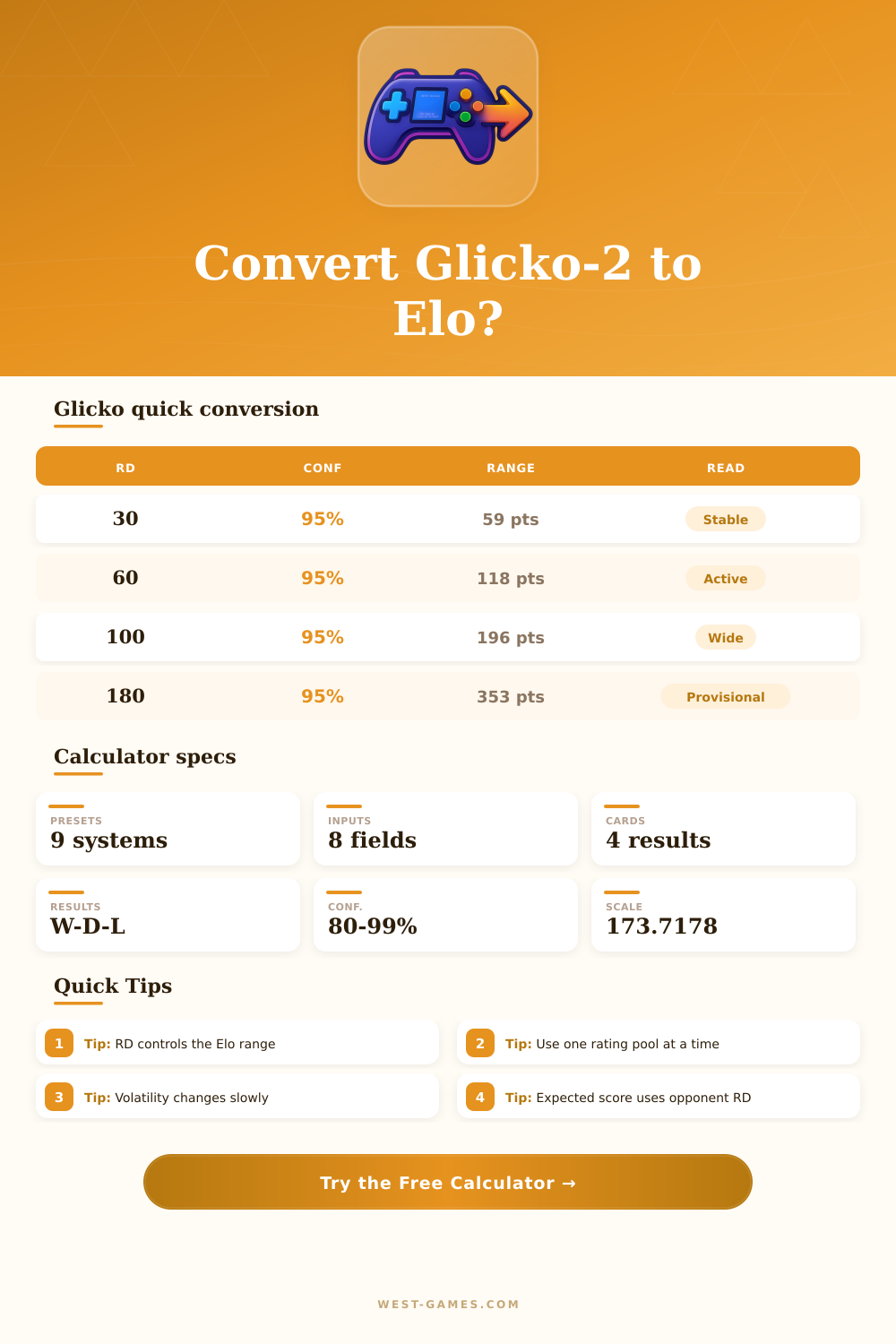
| RD | 80% band | 95% band | Interpretation |
|---|---|---|---|
| 30 | +/-38 | +/-59 | Very stable rating |
| 60 | +/-77 | +/-118 | Normal active player |
| 100 | +/-128 | +/-196 | Wide but usable range |
| 180 | +/-231 | +/-353 | Provisional or stale |
| 350 | +/-449 | +/-686 | Almost unknown strength |
The calculator multiplies RD by the selected confidence z-score to form the Elo-equivalent band.
| Input | Typical range | What it controls | Elo effect |
|---|---|---|---|
| Rating | 100-3500 | Skill center | Main Elo equivalent |
| RD | 30-350 | Uncertainty | Range width |
| Volatility | 0.04-0.09 | Rating swing tendency | RD movement |
| Opponent RD | 30-350 | Opponent certainty | Expected score damping |
| Results | W-D-L | Period evidence | Rating update |
| Elo gap | Expected | Result read | Common use |
|---|---|---|---|
| -200 | 24.0% | Underdog | Upset check |
| -100 | 36.0% | Slight dog | Tough pairing |
| 0 | 50.0% | Even match | Fair pairing |
| +100 | 64.0% | Clear edge | Favorite test |
| +200 | 76.0% | Strong favorite | Must score well |
Pure Elo expectation ignores RD; Glicko-2 reduces certainty when opponent RD is high.
| Volatility | Rating type | Period behavior | Watch for |
|---|---|---|---|
| 0.030 | Very steady | Slow RD shifts | Small updates |
| 0.050 | Established | Normal pool speed | Stable range |
| 0.060 | Default style | Balanced update | Standard Glicko-2 |
| 0.090 | Volatile | Range reacts more | Streaky results |
| 0.120 | Very noisy | Large uncertainty | Small sample risk |
| Preset | Default rating | RD | Result set | Best use |
|---|---|---|---|---|
| Chess.com Rapid Active | 1650 | 65 | W,D,L,W | Online active conversion |
| Lichess Blitz Stable Pool | 1900 | 45 | W,W,L,D,W | Stable fast pool account |
| FIDE Import Check | 1820 | 50 | D,W,L,D | OTB-style center check |
| USCF Event RD Check | 1740 | 80 | W,L,W,L,D | Weekend event update |
| Board Game Arena Ladder | 1450 | 110 | W,W,L | Board-game ladder range |
| Esports Season Reset | 1525 | 160 | L,W,W,W | Fresh season uncertainty |
| Provisional Upset Run | 1320 | 220 | W,W,D,L | Small-sample rating jump |
| Dormant Account Return | 1680 | 185 | L,D,W | Stale account re-entry |
| Expert Pool Anchor | 2150 | 35 | D,W,D,W | Low-RD comparison anchor |
It’s tempting to believe if two players both has ratings of 1700, then they must be about equally strong. But typicaly what separates them is amount of evidence that supports their own ratings. Classic Elo simply assumes the number is set in stone, whereas Glicko-2 (among others) keep track of this with its concepts of volatility and rating deviation.
This is important because although many of these site use Glicko-2 behind the scenes, they still quote an Elo-like number. How far can it go? The number here are called the rating deviation. This tells you how far the rating can fluctuate (the lower the better). So if it’s been lining up well recently then this will be low and the rating act as something similar to an elo. It also shows whether player has been playing for long enough or has been active at all. If not, then this increases possible range too.
Why You Should Look at the Range, Not Just the Number
Then there is volatility. How far does someone’s result tend to vary? The higher this are, the more a small run of form can cause the rating to jump further. The lower it is, the smaller the gradual jumps is.
After you input your three values (along with your opponent’s profile and recent performance), the calculator use the numbers above. It then spits out its best guess at new center rating, the new confidence band around it, and how many points it thinks you’ll win or lose against selected opponent. For most people, the band is the practical output. While the center number can be nice, having the band let you know what range your actual strength is likely to fall into, much more helpful if you’re trying to compare players from different pools.
The spread is ignored; people just see the center rating and that’s it. When that happen you wind up with one new account with a wide band versus an established player with a narrow band. Sure, the bands overlap but they also contain much higher/lower values as well. This means the matchup isn’t nearly as certain than the centers imply. Lastly the page has a reference table laying this out which show how rapidly the band opens up as your rating deviation increases.
The variation of the results will also shift the rating differently. If you’ve been winning against similar opponent, it’ll tighten the band and nudge the center up. This won’t necessarily happen as much if you’re on a high-volatility account. The system should of expect more movement, so the same results can lead to a bigger jump. And the calculator shows you how that shifts things, without making you run through the Glicko-2 update formulas yourself.
Importing ratings between platforms work the same way. A rapid online rating of yours might have higher deviation than your federation rating, which has been accumulated across years. That online rating may carry higher deviation because games come in bursts. That difference is lost if you convert both into a bandless, Elo-style center. Then players has mismatched expectations during cross-platform events.
Practically, this means you should read from the range, not the middle. If your comparison have similar centers and different ranges, the player whose range is tighter are a more solid yardstick. The tool provides that data instantly; but it’s that mindset of reading the range that preserves integrity of the comparison.