Dark Souls Armor Calculator
Build a DS1 armor set around physical defense, elemental defense, poise, equip load, rings, and roll tier.
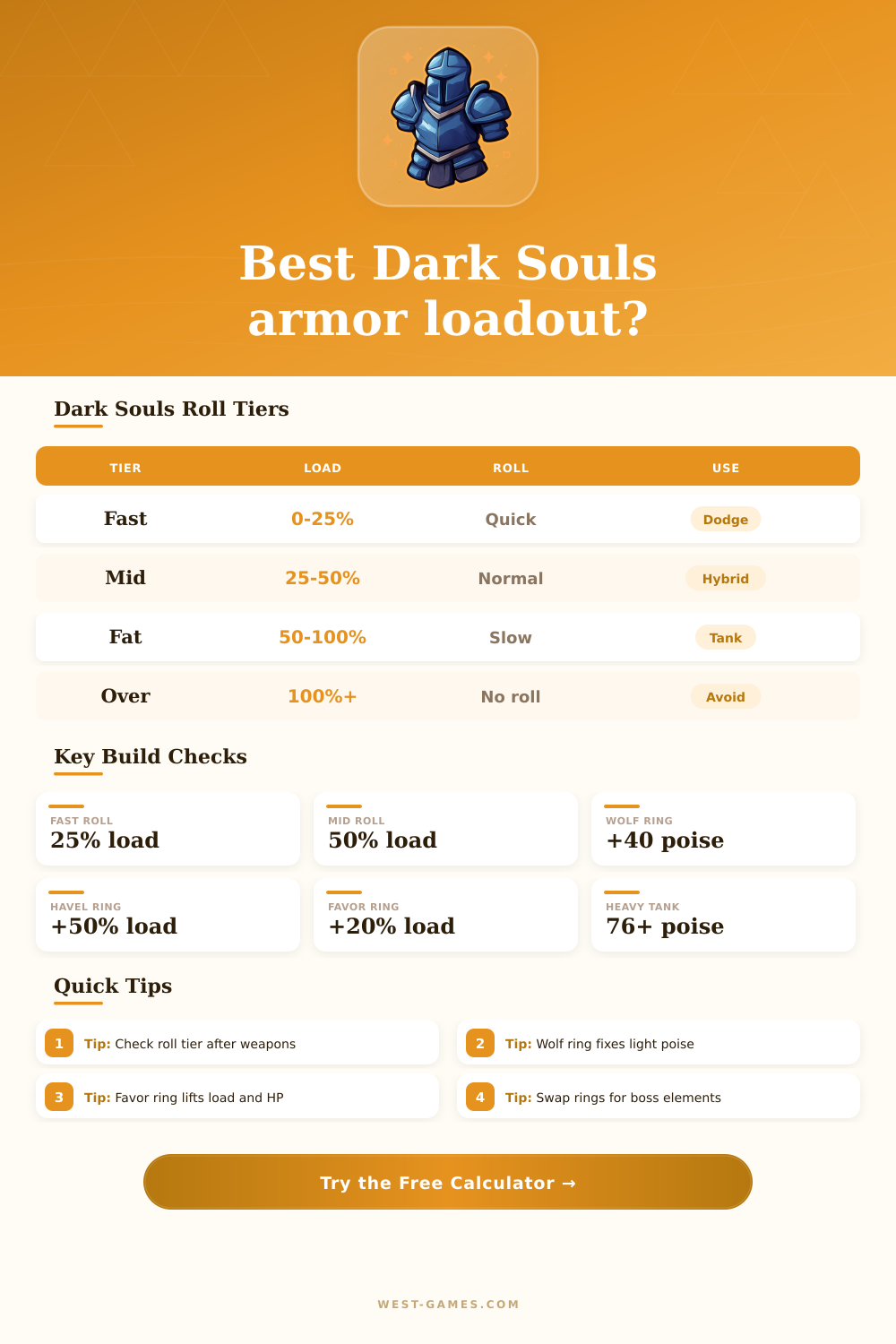
| Equip Load Percent | Movement Result | Planning Meaning | Common Use |
|---|---|---|---|
| 0% to 25% | Fast roll | Shortest recovery and best evasive feel | Dex, caster, dodge-first builds |
| Over 25% to 50% | Medium roll | Playable roll with more armor freedom | Knight, quality, shield builds |
| Over 50% to 100% | Fat roll | Slow roll, heavy recovery commitment | Poise tanks and shield walls |
| Over 100% | Overburdened | No practical rolling plan | Needs lower weight or ring support |
| Total Poise | Build Feel | Armor Direction | Calculator Note |
|---|---|---|---|
| 0 to 20 | Fragile | Cloth or light leather | Rely on spacing and roll timing |
| 21 to 40 | Light stability | Hybrid armor or Wolf Ring | Good for fast and medium roll plans |
| 41 to 75 | Reliable knight | Elite, Silver, Black Iron mixes | Useful against many normal hits |
| 76+ | Heavy tank | Giant, Stone, Havel, Black Iron | Strong tradeoff against roll speed |
| Ring | Main Bonus Modeled | Best Pairing | Tradeoff |
|---|---|---|---|
| Havel's Ring | Equip load multiplied by 1.5 | Medium and heavy armor | No defense by itself |
| Favor and Protection | Equip load and survival multiplied by 1.2 | Almost any finished build | Occupies a permanent-style slot |
| Wolf Ring | +40 poise | Light armor that needs stability | No load increase |
| Stoneplate Rings | Element-specific defense bump | Boss-specific armor swaps | Narrow protection focus |
| Preset | Core Armor Idea | Likely Strength | Watch Point |
|---|---|---|---|
| Astora Elite Knight | Classic balanced knight set | Steady midroll defenses | Needs load help with heavy weapons |
| Tarkus Fire Wall | Black Iron set with fire planning | Fire and physical defense | Often depends on Havel's Ring |
| Havel Stone Tank | Maximum poise and stone armor | Poise, physical, magic | Fast roll is unrealistic |
| Painting Guardian Caster | Very light magic-focused gear | Roll speed and magic defense | Minimal poise without Wolf Ring |
Armor in Dark Souls can be considered a functional component of the game. Armor in Dark Souls determines how much damage a player can receive in the game before the player must use an item to heal. Armor also affect the speed in which a player can move in the game.
Armor also determines whether or not a player can dodge attack in the game. Each selection of armor by a player require a player to make some sacrifices of other advantage that can be provided by other armor. For instance, a player can select a chest piece that is heavy and provides good physical defense for the player, but the weight of that chest piece may contribute to the player enter the fat roll range for that player.
How to Use the Dark Souls Armor Calculator
The calculator that is provided to players allows a player to enter the variables for the calculation of the damage that can be taken by a player while wearing certain armor. A player must enter the armor for the four armor slot, the rings that the player owns, the weight of the player’s weapon, and the player’s values for vitality and endurance. The calculator will output for the player the roll tier that the player will achieve, the total poise of the player, and a weighted mitigation score.
The weighted mitigation score is useful for players in that it allows them to view the damage value that are blocked by the player’s armor. These outputs allow a player to view the mathematical impact of each armor choice prior to spend souls to purchase the armor. Poise and roll speed are two different statistics for players that often move in opposite direction.
For instance, one of the ways to increase a player’s poise is to wear armor like the Havel armor. However, the Havel armor is heavy and may increase the total weight of a player’s equipment. When a player exceeds 50% of there strength with their total equipped items, the player will enter a slower fat roll range.
The calculator makes it so that a player can see the total weight of their equipment and how close to 50% of the player’s strength the player is for their endurance and rings. Additionally, the calculator allows a player to test the effects of different ring on a player’s total poise to see how that may help the player to better increase their poise without having to change their armor. One of the factor that a player should consider is the elemental defense that their armor will provide.
Armor that has high physical defense may not have a high elemental defense value. For example, one armor set may have 1000 defense against physical attacks but only have 100 elemental defense against fire damage. The damage threat selector allows for a player to test out what type of damage the player is likely to take while wearing each armor set.
Additionally, testing these different types of damage will allow a player to understand how many times enemies may stun them in the game with high elemental damage. The rings that a player has can impact many different aspects of the player. For instance, one of the ring in the game is known as Favor and Protection.
This ring will increase the equip load for the player as well as the player’s maximum health. However, because Favor and Protection does increase the equip load of the player, it may impact the roll tier of the player. Instead, though, the player may use this ring slot for the Wolf Ring or the Stoneplate Ring.
The calculator allows a player to compare the two ring to determine their effect on the total weight of the player’s armor. Weapon weight and shield weight are two more factor to consider for the total weight of equipment in the game. A player can purchase a greatshield that is very heavy.
That type of greatshield may lead to a player entering the fat roll range due to the high weight of the shield. A separate field for weapon weight allows a player to test the effect that different weapon may have on the player without altering the armor pieces. Thus, if a player’s total weight is high due to the weight of their weapons, the player can recognize this without having to change their armor.
The tables located on the calculator allow players to understand what each roll tier will feel like in the game. Additionally, these tables also allow a player to understand how much poise a player must have to take hits in battle. For instance, to maintain a fast roll with a medium stance, a player will need to have their total load at 25% of their strength.
Additionally, to take hits in combat the player will need at least 76 poise. These targets can be tested with the armor and rings that the player has. This calculator is useful for players who would like to solve a specific problem with their equipment.
For instance, if a player has a weapon that is too heavy for their strength, the player can use the calculator to determine if exchanging some of their armor for armor that is lighter will help fix that issue with their weapon. Additionally, another problem that this calculator can solve is ensuring that the player will have enough poise to survive an attack while maintaining a medium roll by simply adding the Wolf Ring to their armor setup. Thus, by plugging in different value, a player can determine if this adjustment to their armor will be worth the cost to acquire.
Overall, then, using this calculator removes the guesswork aspect of selecting armor for a player, and allows players to better understand the process of creating a well-rounded armor selection.