DOS2 Character Planner
Plan a Divinity: Original Sin 2 build around origin, race, attributes, combat schools, civil utility, armor pressure, memory slots, party role, and Source skill timing.
| Pick | Planner use | Build fit |
|---|---|---|
| Custom Human | General leadership and flexible tags | Face, support, weapon builds |
| Custom Elf / Sebille | Corpse eating utility and Flesh Sacrifice planning | Necro, ranger, AP burst turns |
| Custom Dwarf / Beast | Compact frontline fantasy and sturdy civil scout | Shield, rogue, geo bruiser |
| Custom Lizard / Red Prince | Fire flavor and persuasion-friendly identity | Pyro, battlemage, party face |
| Fane / Undead | Undead poison healing considerations | Geo poison caster, utility mage |
Origin selection changes role notes; the numeric plan is still driven by attributes, abilities, memory, and party lane.
| Attribute | Best use | Planner weight |
|---|---|---|
| Strength | Two-handed, one-handed, heavy armor fantasy | Weapon damage focus |
| Finesse | Bows, crossbows, daggers, spears | Ranger and rogue focus |
| Intelligence | Elemental and Necromancer spell damage | Magic or blood caster focus |
| Memory | More memorized skills and source packages | Slot pressure relief |
| Wits | Initiative and crit-oriented plans | Secondary after damage stat |
| Lane | Core schools | Status plan | Armor target |
|---|---|---|---|
| Physical breaker | Warfare, Huntsman, Scoundrel | Knockdown after armor break | Physical Armor |
| Blood caster | Warfare, Necromancer, Hydro | Decay, blood surfaces, lifesteal | Physical Armor |
| Storm controller | Aerotheurge, Hydrosophist | Wet into shocked, stunned, frozen | Magic Armor |
| Fire field mage | Pyrokinetic, Geomancer | Oil or poison into burning fields | Magic Armor |
| Summon commander | Summoning plus surface school | Infusions adapt to encounter | Mixed Armor |
| Load | Normal skills | Source reserve | Planner target |
|---|---|---|---|
| Lean bar | 7-8 | 0-1 source skill | Low Memory spend |
| Standard bar | 9-10 | 1 source skill | Moderate Memory spend |
| Wide toolbox | 11-12 | 1-2 source skills | High Memory spend |
| Source-heavy | 8-10 | 2 major source skills | Reserve extra slots |
| Summoner wide | 10-12 | Incarnate support package | Memory and Summoning |
| Slot | Primary stat | Combat ability target | Civil fit | Source timing |
|---|---|---|---|---|
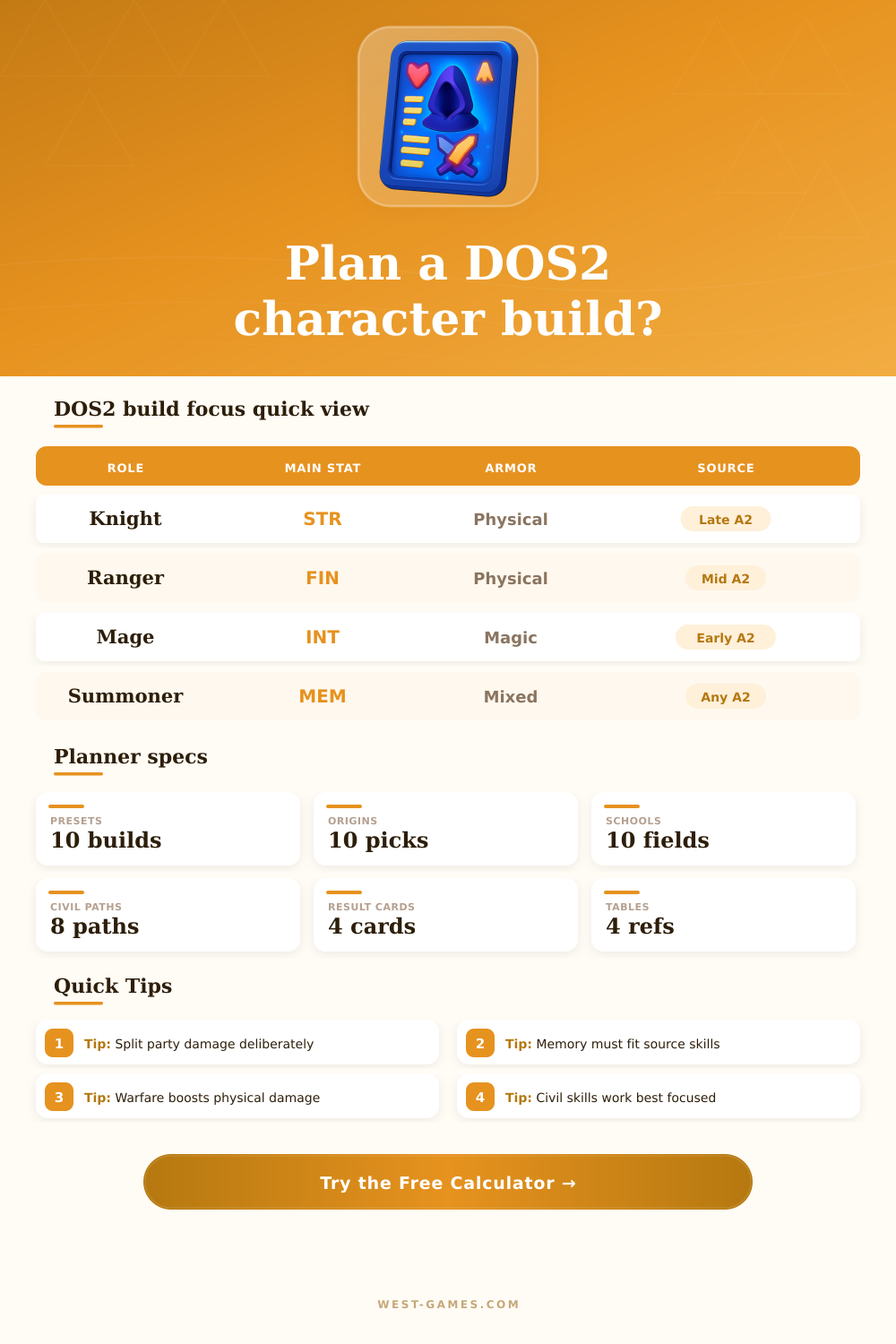
| Two-handed knight | Strength, Wits later | Warfare first, Polymorph utility | Persuasion or Loremaster | Late Act 2 burst source |
| Ranger captain | Finesse, Wits later | Warfare damage, Huntsman height | Lucky Charm or Bartering | Mid Act 2 single-source shots |
| Aero/Hydro controller | Intelligence, Memory | Aero/Hydro balance | Loremaster or Persuasion | Early Act 2 control source |
| Geo/Pyro field mage | Intelligence, Memory | Pyro/Geo with Torturer route | Bartering or Loremaster | Mid Act 2 area burst |
| Summoner support | Memory, Wits, flexible stat | Summoning to 10, then utility | Thievery or Lucky Charm | Any Act 2 source package |
| Necro blood mage | Intelligence, Memory, Wits | Warfare plus Necromancer unlocks | Persuasion or Telekinesis | Late Act 2 combo window |
Beyond the decision of the character’s origin are decisions regarding how the character is to fit into the party and when the character’s abilities are to be most effectivly. Each of these decisions is important to the success of the players during the game sessions; each decision can make the game sessions smooth or difficult to play due to the defenses of the enemy. The planner provided on this page will allow players to test each of these character and ability decisions before finalizing the decision for the game session.
The first of the concepts that players should understand regarding character building for Divinity: Original Sin 2 is the concept of armor pressure. Armor pressure include both physical armor and magic armor defenses for the enemies in the game; damage is not distributed between these two defenses as a way of receiving rewards for do so. Characters that focus upon warfare and huntsman will wear down physical armor defenses quickly, while characters that focus upon pyrokinetic and aertheurge skill will focus upon magic armor defenses.
How to Plan Your Character and Skills
Mixing character builds that wear down different types of armor without a plan will lead to longer combat sessions with the enemies, as the player will wear down the armor defenses of the enemy. The planner helps to manage armor pressure for the player by allowing the player to select the type of damage that the character will direct at enemies, as well as the armor defense that the character will have worn down. The second of the concepts that players should understand is the concept of Memory.
Each of the character’s skills requires a certain number of Memory slots to allocate to those skill; source skills require additional Memory slots beyond those required by the skills themselves. A character build may appear efficient at level eight for the character, but that same character build may not be efficient once the character gains access to source skills; they may not have enough Memory slots for the skills that is required by those source skills. The planner will allow the player to select the type of skill load for the character and the character’s source timing window.
This will allow the game to calculate for the player if the character has sufficient Memory slots to support the skills that they wish for the character to have. The third of the concepts is the impact of the origin choices on the build of the character. Each of the origins for the character provide certain tools and damage types to the character.
Some origins reduce the need for civil ability points for the character, while other origins may require players to focus upon certain types of damage for their character. The planner includes comments regarding these different origins for the players to determine which origin will best support the build that they are creating for their character. For instance, the origin of an undead character with a focus upon poison will interact with healing surfaces differently than a living character.
These differences in interactions are not often visible during combat, but the planner allows for players to see these features of the origins prior to spend their ability points. The fourth of the concepts that players should understand is that civil abilities can be distributed among players within the party. Players are rewarded for focusing upon specific characters for their civil abilities; it is better to have one character that can perform all of their civil skills for persuasion, and another character that gains all of their civil skills for thievery, than to have each of the players attempt to perform each type of civil ability.
The planner will allow players to flag which civil ability they wish for to focus upon, and will indicate to the player whether or not each of the characters in the party has the skills required for those civil abilities. Failure to plan the civil abilities for the characters may lead to each player having a small amount of bartering skills, but no character having enough civil skill to open doors for the party. The fifth of the concepts that players should understand is the timing of the character’s source skills.
The source skills require Memory slots for the players to activate the skills; using source skills early in the game may not be possible with the number of Memory slots that are available to characters. Using the skills during the middle or end of Act 2 may allow for characters to build up their skills prior to use their source abilities. The planner will flag this portion of ability building for the player to determine if the player’s current level of the game and plan for Memory slots match with the timing of the character’s source skills.
Using the skills too early in the game may result in the player having a powerful skill for the character, but being unable to use that skill due to lacking Memory slots. The sixth of the concepts that players should understand is that certain talents and weapon styles will impact the abilities and skills of the character. For instance, the executioner talent encourages players to use their abilities aggressively in combat, while the elemental affinity skills encourages players to stand on certain surfaces in the game.
The game does not use the planner to select the talent that a player will use for their character, but it does allow players to see in what ways the talents interact with the skills of the character. For instance, using the torturer talent on a geo character that also has poison skills will impact the way in which that character wears down the armor of their enemies, differently than if they used a damage talent instead. Seeing these impacts before selecting a talent helps to avoid situations in which a character’s talent works against their desired role for that character.
Finally, the planner can also measure whether the character’s choices are consistent with one another. The planner will determine whether or not all of the player’s choices for their character are generally of the same type or focused upon the same task. While the planner does not replace the exploration of the game and the discovery of different abilities, the planner does help to avoid situations where every character in a party has the same skill and role in the game.