PoE2 Character Planner
Estimate build readiness across class, ascendancy, weapon skill package, spirit reservation, attributes, defenses, passive budget, support gems, and boss or clear targets.
⚔Build Presets
🧭Character Setup
🔮Spirit, Attributes, and Defenses
📊Current Plan Snapshot
The planner is a build-shaping calculator. It does not replace in-game tooltip testing, but it helps expose mismatched attributes, over-reserved spirit, weak resistance coverage, and passive budget imbalance before you commit.
🗺Comparison Grid
Clear Speed
Rewards movement, area coverage, support links, and low spirit pressure. Bow, spell projectile, and grenade packages usually score well here.
Boss Control
Rewards recovery, capped resistances, armor or ES layers, and single-target support investment. Slam, bone, and freeze packages lean into this.
Hybrid Mapping
Rewards balanced offense and survival. Aim for capped elemental res, a moderate free spirit buffer, and enough utility passives to fix requirements.
Trial Safety
Rewards mobility, avoidance, recovery, and low failure spikes. Over-reserved spirit or uncapped cold and lightning res can drag the score down.
📘Class and Ascendancy Reference
| Build Family | Common Ascendancies | Attribute Bias | Planning Note |
|---|---|---|---|
| Bow and projectile mapper | Deadeye, Pathfinder, Amazon | Dexterity first, strength for life | Prioritize clear radius, movement speed, poison or projectile supports, and enough spirit for persistent buffs. |
| Mace or slam bruiser | Titan, Warbringer, Smith of Kitava | Strength first, dexterity for accuracy needs | Survival score matters more than raw offense because animation commitment and boss hits punish thin defenses. |
| Spell caster | Stormweaver, Chronomancer, Blood Mage, Lich | Intelligence first, strength for life | Energy shield and recovery make a large difference, but resistance gaps still reduce goal fit sharply. |
| Minion or companion planner | Infernalist, Tactician, Oracle, Shaman | Intelligence or mixed attributes | Spirit reservation is the limiting resource, so supports and persistent skills should be planned together. |
| Quarterstaff or spear hybrid | Invoker, Acolyte of Chayula, Ritualist, Amazon | Dexterity plus intelligence or strength | Hybrid builds need utility passives for attributes, ailment setup, recovery, and travel path efficiency. |
🧪Formula Breakdown Reference
| Result Card | Formula Inputs | What Raises It | What Lowers It |
|---|---|---|---|
| Offense Index | Skill base x ascendancy x support factor x offense passives x polish x target modifier | Relevant supports, focused damage passives, optimized gear, ascendancy synergy | Unsupported skill tags, too many travel points, poor target fit |
| Survival Score | Life + ES contribution + armor and evasion contribution x resistance factor x recovery factor | Capped elemental res, positive chaos res, recovery, real mitigation layer | Negative chaos res, uncapped elemental res, no recovery, low life pool |
| Spirit Load | Reserved spirit divided by total spirit, then adjusted for ascendancy pressure | More total spirit, reservation efficiency, fewer persistent skills | Minion stacks, heralds, meta skills, reserving over 85% |
| Goal Fit | Weighted offense, survival, spirit buffer, attributes, passive split, and goal-specific priorities | Balanced totals that match the selected boss or clear target | Attribute deficits, passive overspend, weak resists, and poor skill-goal pairing |
🛡Defense and Resistance Targets
| Progress Stage | Elemental Resistance | Chaos Resistance | Defense Priority |
|---|---|---|---|
| Early campaign | 45% to 60% | Any positive value | Life on gear, a movement skill, and at least one clear mitigation layer. |
| Cruel acts | 60% to 75% | 0% or better | Fix resistance penalties before adding luxury damage clusters. |
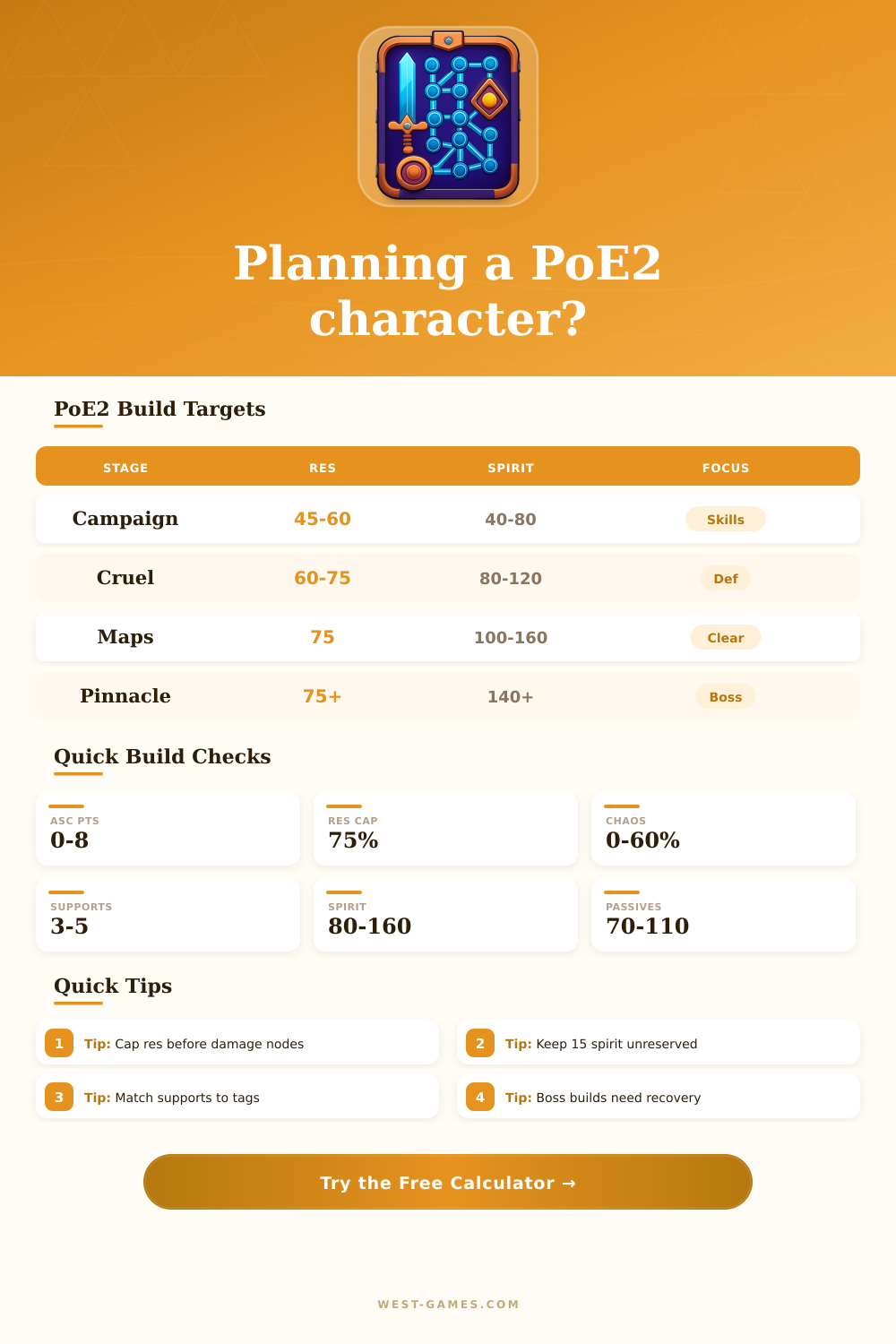
| Early maps | 75% target | 20% to 40% | Combine life or ES with armor, evasion, block, chill, stun, minions, or recovery. |
| Boss practice | 75% or overcap | 40% to 60% | Recovery and single-hit survival matter more than tooltip clear damage. |
| Ascension trials | 75% target | 0% to 40% | Movement, avoidance, recovery, and low spirit strain help sustain mistakes. |
💎Support Gem and Spirit Planning
| Package | Useful Support Direction | Spirit Pattern | Planner Warning |
|---|---|---|---|
| Gas Arrow or Poison Bow | Projectile, poison, area, duration, and detonation supports | Usually medium reservation for buffs or herald-style effects | Do not spend so much spirit that utility skills are squeezed out. |
| Grenade Crossbow | Grenade, area, cooldown, armor break, and burst supports | Low to medium reservation, often more gem-link dependent | Bossing suffers if passives only support clear explosions. |
| Two-Hand Slam | Stun, melee, area, bleed, and heavy hit supports | Low reservation, but wants defenses and recovery | Damage feels worse if attributes or accuracy are under target. |
| Spark or Bone Caster | Spell, projectile, chaining, critical, mana, or physical spell supports | Medium to high reservation for persistent spell buffs | Energy shield does not excuse uncapped elemental resistance. |
| Minion Pyre | Minion damage, fire, ignite, offering, and command supports | High reservation and often the strictest spirit budget | Keep a clear unreserved buffer for utility and recovery layers. |
| Quarterstaff or Spear | Combo, ailment, elemental, bleed, crit, or freeze supports | Medium reservation with hybrid attribute pressure | Utility passives may be required before more damage clusters. |
💡Planner Tips
Creating a Path of Exile 2 character require you to balance many differents systems within the game at once. You must balance your class, your ascendancy, your main skill, your passive skills, your spirit level, your resistances, your life pools, and your movement speed. These attributes interacts with each other and can become challenging to remember all of these attribute at once.
If you dont track these attributes, you may end up creating a build that has significant weakness. The planner will allow you to test the differents systems and see how they interact with each other prior to spend time allocating your points within the passive skill tree. You can use the planner to test how the four support gems will impact your offense stat relative to your spirit cost.
Use the planner to build and test your Path of Exile 2 character
Furthermore, you can use the planner to gain a general idea of how adjusting different attributes will alter your character’s stat. You can also use the planner to test your split within the passive skill tree. For example, if you allocate a significant portion of your passive skill tree to offense but dont allocate enough point to defense, the planner will alert you to this before you invest your points.
Each of the attribute within the planner has a specific function and meaning to your character build. Spirit is one of the most important attribute for your character. For instance, should you allocate a significant portion of your spirit to skills like minions and heralds, you will have less spirit to allocate to movement skill.
This limit your flexibility within the game. The planner will track your spirit and will alert you to any potential issue with your spirit allocation. Your resistances is also one of the most important aspect of your build.
You want to reach 75% elemental resistance by the time you leave the campaign map. However, most player do not focus on chaos resistance as much as the other element. If you do not focus on chaos resistance, you may find yourself losing a significant amount of life very quick when you encounter an enemy that uses damage-over-time attack.
The planner will alert you to the gap within your resistances and how it will impact your readiness score. The planner will not replace playtesting your character build, but it will make it so that you are aware of the cost of having low resistance stat for your character. The allocation of your passive skill tree is a process that can create error.
For instance, you may be inclined to allocate your points to offense skill to boost your damage stat. However, every point you allocate to offense is a point you do not allocate to skills that will boost your life, attribute, and movement speed. If you allocate too many point to offense and defense skill relative to the total number of passive skill point you have available for your class, your plan is not possible.
The planner will alert you to this mistake prior to spend your points on any skill. The importance of each statistic within your character build will differ based off the goal that you establish for your character. For example, characters that are meant to clean map quickly will have high movement speed.
However, characters that are meant to fight boss will have high recovery stat, armor, energy shield, and a focus on investing in skill that target single target. The goal selector within the planner will weight these statistic relative to your character build’s priority. As a result, your character will score highly in the category you select but low in other.
The planner cannot measure how your character will feel while playing the game. For example, the more animation you commit to within the game, the more your character will need defense to protect yourself. A character that scores highly within the planner might require you to stand in one spot or remain in melee range of enemy.
Therefore, the planner will not replace playtesting your character, but it will act as an early filter for what kind of character build you want to create. Whenever you make any change to your character build, you should run the number within the planner. For instance, if you swap out one support gem for another, you will impact multiple statistic within your build.
The planner will allow you to see the impact of these change and make a decision about whether or not you want to proceed. Eventually, the planner will help you recognize different pattern within your character build. For instance, builds that maintain 85% spirit reservation, capped elemental resistance, and a balance between offense and defense passive skill point will be more successful in the map that you play.
Therefore, the planner will not replace playtesting your character, but it will remove the guesswork that you have to make after you have committed to your passive skill tree.