Maxroll Character Planner
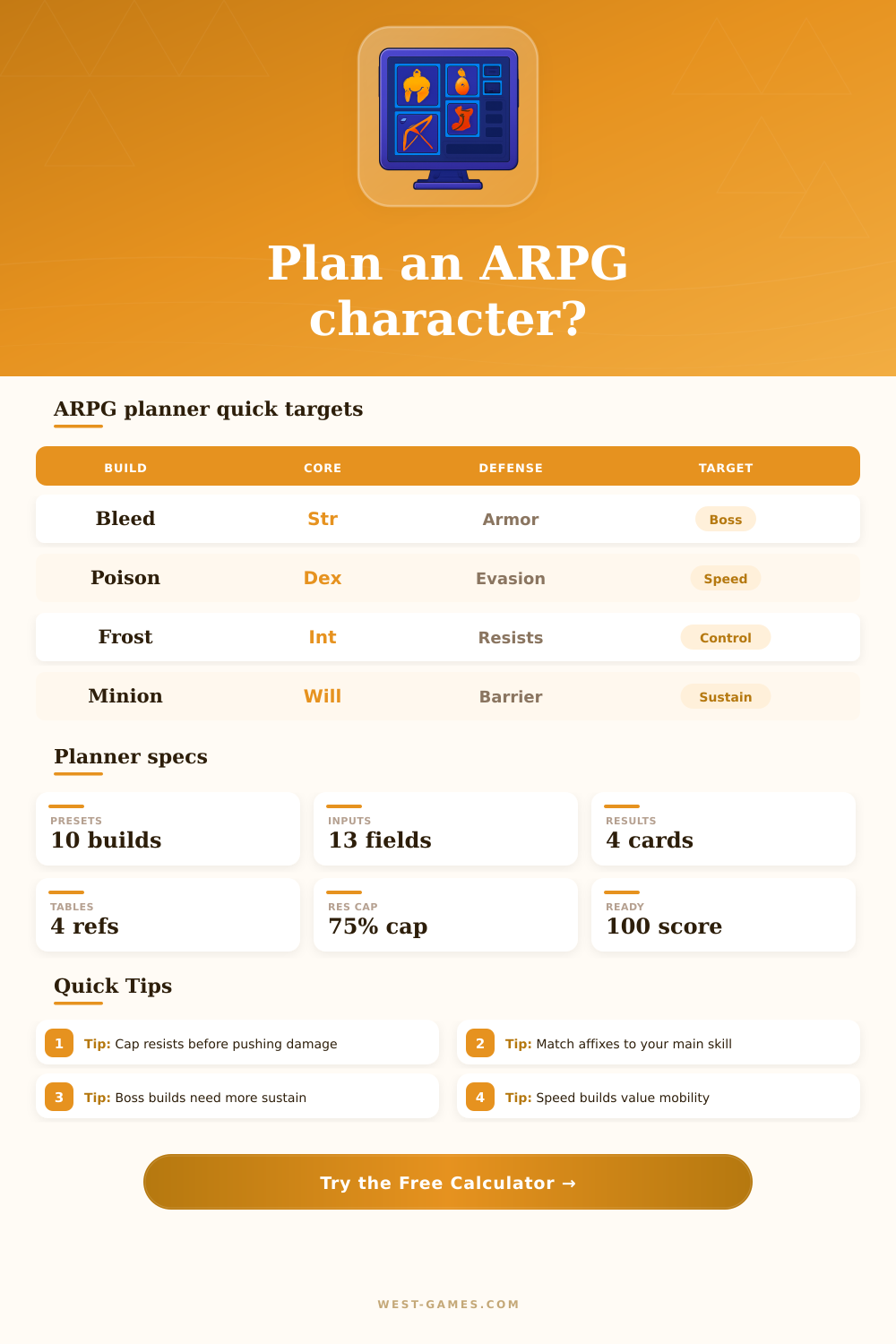
Compare ARPG class profiles, skill packages, stat weights, gear affixes, passive budgets, defense caps, and bossing versus speedfarm readiness.
| Archetype | Primary stat priority | Secondary priority | When it shines |
|---|---|---|---|
| Berserker bruiser | Strength, crit damage, overpower | Armor reduction and life sustain | Bossing, cleave, melee push |
| Shadow assassin | Dexterity, crit chance, poison | Cooldown recovery and mobility | Speedfarm and elite deletion |
| Elementalist caster | Intelligence, spell level, penetration | Resource sustain and cast speed | Area control and burst windows |
| Sentinel guardian | Block, armor, thorns scaling | Cooldown uptime and resist overcap | Hardcore, push, attrition fights |
| Ranger marksman | Dexterity, projectile damage, crit | Attack speed and dodge uptime | Open maps and fast clear chains |
| Necromancer summoner | Minion damage, command speed, aura | Barrier, minion life, curse effect | Safe bossing and layered pressure |
| Affix group | Damage weight | Defense weight | Planner interpretation |
|---|---|---|---|
| Main skill rank or gem level | 10 | 1 | Highest impact when the skill package has a strong multiplier. |
| Crit chance plus crit damage | 9 | 0 | Best after baseline hit chance, uptime, and resource stability are solved. |
| Attack, cast, or trigger speed | 8 | 2 | Raises output and smooths movement, leech, on-hit, or proc loops. |
| Resistance and damage reduction | 1 | 10 | Priority until cap, especially for push and hardcore profiles. |
| Life, ward, barrier, or shield | 1 | 8 | Transforms capped resistance into practical survival time. |
| Cooldown recovery or resource gain | 6 | 5 | Raises uptime for ultimates, guard skills, auras, and burst rotations. |
| Defense layer | Soft target | Strong target | Planner effect |
|---|---|---|---|
| Lowest elemental resistance | 70% | 75% plus overcap | Below 70% reduces readiness sharply for endgame content. |
| Armor or damage reduction | 40% | 60% to 75% | Raises survival rating more in bossing and push modes. |
| Life, ward, or shield index | 90 | 125 plus | Buffers spike damage after mitigation has been applied. |
| Recovery or sustain loop | Reliable | Always active | Represented indirectly through speed, class profile, and target mode. |
| Control avoidance | One source | Two sources | Improves real dungeon consistency even when sheet DPS is high. |
| Progress band | Passive points | Endgame points | Build planning focus |
|---|---|---|---|
| Fresh endgame | 45 to 70 | 0 to 60 | Core skill path, first defense layer, basic resource loop. |
| Mapping baseline | 70 to 95 | 60 to 140 | Damage clusters, cap resists, unlock key board or mastery nodes. |
| Push preparation | 95 to 125 | 140 to 230 | Defense conversion, glyph leveling, elite damage, utility sockets. |
| Optimized endgame | 125 plus | 230 plus | Point efficiency, affix perfection, overcap, and alternate loadouts. |
Planning a character for an Action Role Playing Game require that you make many decisions about that character. For instance, you must choose a character that can efficienty clear the maps in the game, that can survive the enemy that it encounters, and that can deal damage to the games boss. If you dont make your character selection with a plan, you may end up with a character that is strong in one area, but that becomes weak relative to other characters as you continue to encounter more difficultly content.
The games planner will help you to evaluate your character build prior to full selecting a character for your game. The planner allow you to select a character class, a skill package for the character, and a target mode for the game. Additionally, the planner permits you to enter numbers representing your expected character feature, such as weapon damage, minion damage, critical strike value, speed bonus, and the lowest resistance values that your character will possess.
How to Plan Your Game Character
The planner will weigh these characters against your defense layer and upgrade readiness for the character to determine whether or not your character is ready for the next tier of content within the game. Defense layers is essential to your character, yet many players often focus too much on developing damage for their characters, instead of focus upon their defense layers. While it may be appealing to increase the damage that your character can deal by ten percent, it is more important that you increase your character’s resistance values toward the enemy damage to the maximum.
Additionally, other defense layer, such as armor and damage reduction values are also important to your character. A character that does not have a variety of defense layer will fail against even a single enemy attack, while a character that has well developed defense layers will be able to take a heavy hit. The planner accounts for these different types of defense layer, combining them together with the characters resistance, armor, and life into a single survival rating for the character.
When selecting a skill package for the character, there are also tradeoffs that must be made. For instance, a single target skill may be the best for dealing damage with your character to the bosses that you encounter, yet may be slow when you are required to fight many enemy at once on the map. Additionally, a mobility skill may allow your character to move quick throughout the map, but it may be the wrong choice if your primary focus is damage dealing.
The planner allows you to select different skill package for your character, and to view how each will impact your damage and clear speed. The planner can help you to decide whether you want to focus upon your skill package for speed farming or bossing. Passive node and paragon points are finite resource for your character and can be used to develop both your skill and your defense layers.
In the beginning of the game, you will use these points to purchase and develop your core node and defenses. Later in the game, however, you will use them to purchase additional efficiency, overcap skill, or any utility skill. The planner treats passive nodes and paragon points as a finite resource for your character, as it will show both damage and survival value with different level of passive nodes and paragon points invested into your character.
This will allow you to not overspend your points on mapping skill if you dont have enough points to develop essential defense layer. Gear quality impact the performance of your character. While early gear with mixed affix may allow your character to complete the initial stage of the game, it will be less effective once your skill rank and passive cluster reach high levels.
The planner accounts for gear quality, treating it as a multiplier in the calculation that are performed for the character. Overall, the main purpose of the planner is to view your character as a system. Rather than viewing your character as a series of individual choice that you made when building your character, you should view your character as a system in which each component impact each other component.
If your survival rating is lower than your damage for your character, for instance, you know that you must upgrade the defense layer for your character. Additionally, if your upgrade readiness level is low, the planner can show you whether you are missing a defense layer or whether you do not have enough skill level in one of your glyph. Thus, using the game planner will help to ensure that your character is fully coherent with one another, since you are measuring the entire system with the planner rather than any one part of that system.
You should of used it more. It is actualy alot more easy than guessing.