🎮 WoW Retail Character Planner
Compare class/spec fit, hero talents, stat weights, item level, tier pieces, embellishments, enchants, and Mythic+, raid, or PvP role targets before locking gear choices.
| Spec | Role | Strong in | Watch |
|---|---|---|---|
| Arcane Mage | DPS | Raid burst | Movement |
| Prot Paladin | Tank | Utility keys | Magic spikes |
| Resto Druid | Healer | HoT ramps | Burst checks |
| Aug Evoker | Support | Group amps | Timing |
| Blood DK | Tank | Self-heal | Kite gaps |
The planner uses role baselines, not tier-list placement, so weaker player execution can still outweigh a strong theoretical profile.
| Stat | DPS use | Healer use | PvP use |
|---|---|---|---|
| Critical Strike | Burst | Spot heals | Kill windows |
| Haste | Uptime | Cast flow | Pressure |
| Mastery | Spec scaling | Kit scaling | Varies |
| Versatility | Flat gain | Flat gain | Core stat |
Actual stat breakpoints depend on current gear, talents, encounter length, and rating conversion, so this tool applies soft diminishing returns.
| Gear piece | Planner bonus | Best use | Risk |
|---|---|---|---|
| 2-piece tier | Moderate | Early set | Low ilvl |
| 4-piece tier | High | Core build | Bad stats |
| Embellish | Stackable | Crafted slots | Cap at two |
| Weapon | Role heavy | DPS and tanks | Wrong stats |
A high item-level non-tier piece must beat the tier formula, not just show a larger raw item level number.
| Target | Output | Survival | Utility |
|---|---|---|---|
| Mythic+ weekly | High AoE | Medium | High |
| Mythic+ push | Very high | Very high | Very high |
| Heroic raid | Sustained | Medium | Medium |
| Mythic raid | Precise | High | High |
| Solo Shuffle | Burst | Very high | Control |
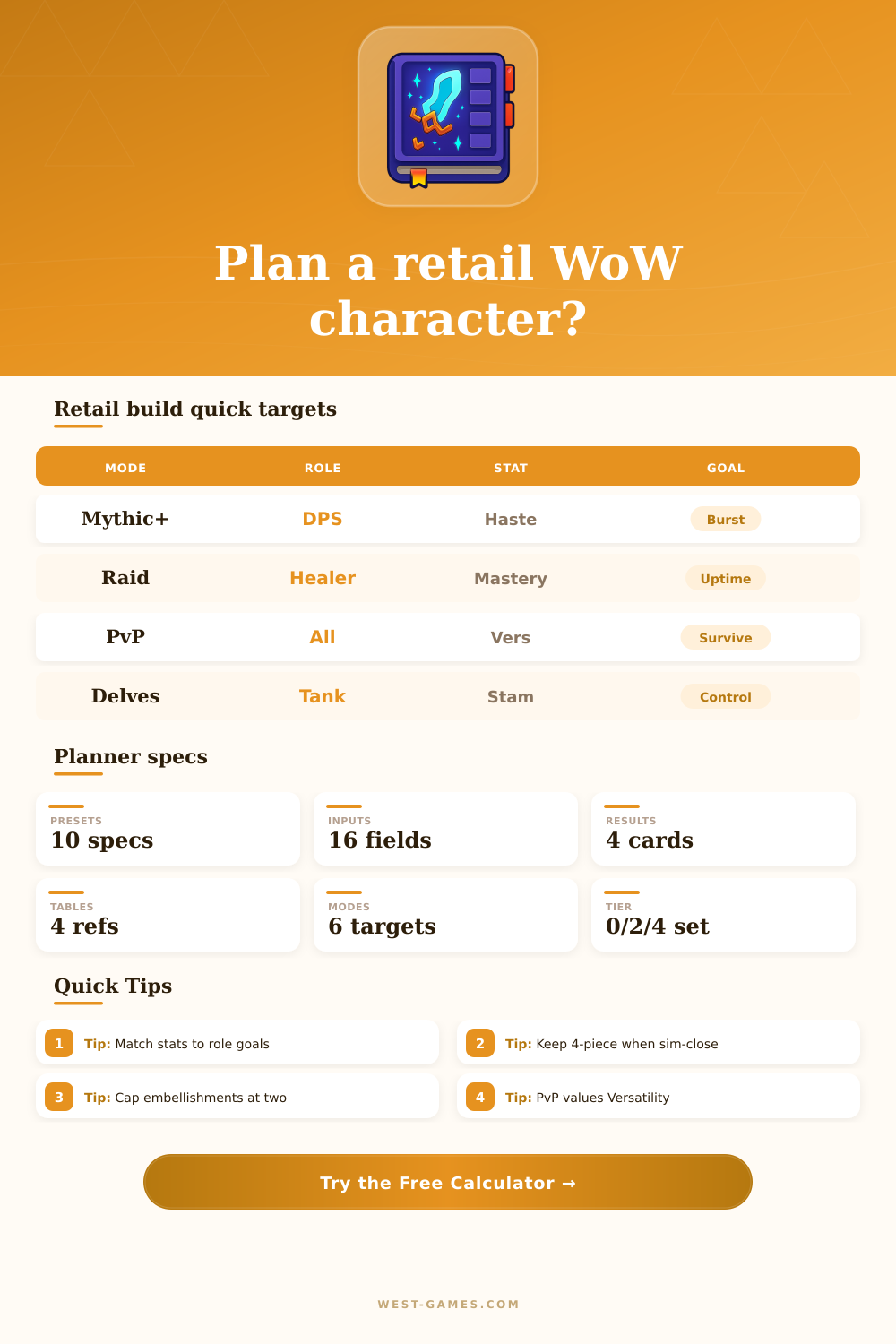
PvP and Mythic+ weight Versatility, interrupts, control, and defensive timing more heavily than a pure raid training dummy estimate.
Creating a character for retail World of Warcraft require attention to the changes to the value of different game mechanics every season. The game changes the value of mechanics from one game patch to the next; one patch may reward burst damage for players while another may value sustained damage. Each of these factors will have an impact upon the decision of which gear to purchase for your character, and such a decision requires more than simply reading the tooltip for each items or checking the leaderboard for the best gear for each role.
The planner require players to perform mathematical calculations to determine the value of their gear. The planner considers each of a player’s items (item level, stats, tier), the role that the player intends to play within any given content, and applies formulas to each of these factors to arrive at a readiness percentage for that players gear. That readiness percentage indicate how close the gear comes to the requirements for content like Mythic+, raids, and PvP.
How to Choose Gear in World of Warcraft
In addition to providing a readiness percentage, the planner also consider each players potential output and survivability within the game to provide another measurement of the value of their gear. While the gear calculator does not provide a specific answer as to the value of each player’s gear, it does provide an indication of which way to adjust gear next. Many of the decision regarding gear in retail World of Warcraft are made based off the role that a player intends to use.
For instance, haste is a valuable statistic for characters like arcane mages who intend to play in Mythic+ raids; it is, however, of less value in the higher keys of those raid instances due to the reduced uptime of those mana cost. The calculator adjust for the different values of haste, burst damage, and survivability based upon the content that a player intends to play; higher keys have different requirements than heroic raids, for instance. The hero talents for many of the classes provide players with different values for different specializations of those classes.
For instance, the hero talent for spell casts is valuable for spells like Arcane Burst or Frostbolt, but of less value for spells that have shorter casting time. The calculator provides a bonus to a players gear value if the player intends to use the hero talent that is preferred for players of that specialization, and provides a penalty if the player intends to use an experimental talent for that class. Using the talent that is not the preferred talent for that class does not indicate a player’s gear purchase is incorrect, simply that the player has to exhibit higher levels of execution to gain the same value as others using the same gear.
The importance of secondary stats for gear adjustments is also account for in the gear calculator. Each of the secondary stats provides different benefits to a player and each stat has different values based upon the spread of a player’s current rating for those stats. For instance, critical strike will improve burst damage while haste will increase the uptime of mana costs for spells.
The planner accounts for the fact that not all secondary stats have the same value within the game; a player receives diminishing returns for each stat so that their gear does not receive infinite scaling if they instead purchase one piece of gear with all of their secondary stats. Additionally, the planner provides players with an indication as to which of the secondary stats have the highest value for that players current gear. The gear calculator accounts for the importance of gear like tier set bonuses, embellishments, and weapon quality.
Specifically, four-piece set bonuses are generally worth using unless the level of another item is high enough to provide the same benefit. Two embellishments are the maximum number provided for gear for this reason. Weapon track is both important for damage specializations as well as for tanks due to armor and stamina.
Additionally, execution is factored into the calculations provided by the gear calculator. Players who exhibit better execution abilities will produce more output than those who possess the same gear but do not exhibit the same level of skill in executing abilities. An execution setting within the gear calculator indicates how much an execution difference will impact a players output.
The reference tables for the different types of content for which players may gear themselves provide context for why a player’s gear might return a readiness percentage that is lower than that players expectation. Content like PvP and higher tiers of Mythic+ values stats like versatility, interrupts, and defensive abilities more heavily than content like single-target damage simulations. The gear calculator is a tool for comparing gear rather than a tool that provide an answer to the value of a players gear.
Instead, the player should load their current gear profile and then make one change at a time (such as attempting to equip a different trinket or obtaining the next tier item). Each change will provide a new readiness score, and these adjustments will allow players to understand which direction to focus their gear investments over time rather than making adjustments to every gear upgrade that is dropped. Overall, the game provides gear and content for those who understand the requirement of each role within the game.
The gear calculator provides a way to test a players understanding of their role within the game relative to their character sheet.