☢ Fallout 76 Character Planner
Plan SPECIAL allocation, perk-card ranks, legendary perk slots, mutations, weapon archetype, armor goals, AP, VATS, carry weight, and team role fit.
| Stat | Main uses | High-value builds | Watch point |
|---|---|---|---|
| Strength | Carry, heavy, melee | Heavy, melee, shotgun | Weight card bloat |
| Perception | Rifles, VATS aim | Commando, rifle, bow | Needs 12-15 often |
| Endurance | Survival, HP | Full health, tank | Easy to underspend |
| Charisma | Teams, sharing | Support, XP captain | Shared rank gate |
| Intelligence | XP, PA, crafting | Heavy, crafter, ops | Repair card crowding |
| Agility | AP, sneak, Dodgy | VATS, stealth, melee | Adrenaline competes |
| Luck | Crits, mutations | Bloodied, VATS | Class Freak space |
Card capacity is capped by the displayed SPECIAL category, so a narrow stat can block otherwise strong perks.
| Level | Slot count | Planning use | Typical pick |
|---|---|---|---|
| 50 | 1 slot | First build anchor | Legendary SPECIAL |
| 75 | 2 slots | Core flexibility | SPECIAL or survival |
| 100 | 3 slots | Damage support | Follow Through style |
| 150 | 4 slots | Utility unlock | Ammo or defense |
| 200 | 5 slots | Hybrid comfort | Extra SPECIAL |
| 300 | 6 slots | Endgame spread | Final flex slot |
The calculator compares level-unlocked slots against the number you plan to reserve for this loadout.
| Archetype | Core stats | Key card pressure | Best role |
|---|---|---|---|
| Commando | PER/AGI/LCK | Rifle, crit, AP | Boss DPS |
| Heavy guns | STR/INT | Heavy, PA, ammo | Tank DPS |
| Rifleman | PER/AGI | Sneak, rifle | Solo picker |
| Shotgun | STR/CHA | Shotgun, medic | Close support |
| Melee | STR/AGI | Melee, defense | Brawler |
| Explosive | PER/INT | Grenadier, demo | Event tags |
| Bow | PER/AGI | Bow, sneak | Scout |
| Pistol | AGI/LCK | Pistol, crit | Mobile VATS |
Hybrid cards can work, but the readiness score rewards builds that protect their main weapon lane first.
| Package | Positive focus | Card support | Risk |
|---|---|---|---|
| Marsupial/Speed | Mobility | Starched Genes | Carry habits |
| Eagle Eyes | Crit damage | Class Freak | STR penalty |
| Herd Mentality | Team stats | Strange in Numbers | Solo loss |
| Twisted Muscles | Melee output | Class Freak | Gun accuracy |
| Unyielding | Low-health stats | Serendipity | Rad control |
| Power armor | Mitigation | Stabilized | Core weight |
Mutation-heavy plans should reserve Luck and Charisma space before chasing extra quality-of-life cards.
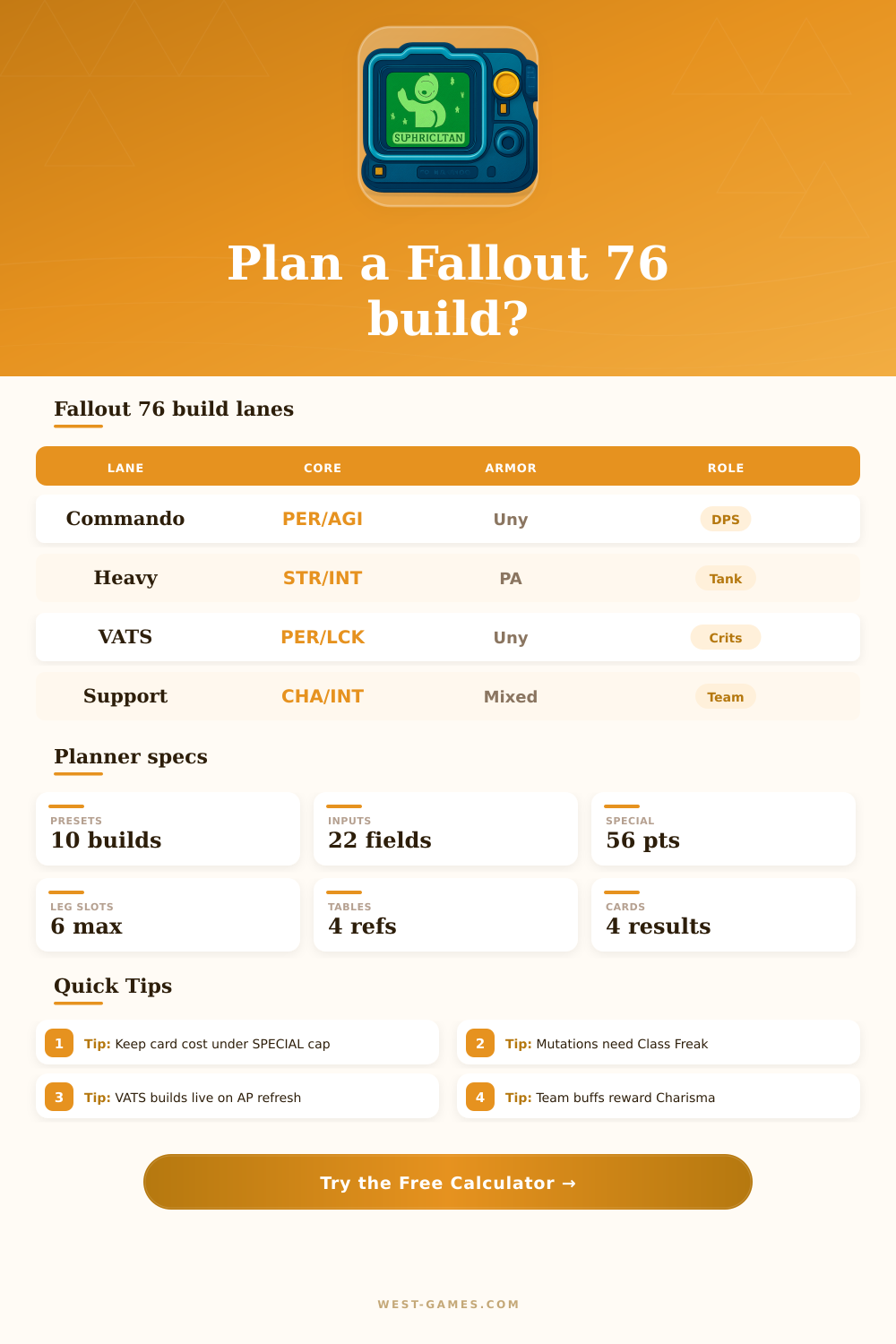
To build a character in Fallout 76, a person has to ensures that the various components of the character build work good together during combat or other event in the game. A Fallout 76 character build is not about the specific number of SPECIAL points that a player will have, but instead about how the various component of the game can interact with one another. The planner that is available to players for Fallout 76 exists because the game provide 56 SPECIAL points to a player.
A player uses these SPECIAL points to purchase perk cards, legendary perks, mutations, and armor. However, if a player do not ensure that the game’s various components interact well with one another, the player may have high damage stats and abilities for the character yet still experience various problem during gameplay. The inputs for the planner represent the requirements for the components of Fallout 76.
Planning Your Fallout 76 Character
A player can use these inputs to determine how the various aspects of the game affect the players build. The archetype of the weapon that a player chooses will impact the SPECIAL points that is required within the game, as well as impact the general strategy that a player will use within the game. The health of a players character will dictate whether SPECIAL points should go into purchasing Unyielding effects for health rather than Overeater mitigation, which will also impact how SPECIAL points are distributed within the game.
The choice of mutation package will impact whether a player needs more Luck for mutations like Class Freak and Starched Genes or more Charisma for mutations like Strange in Numbers. Finally, the pressure that a player will be applying to the character will also impact the character build that the player makes. Character builds that work for casual play might not work for boss fights or Daily Ops, and vice versa.
These relationships are all calculated for a player to understand which components of the build are useful and which are not. Some character builds will require a trade-off of SPECIAL point allocations to ensure that a players character is balance and has the abilities that is required. For instance, a Commando character build will require high levels of both Perception and Agility so that they have effective use of VATS.
However, the high levels for these characteristics will use up some of the SPECIAL point budget for the character. For instance, increasing Perception to 15 and Agility to 14 will require a decrease in another SPECIAL attribute for the character, as the total SPECIAL points is limited to 56. The planner for Fallout 76 helps a player to see these trade-offs before the player spends their SPECIAL point levels.
Similarly, a heavy gun character build will require high levels of Strength so that the player has good weapon cards and can carry their weapon, as well as high levels of Intelligence for using Stabilized and Power Armor perks. Additionally, the player must plan their character build around these specific levels, as legendary perk slots are only earned at specific levels. Thus, a player might create a different character build if they are at level 120 as compare to if they are at level 260.
There are various reference tables available for Fallout 76 for players that help to indicate which stats will boost which weapon types. Additionally, there are tables that indicate which mutation package require high amounts of Luck and Charisma stats. For example, builds with bows that use the full mutation package will require higher Luck and Charisma stats than a gun character that do not use any mutations.
These characteristics will require more SPECIAL points within those categories. While the tables do not create a build for a player, they do make the pressure points for the SPECIAL points visible to the player. The calculator can use these SPECIAL point allocations to calculate how good a players build will be.
A player can also consider their role within the player team when creating their character. For example, if a player intends to create a damage-dealing (DPS) character, they will not require high Charisma stats, as they will not have to rely on other players to recieve their damage. In contrast, a player who builds a support character or an XP captain will have high Charisma stats to allow the teams perks to work.
This role will affect both the allocation of SPECIAL points and armor for that character. The planner calculates these variables to indicate to a player whether or not their chosen role is realistic for SPECIAL points and armor. Many character builds fail because players treat their 56 SPECIAL points like a checklist.
For example, many players will max out their weapon stats and purchase as many damage cards as they can, but then find that other stats like carry weight or action points are an issue for the player. The planner calculates for players the utility and defense score for their characters so they know that adding too much SPECIAL point investment into a specific category can be an issue. Another mistake that many players make is ignoring the timing of legendary perks.
Many players do not consider that the game only provides legendary perk slots at specific levels for the character. For instance, at level 92, a character will not be able to take six legendary perk like a level 260 character can. Thus, the planner will reduce the score for players who attempt to create a plan without considering legendary slot availability.
The planner allows players to change one variable and see how the scores for others may change. A change from a bloodied character to a full health character will change the armor fit for that player. Similarly, increasing the amount of defense cards will increase the resistance of the character, but the card-pressure score will also increase.
Additionally, increasing the Agility stat of a character will increase the action point score of the character build, but another value will have to be decreased to maintain the 56 SPECIAL point budget for that character. Thus, players can use the planner to determine whether they will enjoy the character build that they are attempting to create or if they will find it to be frustration to use. While not a replacement for actualy playing the game, the planner will save players from a certain amount of guesswork between levels.
Players can use the planner to determine if their character build will support their desired role. Using the planner, players can avoid wasting any levels creating a character that will not work as intended. Thus, the planner also prevents players from getting frustrated at having to respec their characters.