⚒️ New World Smelting Calculator
Plan ingot targets from ore tiers, charcoal, flux, refining station tier, Smelting skill, bonus yield chance, aptitude progress, craft batches, and session time.
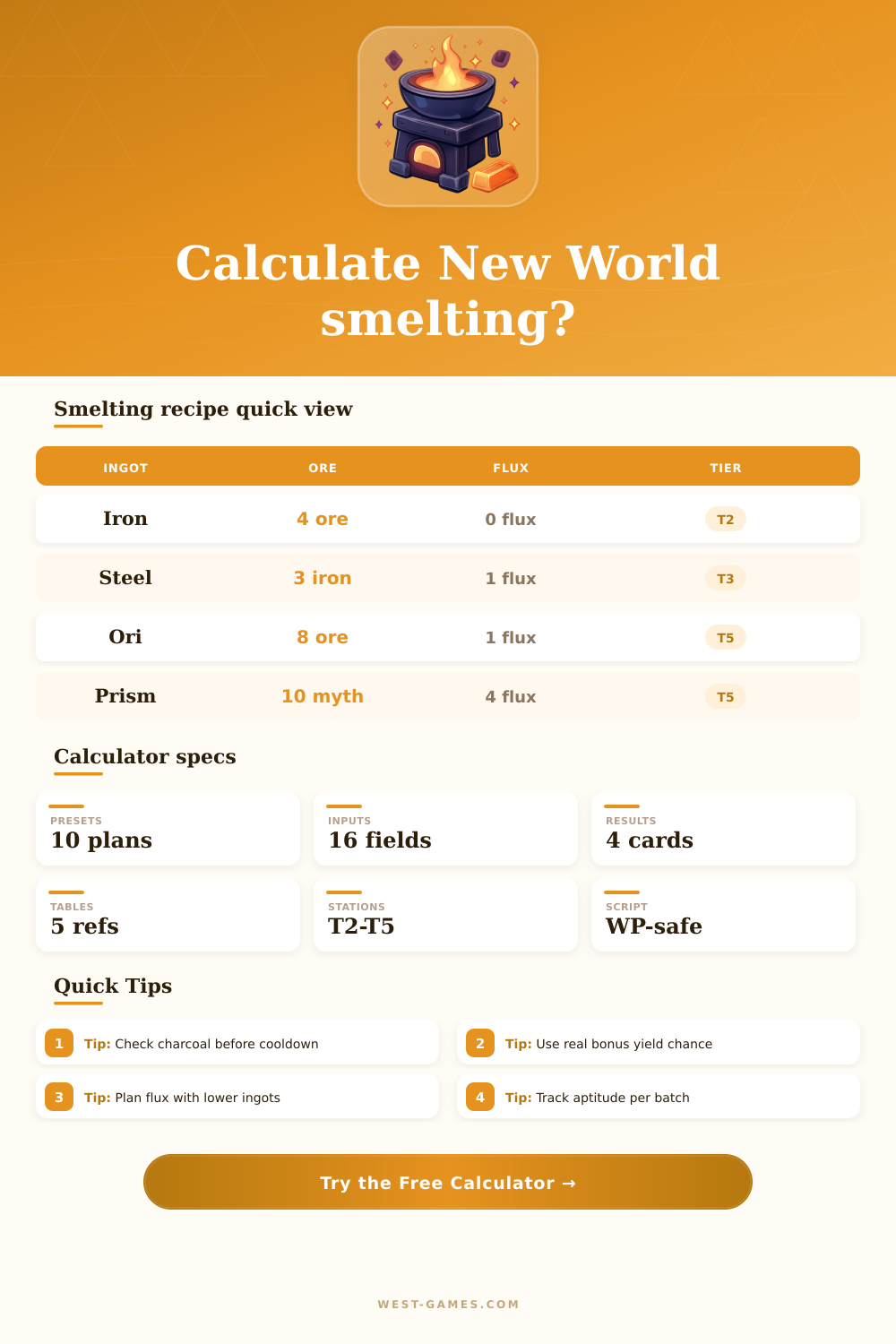
| Recipe | Tier | Primary input | Lower input | Skill | Station |
|---|---|---|---|---|---|
| Iron Ingot | T2 | 4 Iron Ore | None | 0 | T2 |
| Steel Ingot | T3 | 3 Iron Ingot | None | 50 | T3 |
| Starmetal Ingot | T4 | 6 Starmetal Ore | 2 Steel Ingots | 100 | T4 |
| Orichalcum Ingot | T5 | 8 Orichalcum Ore | 2 Starmetal Ingots | 150 | T5 |
| Asmodeum | T5 | 5 Orichalcum Ingots | Cinnabar and Tolvium | 200 | T5 |
| Mythril Ingot | T5 | 12 Mythril Ore | 2 Orichalcum Ingots | 205 | T5 |
| Prismatic Ingot | T5 | 10 Mythril Ingots | 1 Asmodeum | 250 | T5 |
The calculator keeps lower-tier inputs editable because some players stockpile chain ingots before calculating the final smelting run.
| Recipe group | Charcoal | Flux | Flux type |
|---|---|---|---|
| Iron and Silver | 0 | 0 | None |
| Steel and Gold | 2 | 1 | Sand or Obsidian |
| Starmetal and Platinum | 2 | 1 | Obsidian Flux |
| Orichalcum and Mythril | 2 | 1 | Obsidian Flux |
| Prismatic Ingot | 4 | 4 | Obsidian Flux |
If your game version or server data shows a different reagent, change the owned and target fields to match the recipe screen.
| Check | Ready sign | Warning sign | Calculator result |
|---|---|---|---|
| Skill level | Meets recipe | Skill gap | Skill check card |
| Station tier | At or above recipe | Lower tier | Station check card |
| Bonus yield | Positive stack | Negative chance | Attempts reduced |
| Aptitude | Enough XP | Partial level | Progress percent |
| Cooldown | Within daily cap | Exceeds cap | Breakdown note |
High-tier recipes can have negative extra item chance, so the effective yield line is often lower than your visible bonus stack.
| Session type | Best input | Main risk | What to compare |
|---|---|---|---|
| Town board | Batches | Overcrafting | Target minus owned |
| Gear prep | Ingots per batch | Lower ingot gap | Chain materials |
| Daily cooldown | Cooldown cap | Cap overflow | Attempts vs cap |
| Aptitude push | XP per level | Long queue | XP per minute |
| Storage stock | Owned ingots | Hidden flux gap | Shortfalls table |
Use the comparison grid to see whether more yield or smaller target batches saves more ore, flux, and queue time.
| Preset | Recipe | Target | Bonus | Use case |
|---|---|---|---|---|
| Iron Ingot Town Board | Iron Ingot | 200 | 12% | Low-tier boards |
| Steel Tool Batch | Steel Ingot | 180 | 18% | Tools and weapons |
| Starmetal Weapon Prep | Starmetal Ingot | 120 | 24% | Mid-tier crafting |
| Orichalcum Armor Stock | Orichalcum Ingot | 90 | 30% | Armor materials |
| Prismatic Daily Set | Prismatic Ingot | 10 | 38% | Endgame cooldown |
Presets are planning baselines. The form fields are intentionally editable for current patch data, company buffs, and personal inventory.
In New World you hit that point where you’re wearing Tier 5 gear and you realize you’ve filled up your inventory with raw ore and now you don’t know how to turn it into weapon upgrades. It’s a unique frustration. You have what you need, but there are no ingots and a lack of tools to make those ingots seem like too much work.
The issue isn’t usually mining, its managing the logistics of transforming rock into something else without using up all your fuel or wasting time. Smelting is as much about supply chain management as it is combat skill. Think of your refining station as a little factory instead of an area where you can just throw down some rocks.
How to Smelt Better in New World
With those inputs, the calculator (seen above) runs through the rest for you, so there’s no fumbling with conversion rates. Before you’re knee-deep in crafting, it will force you to face cost of expensive gear head-on. Until it’s too late, most players don’t realize ingredient chain. You can’t simply melt down raw Iron Ore to get Steel Ingots. Raw Iron Ore becomes Iron Ingots first. Then those becomes something else. If you’ve got a pile of the former and none of the latter, you’re out of luck. By separating out your owned low-level ingots from your base ore, the tool makes this clear. That’s important because otherwise youll end up panicking halfway into a session when you remember “oh, I forgot to go back up the recipe tree.”
New World Smelting and Refining New World has some big budget killers with regards to charcoal and flux. Sure we all count our ore, but who plans for the fuel? If you’re not careful, a single high-end smelt will use up dozens of units of charcoal in one session. On the page, there’s a handy reference table grouping like recipes by shared reagent needs. This allows you to batch out your crafting sessions smartly. For example, it makes sense to group all your Iron and Silver smelting together as neither require charcoal or flux. Gold and Steel both requires Sand Flux and Fuel. By organizing your work this way you reduce the friction of running back to gather more resources between batches, or having to switch stations mid-session.
The other place people get tripped up is with bonus yield. If your fort has a bunch of good buffs and your gear gives you a 30% bonus, you’ll think you just need 70% of the required materials. That works if you’re making lower level stuff, but there’s a negative bonus to the extra items that can eat away at that bonus as you go up in tier. So the calculator lets you put in how much you want to ding the effective yield for higher-end stuff (like Prismatic Ingots or Asmodeum). For example, I set mine to -0.5 because higher recipes can have negative extra item chances that offset bonuses for endgame materials like Asmodeum. That matters when you don’t want to waste rare materials on failed attempts.
And then there’s time, which is also a waste. Hundreds of items queued up manually can eat away at the day. Each attempt takes real seconds to smelt, and while the game runs in the background, queueing up hundreds of items manually eats into your day. This tool looks at what youve seen taking you to craft something, and estimates how long that would take for a session. This gives you a realistic idea of how long the project will take. Maybe it tells you you need four hours straight to smelt to reach your goal? You could reduce your output goal, or spread it out over a couple of days instead. It turns a vague task into one with a real schedule.
In short, refinement is all about making preparations, not reacting to a problem. Saying “Oh no! My smelter just emptied out!” isn’t going to help anything if you run out of charcoal. Learn how tier upgrades work, know what is in your flux stash, and prepare your batches ahead of time. This turns a chore into an effective manufacturing line.
A minute or two spent planning before logging in is often the difference between a harried player frantically searching for scraps versus a prepared player ready to craft. You should of done your math first. Not your button presses, and you’ll see it reflected in your inventory.