🔥 Diablo 4 Experience Calculator
Estimate Diablo IV XP needed, activity clears, Torment bonus impact, elixir and event stacking, downtime, and practical time to your next character level.
| Ruleset | Cap | Best use | Curve style |
|---|---|---|---|
| Lord of Hatred era | 70 | Current planning | Late steep ramp |
| Vessel of Hatred era | 60 | Patch 2.x tools | Compressed endgame |
| Legacy launch era | 100 | Old guides | Long 50-100 climb |
| Difficulty | XP model | Use case | Watch out |
|---|---|---|---|
| Normal to Expert | 1.00x-1.25x | Early leveling | Speed matters |
| Penitent | 1.45x | Pre-Torment | Gear check |
| Torment I-IV | 1.70x-2.35x | First endgame | Deaths cost pace |
| Torment V-VIII | 2.60x-3.40x | Power farm | Armor/resists |
| Torment IX-XII | 3.70x-4.70x | High push | Only if fast |
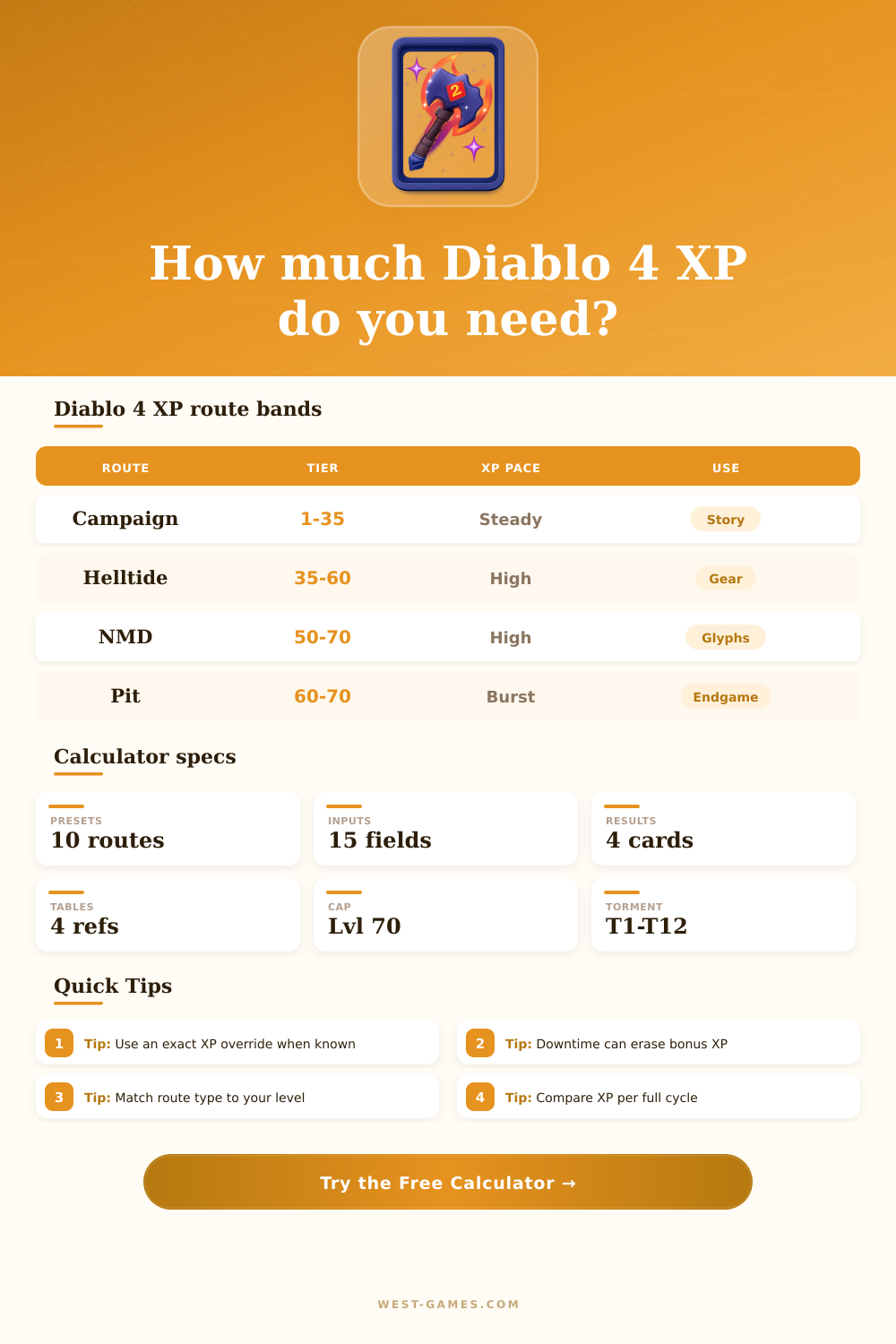
| Route | Base XP | Cycle | Level fit |
|---|---|---|---|
| Campaign quests | 140K | 8.0m | 1-35 |
| Helltide loop | 520K | 7.5m | 35-60 |
| Nightmare Dungeon | 760K | 6.8m | 50-70 |
| Infernal Hordes | 1.15M | 9.5m | 55-70 |
| The Pit | 940K | 5.2m | 60-70 |
| Whisper cache | 380K | 10.0m | Any |
| Input | Typical | Calculator effect | Note |
|---|---|---|---|
| Elixir | 5% | Multiplier | Keep active |
| Incense | 0%-5% | Multiplier | Group friendly |
| Season blessing | 0%-20% | Multiplier | Patch varies |
| Mother's Blessing | Variable | Event bonus | Enter manually |
| Party nearby | 5%-10% | Multiplier | Use actual setup |
| Output | Formula | What changes it | Best improvement |
|---|---|---|---|
| XP needed | Ruleset curve or exact override | Level, target, progress | Use exact XP |
| Run XP | Base XP x fit x multipliers | Difficulty and bonuses | Test one run |
| Runs needed | XP gap / run XP | Base XP accuracy | Pick dense route |
| Time target | Runs x cycle minutes | Downtime and deaths | Trim reset time |
Players must also decide how to spend their times within the game. The time that a player spend within the game will ultimately determine the amount of experience that they earn. Players dont usually have to wonder whether or not they will earn experience from the game; however, they must decide whether the route that they choose to play will provide them with enough experience before they become bored of the game or become distracted from their in-game goals.
Planning their playthrough allows players to compare the different route that are available in the game prior to beginning to grind levels in the game. By taking a few minutes to consider each route, players can avoid spending an hour grinding levels in the game without earning enough experience. Another important factor to consider in the game is the experience that is earned based on the level of the player.
Choose the Best Route to Level Up
The campaign content and side quests is engaging for players during the early stages of their character’s life. However, during the later stages of the game, these quests are less engaging than alternatives such as Helltide or Nightmare Dungeons maps. The difference in the experience that is earned from these quests is likely the result of how these quests interact with the level of the character, the difficulty of the quests, and the bonuses that the player selects to activate during gameplay.
If the player does not pay attention to these factors, they may find that their experience earned is less then they had previously expected from the game. The calculator that is present within the model can perform mathematical functions once the player enters the necessary information. The calculator does, however, not replace the player’s decision-making process within the game.
When a player selects the route that they would like to use to level up, they are providing information to the calculator about the type of gameplay that they will be enjoying. When they select a Torment tier, they are making a decision regarding the experience multiplier and the number of deaths that they may have within their gameplay. Additionally, when they enter the elixir bonus or the percentage for seasonal events, they are making a selection about the temporary buffs that they will use during gameplay.
These variable are not isolated from one another as they will compound or cancel each other depending on the length of time that it takes to complete one cycle of the selected route. Downtime can have an impact on the efficiency of each route. Routes require players to travel to towns to rest, to salvage their items, to craft sigils, and other resets in the game.
These types of activities reduce the effectiveness of the level farming route that they use. The time spent during these town activities can be considered as downtime for the leveling process. Additionally, the number of deaths that a player has within a route will impact the efficiency of that route.
While thirty seconds may be lost with one death, performing many deaths will add up to an increased amount of time that it takes for a player to level up. The model allows for players to test how many minutes of downtime and the number of deaths will impact the total amount of time that it takes for a player to level up. Difficulty is an important decision for players to make in the game.
The higher the Torment tier that is selected, the more experience that is earned from the monsters within the game. However, higher Torment tiers also lead to longer playthrough times to complete each clear for the player, as they will have more stops for recovery between each kill. The ideal Torment tier for players is the one that provides the most experience within the time required to complete one playthrough.
This threshold for the ideal Torment tier can change as the player levels up and gains new gear and increases their game build. A Torment tier that was comfortable for players during the 55 level range may not be as comfortable at 64. Route selection follows the same logic as the difficulty selection.
Helltide may be rewarding for those who know the locations of the chests in the game but offers a high volume of cinders. Nightmare Dungeons provides experience for characters and glyphs which are useful for players who have Paragon boards. The Pit is rewarding for players who can maintain their pace and perform as quickly as possible.
Infernal Hordes provides high amounts of experience however takes longer to complete the game. Infernal Hordes also impact the amount of downtime that players have in the game to recover from deaths. No route will be the best route for all players as each route may be beneficial for certain players over others due to their level of skill and risk tolerance.
These reference tables are essential to ensure that this model remains accurate for each game season. The rules for each game season can change, thus the reference tables will allow players to select between the routes and experience provided by the Lord of Hatred era, the Vessel of Hatred compression, or the legacy curve. Using these different game curves will allow for players to avoid using outdated assumptions about the game compared to the new reality of the current state of the game.
The default settings for difficulty and gameplay activities will provide a starting point for players for their leveling journey in the game. Some of the most common mistakes that are made include focusing upon only one variable. For instance, players may select a high tier for Torment because that is the selection that was used in previous levels.
However, it is possible that higher levels will result in slower clears for players. Another mistake is to forget to refresh an elixir. Additionally, players may not account for the experience provided by each route when comparing routes.
However, the model has been created to identify these mistakes as it considers the whole journey for players rather than just one variable. One of the most important habits for players to develop within the game is to test the time that it will take for each of the different routes in the game to reach the same target level. For instance, players may become obsessed with a route that was found to be fast for leveling but may not account for the amount of time that may be spent on other activities.
Additionally, players may find that the slower route is actually the better route to use due to the glyph experience or the amount of resources that would be required to take a specific route. Although the model incorporates various numbers for experience and time, these numbers are meant to assist players in making their decisions rather than replacing the players abilities to make those decisions themselves. Although the model allows for players to plan their game journey, it does not eliminate the grind itself but ensures that the player’s time is accounted for and earning them the levels that they desire.