🛡 Diablo 4 Paladin Skill Tree Calculator
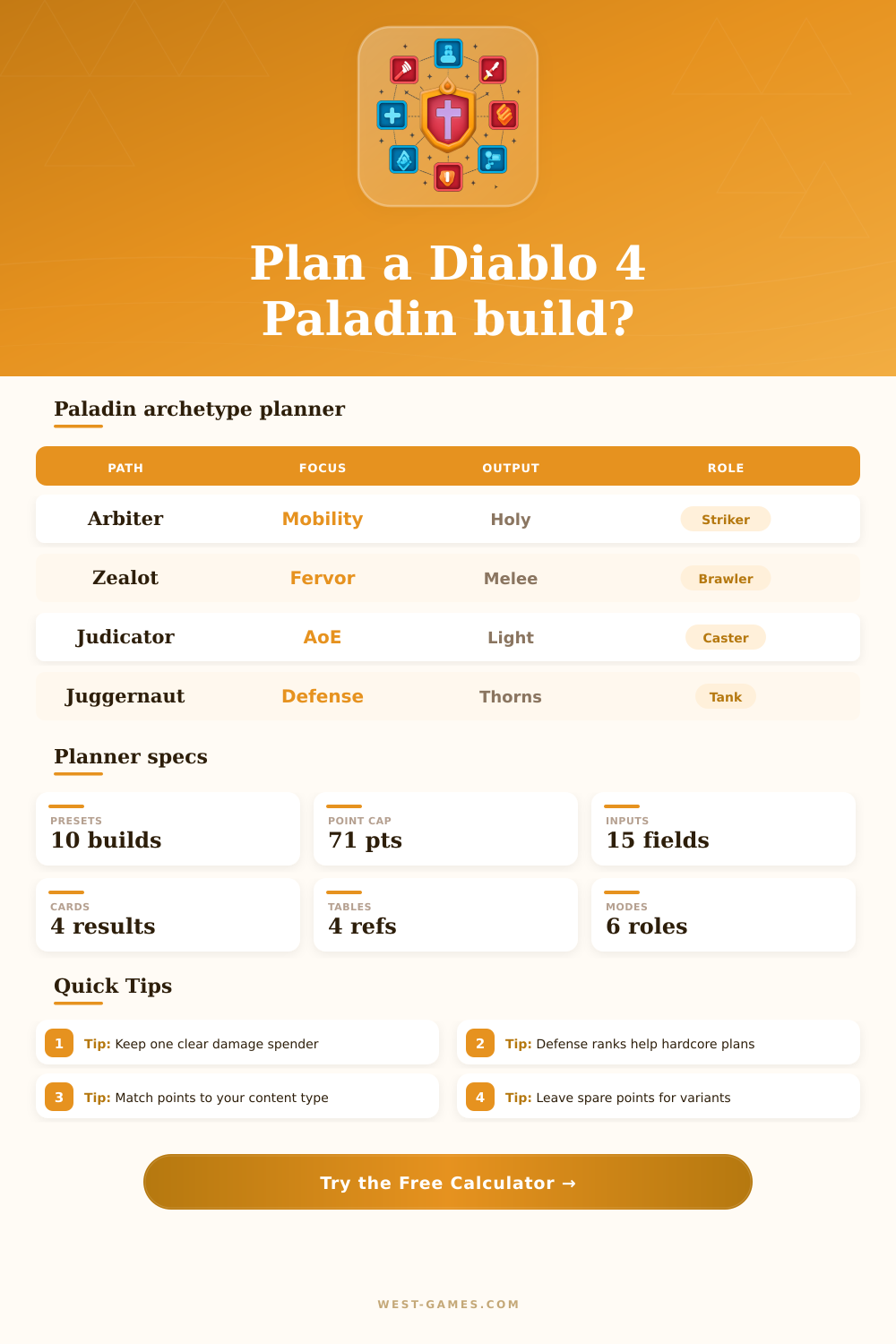
Plan Paladin point budgets, archetype fit, and build readiness for Arbiter, Zealot, Judicator, and Juggernaut setups.
| Archetype | Damage | Defense | Mobility |
|---|---|---|---|
| Arbiter | 28% | 17% | 26% |
| Zealot | 34% | 20% | 16% |
| Judicator | 36% | 14% | 12% |
| Juggernaut | 22% | 36% | 10% |
Weights are planner targets for evaluating a build, not locked in-game requirements.
| Role | Primary | Secondary | Risk |
|---|---|---|---|
| Solo | Damage | Defense | Medium |
| Boss | Single target | Uptime | High |
| AoE | Holy wrath | Mobility | Medium |
| Support | Auras | Survival | Low |
| Hardcore | Defense | Control | Very high |
Role emphasis changes the readiness score without changing your raw point budget.
| Family | Low | Balanced | Heavy |
|---|---|---|---|
| Basic | 1-3 pts | 4-6 pts | 7-12 pts |
| Core spender | 4-7 pts | 8-12 pts | 13-18 pts |
| Defensive | 3-6 pts | 7-11 pts | 12-18 pts |
| Mobility | 2-4 pts | 5-8 pts | 9-14 pts |
| Holy wrath | 4-8 pts | 9-14 pts | 15-20 pts |
| Aura support | 0-4 pts | 5-9 pts | 10-16 pts |
Use heavy investment when a legendary aspect, unique, or key passive multiplies that family.
| Preset | Best content | Point shape | Watch item |
|---|---|---|---|
| Arbiter Speed | Speed farms | Mobility first | Low mitigation |
| Zealot Brawler | Elite packs | Core plus defense | Cooldown gaps |
| Judicator Storm | Dungeons | Holy wrath heavy | Resource drain |
| Juggernaut Wall | Hardcore | Defense heavy | Slow clears |
| Group Aura | Party play | Aura heavy | Solo damage |
A good tree usually has one heavy family, two balanced families, and a clear reason for every spare point.
Planning an paladin in Diablo 4 involves using a limited pool of skill points to enable the paladin to function effective when faced with many enemy on the screen. A paladin use holy damage and defense at the same time, and so every skill point that is spent is important. Some players will choose a skill point allocation that reward speed and repositioning, while others will take more aggressive stance and choose to stand in the middle of the enemies they must kill.
The calculator above will mathematically calculate the value of your skill point allocation in the game. Because the calculator will compute these values, you may focus on your playstyle rather then the numbers. Each of the paladin archetypes in the game will use the same resources but in different ways.
Plan Your Paladin Skill Points in Diablo 4
Each archetype will have different requirements of the player to suit the archetypes. Players who choose the arbiter archetype will reward them for there repositioning. The zealot archetype require the player to focus on core damage and defense.
The judicator archetype will focus on dealing holy damage with area coverage. The juggernaut archetype will use their defense to increase their clear speed rather than investing in damage node. This calculation will compare a player’s skill point allocation to the weight each archetype uses and adjust for the role selected by the player.
This will provide a player with an idea of whether or not their skill tree is in good standing or whether their skill point allocation is aligned with the use they would like to make of their paladin in the game. The different skill families within the paladin class are important for the way that the paladin interacts with gear. Skills in the basic skill family will generate resource and enable the rest of the skills in the paladin’s rotation.
Core spender skills provides the main damage for the paladin and require heavy investment into them. Defensive skills will protect the paladin while they are using other skills, while mobility skills provide the paladin with the ability to move more frequent in the game. Holy wrath skills increase the damage that the paladin deals with holy damage, while aura skills allow the paladin to decide whether their paladin is create for solo or group play.
The tool will calculate these skills without having to commit their use in the game. A player’s choice of role will provide a difference in the value of the skills a paladin allocates to their paladin. A solo paladin will allow for the paladin to have lower defense while they deal with high damage into enemies.
A boss-focused paladin will reward the player for focusing on a single target rather than many enemy while also having high defense into their attacks. Players who wish to focus on helltide and dungeon farming will provide more value to holy wrath and mobility. For players who choose to support their group, the auras and survival skills will be rewarded.
For hardcore survivors, defense and control will be the focus of their paladin. For speed farming, both survival and mobility will be focused upon to allow the paladin to quickly clear the screen of enemies. Each of these role will have different weights reflected in the calculation of a player’s skill point allocation and effectiveness.
The mistake that many players commit with their paladin’s skill points include using an even spread of skill points into each category, ignoring the gear that enhances paladins’ skills, and ignoring the importance of defense for melee class. An even spread of skill points will result in the paladin not being able to efficiently perform in any specific area of the game. Investing too much into a skill that does not recieve legendary aspect will waste the player’s opportunity to use those skill multipliers.
Not investing enough in defense will result in failure against enemies with modifiers. Both the fit and readiness scores will inform the player of any of these issue. Although separate from the skill tree, cooldown reduction and holy damage will affect a paladin’s performance in the game.
High cooldown reduction will result in high uptime of defensive and mobility skills, increasing the value of the skill points that were invested into the paladin. Holy damage will increase the output of wrath skill and provide more value to a paladin with many holy nodes. Survival stats from armor or barrier will reduce the number of defensive skill ranks that the paladin must use to survive enemy attack.
These stats will be included in the calculation of a player’s readiness of the paladin in the game. A good plan will allow for some skill points to remain unused in case of any problem. If a player fully use every skill point available to the paladin, they will leave no margin for acquiring a unique item or changing aspect.
By leaving some skill points available, they will have the flexibility to adjust the paladin according to the content of the game or new gear. The budget status for a paladin will allow the player to see whether or not their skill point budget is tight or flexible before they have to commit their paladin’s skill points. Building the paladin involves the player making a decision on the general shape of their paladin’s skill tree and equipping their item accordingly.
While the skill point calculator can assist a player in planning their paladin, the player must make the final decision based off how the paladin feels when the player is actively playing the game.