⚔️ Rift Skill Tree Calculator
Plan soul splits, role goals, and capstone timing before you lock your Rift build.
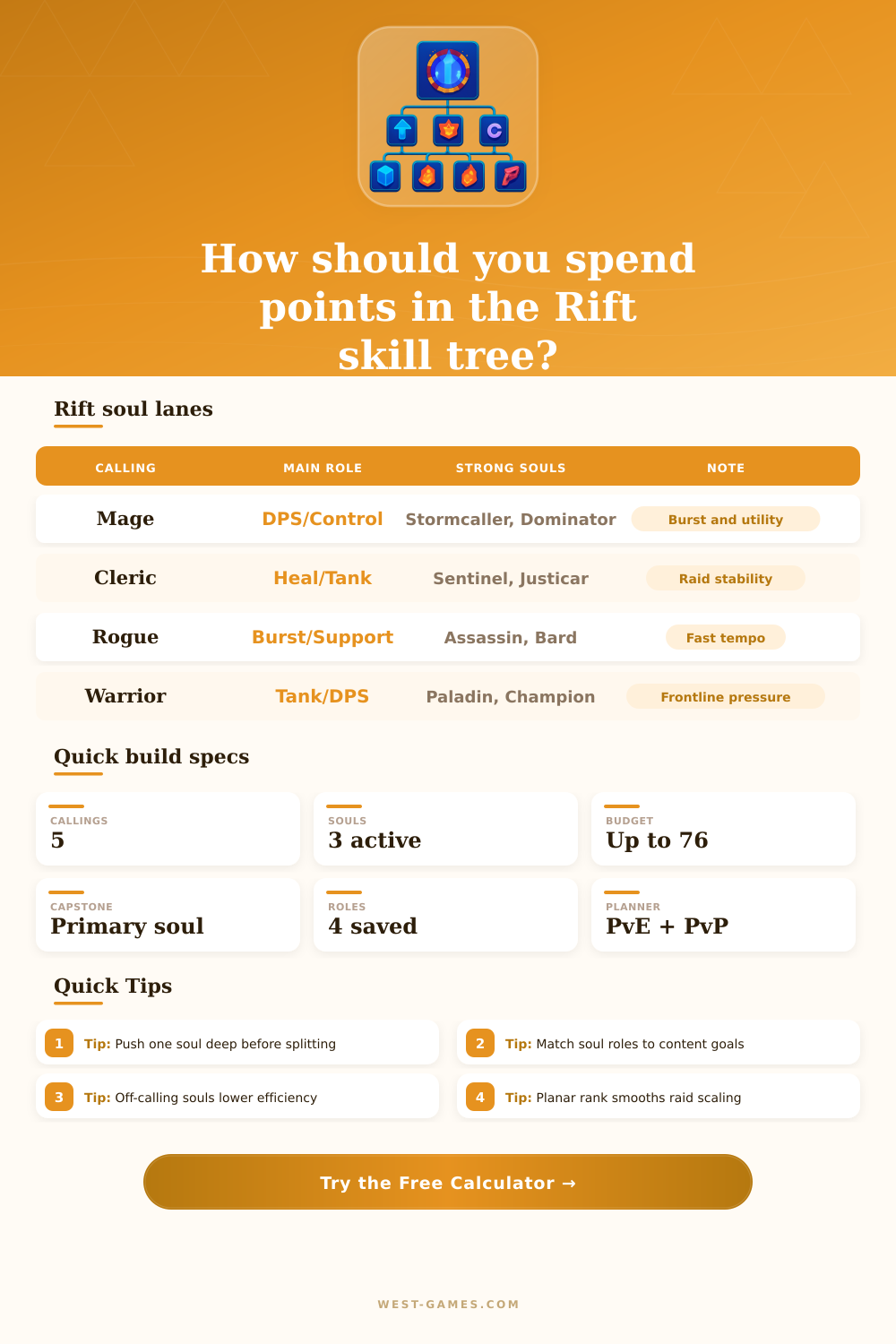
| Calling | Primary roles | Common souls | Plan note |
|---|---|---|---|
| Mage | DPS / Control | Stormcaller, Dominator | Strong burst and control swaps |
| Cleric | Heal / Tank | Sentinel, Justicar | Reliable raid stability |
| Rogue | Burst / Support | Assassin, Bard | Fast rotations, flexible utility |
| Warrior | Tank / DPS | Paladin, Champion | Frontline pressure and durability |
| Primalist | DPS / Hybrid | Vulcanist, Titan | Adaptive elemental routing |
Keep all three souls inside your calling when possible for better passive synergy.
| Points in soul | Band | Unlock pace | Use case |
|---|---|---|---|
| 0-15 | Starter | Core passives | Utility dip |
| 16-31 | Mid lane | Rotation tools | Secondary support |
| 32-43 | Deep lane | Major throughput | Main soul base |
| 44+ | Capstone push | Top-tier power | Endgame lock-in |
Most builds feel complete once the primary soul reaches the deep lane or capstone push.
| Goal | Top role weight | Secondary weight | Build signal |
|---|---|---|---|
| Raid DPS | Damage 100 | Control 55 | Push throughput and uptime |
| Raid Heal | Healing 100 | Support 72 | Stabilize sustained pressure |
| Dungeon Tank | Tank 100 | Support 48 | Prioritize mitigation chains |
| PvP Burst | Damage 92 | Control 80 | Win fast windows and resets |
| Solo Farming | Damage 82 | Self-heal 68 | Speed clears with sustain |
The calculator grades your selected souls against these weights for a practical content-fit score.
| Build style | Primary pts | Secondary pts | Tertiary pts | Notes |
|---|---|---|---|---|
| Deep carry | 46 | 20 | 10 | Strong capstone timing |
| Balanced hybrid | 40 | 24 | 12 | Stable utility spread |
| PvP control | 38 | 26 | 12 | More lockdown tools |
| Support first | 36 | 28 | 12 | Raid safety and buffs |
Use these as guardrails, then tune by encounter needs and your gear stage.
When you reach level 61 in teh game, you will have access to soul points that you can distribute among the available soul trees to increase your character’s power. However, you must be careful with how you distribute these points because spreading them too thin across the soul trees will leave you with a character that dont provide the maximum amount of power to your raids. Focus your soul points on a few areas of your character rather than try to increase the power of every soul tree.
You have access to three souls that you can level up with your soul points. These souls can be your primary soul, your secondary soul, and your tertiary soul. Your primary soul will provide the most significant amount of power to your character, so you should allocate the majority of your soul points to this soul.
How to Use Soul Points at Level 61
Many players chooses to allocate 44 soul points to their primary soul. Players allocate 44 points to their primary soul because 44 soul points will allow them to reach their capstone ability. Capstones are essential ability that significantly change the functionality of your character; thus, reaching the capstone of your primary soul is one of the goals that most players aim to achieve by the time they reach level 61.
Your secondary soul should receive between 20 and 25 soul points to give you additional tools for your combat rotation. Your tertiary soul, which provide the least amount of power to your character, should have a small amount of soul points allocated to it to allow you to reach certain breakpoints in your soul trees. Your character’s calling determines the best souls that work for your character.
For instance, mages has calls that work best for burst damage and control. Thus, the best souls for mages include a Stormcaller and a Dominator. Clerics have calls that work best for healing others in your raid.
Thus, the best souls for a cleric will include a Sentinel or a Justicar soul to assist with healing your raid. For characters such as rogues, the best souls will include Assassin souls for burst damage. Warriors have a few different souls that work the best for their calling.
Rogues will use Champion or Paladin souls to provide their defenses and mitigate incoming damage from their raid. You must ensure that the souls that you allocate your soul points to match your character. If you use souls that do not match your character’s calling, your character will be less efficient with your abilities and your passives will not perform as good as they could.
Your goal for your character will determine your point distribution within your soul trees. If you want your character to deal damage in your raid, your best bet is to use a Pyromancer soul for your primary soul. If you are playing a healer, your best point allocation will be to a soul that provide stability and healing-over-time abilities, such as the Chloromancer soul.
If you are playing a tank for dungeons, prioritize point allocations that will increase your mitigation abilities. For PvP, prioritize souls that offer the best amount of control and damage in the shortest amount of time. For example, if your goal as a player is to farm content alone, you will want to use a soul point distribution such as a 46-20-10 split for your dominance for your primary soul or a 40-24-12 split to create a flexible character that can fulfill a variety of role in your game.
Many players make mistakes with their distribution of soul points. Using a capstone ability that does not match the role of your character to maximize your damage is one mistake. Players often spread their soul point allocations too thinly across their souls, which limits the power that they can recieve from the character build.
Any character that does not have at least 32 points allocated to their primary soul will not feel the same level of completion from their character that they could if they had allocated the points optimal. Your character plan should of account for your future levels because the character plan that works for level 61 may not continue to provide your character with the power that they requires at level 70. Beyond distributing your soul points, there are other aspects of the game that will increase the power of your character.
Mastery tiers will give you additional mathematical advantage to your character, and planar essence will provide additional ways to boost your character’s power. Do not ignore the planar essence aspect of your character because this will limit your character’s power in expert content. Use the presets available for your character to plan your point distribution.
These will show you the best ways to allocate your soul points to reach specific mastery tier for your character. Using these presets will allow you to avoid any mistake that you may make in the allocation of your character’s soul points.