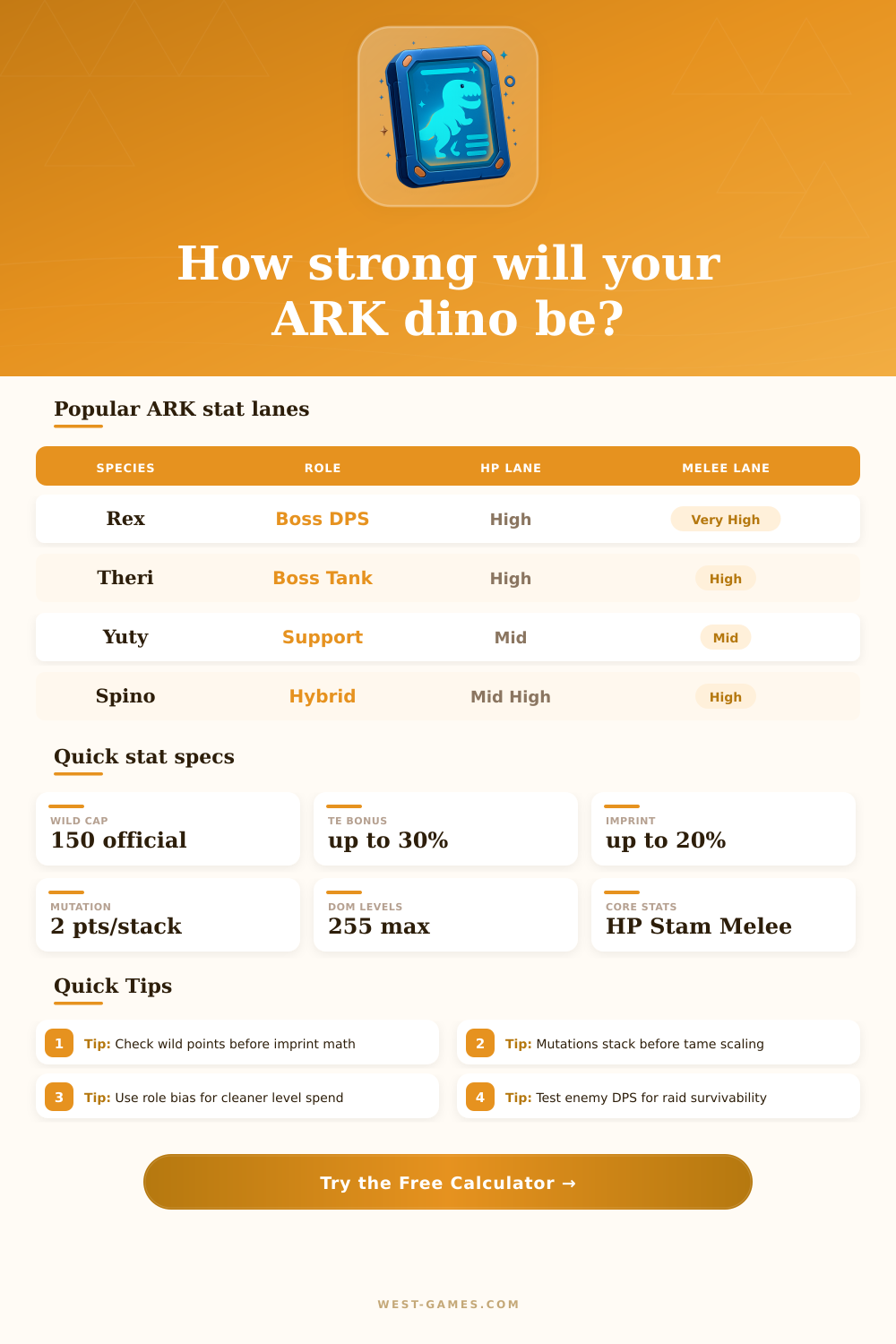
🦖 ARK Dino Stat Calculator
Estimate tame scaling, imprint bonus, and mutation value before you lock your breeding line or boss roster.
| Species | Base HP | Base Stam | Base Melee | Weight |
|---|---|---|---|---|
| Rex | 1100 | 420 | 100% | 500 |
| Therizino | 870 | 350 | 100% | 365 |
| Yutyrannus | 1100 | 400 | 100% | 500 |
| Spino | 700 | 350 | 100% | 350 |
| Argentavis | 365 | 400 | 100% | 350 |
| Baryonyx | 440 | 325 | 100% | 325 |
| Giganotosaurus | 80000 | 400 | 100% | 700 |
| Megatherium | 1000 | 350 | 100% | 400 |
| Carnotaurus | 420 | 300 | 100% | 300 |
Use this table to compare raw stat floors before wild and mutation investment.
| Server | HP tame | Melee tame | Domestic | Imprint |
|---|---|---|---|---|
| Official PvE | 1.00 | 1.00 | 1.00 | 1.00 |
| Official PvP | 0.90 | 1.10 | 0.95 | 0.90 |
| Small Tribes | 1.10 | 1.15 | 1.10 | 1.00 |
| Unofficial Boosted | 1.35 | 1.40 | 1.30 | 1.10 |
| Single Player | 1.45 | 1.35 | 1.40 | 1.20 |
Pick the server profile that matches your cluster settings before reviewing results.
| Role | HP focus | Melee focus | Stamina focus | Target EHP | Target Melee | Primary use |
|---|---|---|---|---|---|---|
| Boss DPS | 35% | 50% | 15% | 85000 | 950% | Main boss damage mount |
| Boss Tank | 55% | 30% | 15% | 120000 | 650% | Damage soak and aggro |
| Cave Runner | 40% | 35% | 25% | 45000 | 500% | Tight cave survival |
| Flyer Utility | 25% | 20% | 55% | 18000 | 300% | Carry, scout, relocate |
| PvP Burst | 30% | 60% | 10% | 60000 | 1200% | High pressure raids |
| Line Breeder | 45% | 40% | 15% | 90000 | 900% | Foundation breeding stock |
Target values are practical planning anchors, not hard caps.
| Stage | HP stacks | Melee stacks | Extra points | Typical result | Use case |
|---|---|---|---|---|---|
| Starter line | 0-5 | 0-5 | 0-20 | Early boss viable | Quick progression |
| Mid line | 10-20 | 10-20 | 40-80 | Strong raid baseline | Daily cluster runs |
| Late line | 25-35 | 25-35 | 100-140 | High end boss clears | Tribe primary line |
| Cap chase | 40+ | 40+ | 160+ | Specialized extremes | Niche min-max projects |
Keep mutation lines isolated by stat to prevent wasted stack inheritance.
The statistic for all dinosaurs in ARK will determine the effectiveness of the dinosaur in combat. The effectiveness of the dinosaur relate to how much damage that it can take or how much damage that it can deal with other dinosaur in combat. Many player may focus on the total level of there dinosaurs, but the individual statistics of their dinosaurs are more important than the total level of their dinosaurs.
The statistics for all dinosaurs in the game are referred to as the wild statistics. Mutation are added to these statistics, and the taming effectiveness multiply the total of the wild statistics and the mutations. The domestic level of a dinosaur are applied last to the wild statistics and mutations.
How Dinosaur Stats Work in ARK
For example, a dinosaur with high wild statistics will have more higher total statistics after taming than a dinosaur with low wild statistics, even if the dinosaur with low wild statistics has a high number of domestic levels. In order to maximize the total statistics of a dinosaur, players should seek out dinosaurs with high wild statistics. Different roles require different distribution of statistics for the dinosaurs.
For example, if a player desire to use a dinosaur to take damage, then the dinosaur should have high melee damage statistics and health statistics. If a player focuses only on melee damage statistics for their dinosaur, then their dinosaur may tire, and they wont be able to attack other dinosaurs. If a player desires for their dinosaur to tank damage, it will require high health statistics.
One way to calculate the health of a dinosaur is with a calculator. The calculator will calculate the effective health of the dinosaur by taking the total raw health statistics and adding the protection statistics from the armor on the saddle. The effective health of a dinosaur will determine the number of seconds that the dinosaur will survive a specific amount of damage per second.
Mutations can be used to increase the statistics of the dinosaurs. Each mutation will increase the specific statistic of a dinosaur in the wild by two point. These mutations are applied prior to taming the dinosaur.
Using mutations will allow players to increase the damage that their dinosaurs can make without having to increase the domestic level of their dinosaurs. Using too many mutation, however, can lead to inbreeding the dinosaurs. Inbreeding can lead to poor outcome for the statistics of the dinosaurs created from these lines.
Many people will use between 10 and 20 mutation stack for each statistic to provide increased statistics to their dinosaurs without inbreeding their population of dinosaurs too much. The type of kibble that is used to tame the dinosaurs will also impact the total statistics of the dinosaurs. Using exceptional kibble will result in high taming effectiveness for the dinosaurs, which will allow the player to retain the statistics of the dinosaurs.
Using berry instead of kibble will result in lower taming effectiveness. This will lead to lower total statistics for the dinosaur. Additionally, the imprint percentage should be high for the taming process.
A high imprint percentage will result in bonus for the rider for that specific dinosaur. Using a low imprint percentage will result in a low amount of these bonuses for the rider. There are some mistake that players should avoid when managing the statistics of their dinosaurs.
One mistake is to increase domestic levels for only one category of statistic for the dinosaurs. Another mistake is to test the melee damage of their dinosaurs without also ensuring that the statistics of the dinosaur can take the amount of damage that it will take from other enemies. Always model the type of threat that the dinosaurs will see, and equip the saddle to match the role of the dinosaur.
Additionally, always stabilize one male line for each category of statistic before cross-breeding lines of dinosaurs. Successful breeding of dinosaurs require the projection of the outcome of different breeding lines.