🚀 Kerbal Space Program Delta V Calculator
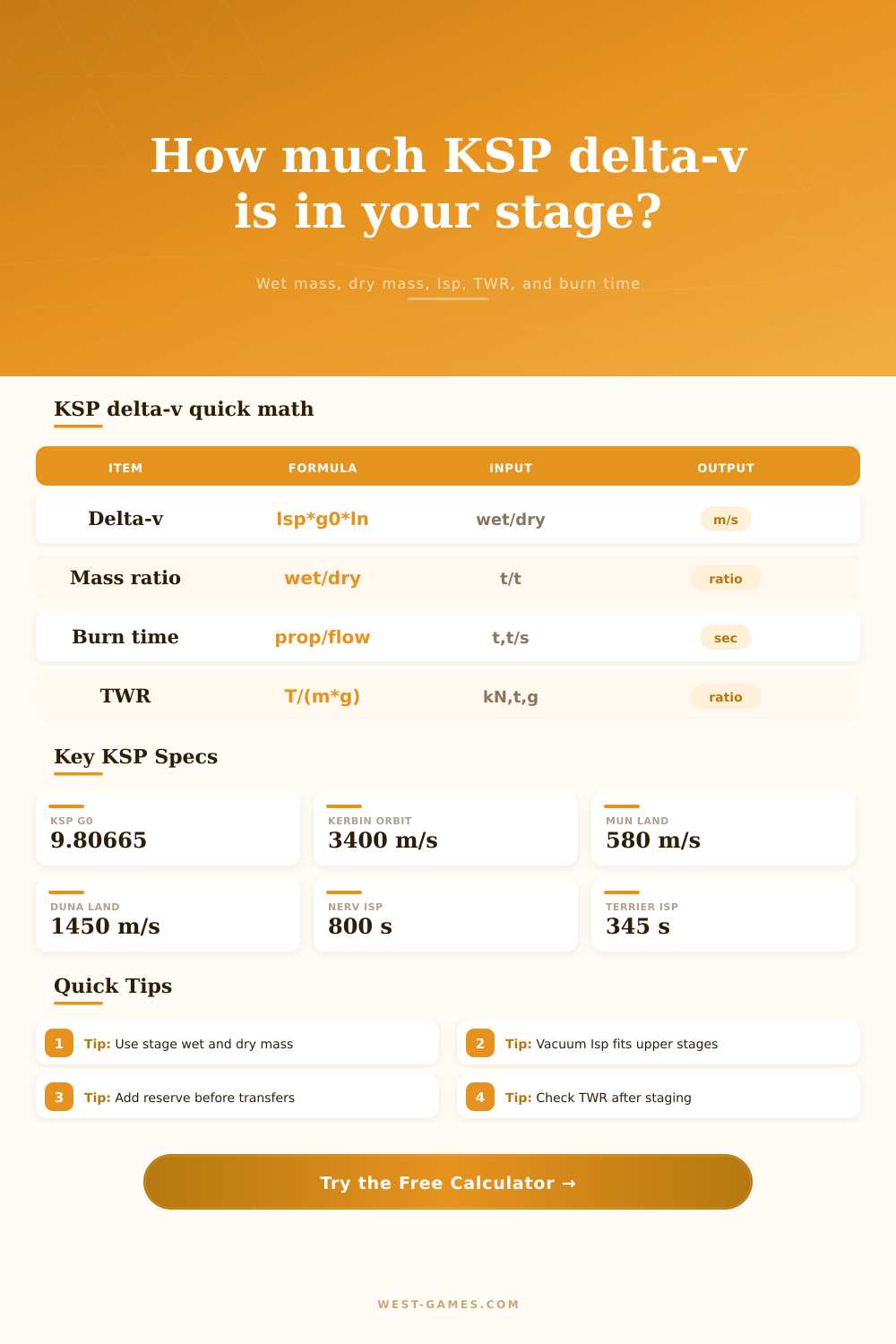
Plan KSP stages with the Tsiolkovsky rocket equation, stock engine Isp presets, wet and dry mass, local gravity, target delta-v, reserve margin, TWR, and burn-time estimates.
| Engine | Role | Vac Isp | Sea Isp | Vac thrust | Sea thrust | Engine mass |
|---|---|---|---|---|---|---|
| LV-T30 Reliant | Simple lower stage | 310 s | 265 s | 240 kN | 205.16 kN | 1.25 t |
| LV-T45 Swivel | Steerable early launcher | 320 s | 250 s | 215 kN | 167.97 kN | 1.50 t |
| LV-909 Terrier | Small vacuum lander | 345 s | 85 s | 60 kN | 14.78 kN | 0.50 t |
| 48-7S Spark | Tiny probe or hopper | 320 s | 270 s | 20 kN | 16.56 kN | 0.13 t |
| RE-L10 Poodle | Medium vacuum stage | 350 s | 90 s | 250 kN | 64.29 kN | 1.75 t |
| RE-M3 Mainsail | Heavy lifter core | 310 s | 285 s | 1500 kN | 1379.03 kN | 6.00 t |
| S3 KS-25x4 Mammoth | Very heavy booster | 315 s | 295 s | 4000 kN | 3746.03 kN | 15.00 t |
| LV-N Nerv Atomic | Long-range vacuum tug | 800 s | 185 s | 60 kN | 13.88 kN | 3.00 t |
| Goal | Typical budget | Best Isp mode | TWR note | Reserve note |
|---|---|---|---|---|
| Kerbin surface to low orbit | About 3400 m/s | Pressure to vacuum mix | Start above 1.2 on Kerbin | Add room for gravity turn errors |
| Low Kerbin orbit to Mun intercept | About 860 m/s | Vacuum | Low TWR is workable | Keep capture correction margin |
| Mun landing from low orbit | About 580 m/s | Vacuum | Hover-capable TWR helps | Keep landing hover fuel |
| Minmus landing from low orbit | About 180 m/s | Vacuum | Very low TWR can work | Reserve covers slope changes |
| Low Kerbin orbit to Duna intercept | About 1060 m/s | Vacuum | Nerv burns can be long | Add correction and capture margin |
| Tylo land and return segment | High: 2200+ m/s each way | Vacuum | High TWR is vital | Plan generous descent reserve |
| Metric | Formula used | KSP unit detail | When to watch it |
|---|---|---|---|
| Delta-v | Isp x 9.80665 x ln(wet / dry) | Mass can be tonnes or kg if both masses match | Every stage design |
| Mass ratio | Wet mass / dry mass | Dry mass includes payload above this stage | When adding tanks gives weak gains |
| Propellant fraction | (wet - dry) / wet | Shown as a percent of wet stage mass | When comparing tank layouts |
| Mass flow | Total thrust / (Isp x 9.80665) | kN divided by m/s gives tonnes per second | Burn-time planning |
| Initial TWR | Total thrust / (wet x local gravity) | 1 kN equals 1 t m/s2 in KSP-style units | Launches, landings, Tylo, Eve |
| Pressure Isp | Sea Isp to vac Isp interpolation | First-order estimate for 0-1 atm | Atmospheric ascent estimates |
You spend three hours in Vehicle Assembly Building. You put it all together carefuly, arrange the engines and tanks just so. Yes, that’s a good-looking rocket there. It has good symmetry. The parts is all there. Fire up the main engines. Flip the throttle switch. And then… crack! The rocket tear itself to pieces on the launch pad.
No, it wasn’t bad luck. It wasn’t some oddity of physics engine. The issue was failing to take rocket equation into account. In spaceflight, delta-v is the currency. Get out calculator and start tracking how much you’re spending.
Why Rockets Break and How to Fix Them
This is what I used to solve Tsiolkovsky rocket equation for me: According to the equation, your speed are proportional to exhaust velocity and mass of fuel divided by mass of empty rocket. Seems straightforward? Adding fuel adds weight, which require more fuel to lift, which adds even more weight. To get off the ground again, you’ll need another pound of fuel, which in turn means another pound of added weight. That’s where amateur rocket designer goes wrong, designing rockets that appear to be powerful but have no range.
Before committing yourself to any design, you must has an idea of how much fuel you can carry. There’s also a difference between transfer stage and launch stage. Atmospheric drag and gravity pull at you when you’re at Kerbin, trying to lift off. At that point, what you want is a lot of thrust for your weight. Use dense fuel. Use big engines.
Once you get up into space, where there’s no atmosphere, efficiency matter. This is where specific impulse, or Isp, can helps you out. High-Isp engines burns fuel slowly, but they put out more delta-v for every ton of propellant. The calculator has an option to switch back and forth between vacuum and sea-level Isp. All too often people thinks “engine = engine” and don’t differentiate between how different engines performs in different environments.
High mass reduces your delta-v. All that weight you have to haul around includes tanks, engines, and parts. It is dry mass. Too much dry mass? No matter how much fuel you add, you’ll lose. The mass ratio is calculated based off both your dry mass and your wet mass. Even an expensive engine won’t give you a good delta-v if your mass ratio are low. Frequently, it’s better to shave off some dry mass rather than adding some fuel tanks. Adding tanks will increase your wet mass.
Another important input is reserve margin. This is the engineering term for a safety buffer against unexpected actions or miscalculations. In space travel it’s the same thing. Should you calculate just enough delta-v to get to the Mun? A tiny steering mistake might strand you there forever. Ten to fifteen percent reserve isn’t pessimism. It’s survival. When the calculator calculates your total delta-v, it removes the reserve so that you know how much you can count on.
Get going fast with preset buttons. For example, they load common mission parameters such as Duna landings or Kerbin orbit insertion. It is not a solution but a starting point. The numbers depends on what engine you use, how much payload you carry, and how you pilot it. Take the presets to learn about the baseline requirement, and tweak to match your design.
Trade-offs are rocket science. High efficiency? High thrust? Rarely both. Heavy shielding? Low dry mass? Expect the math to penalize at least one of those choices. It’s not about maximizing all numbers. It’s about balancing them until the rocket flies.
You should of had patience and the right tools, and soon enough you won’t crash on the pad anymore. You’ll reach the stars. You’ll know that the engines cuts off in orbit with exactly the speed change you’d planned.