⚔️ BG3 Stat Calculator
Plan ability spread, attack reliability, and spell pressure before locking your party role.
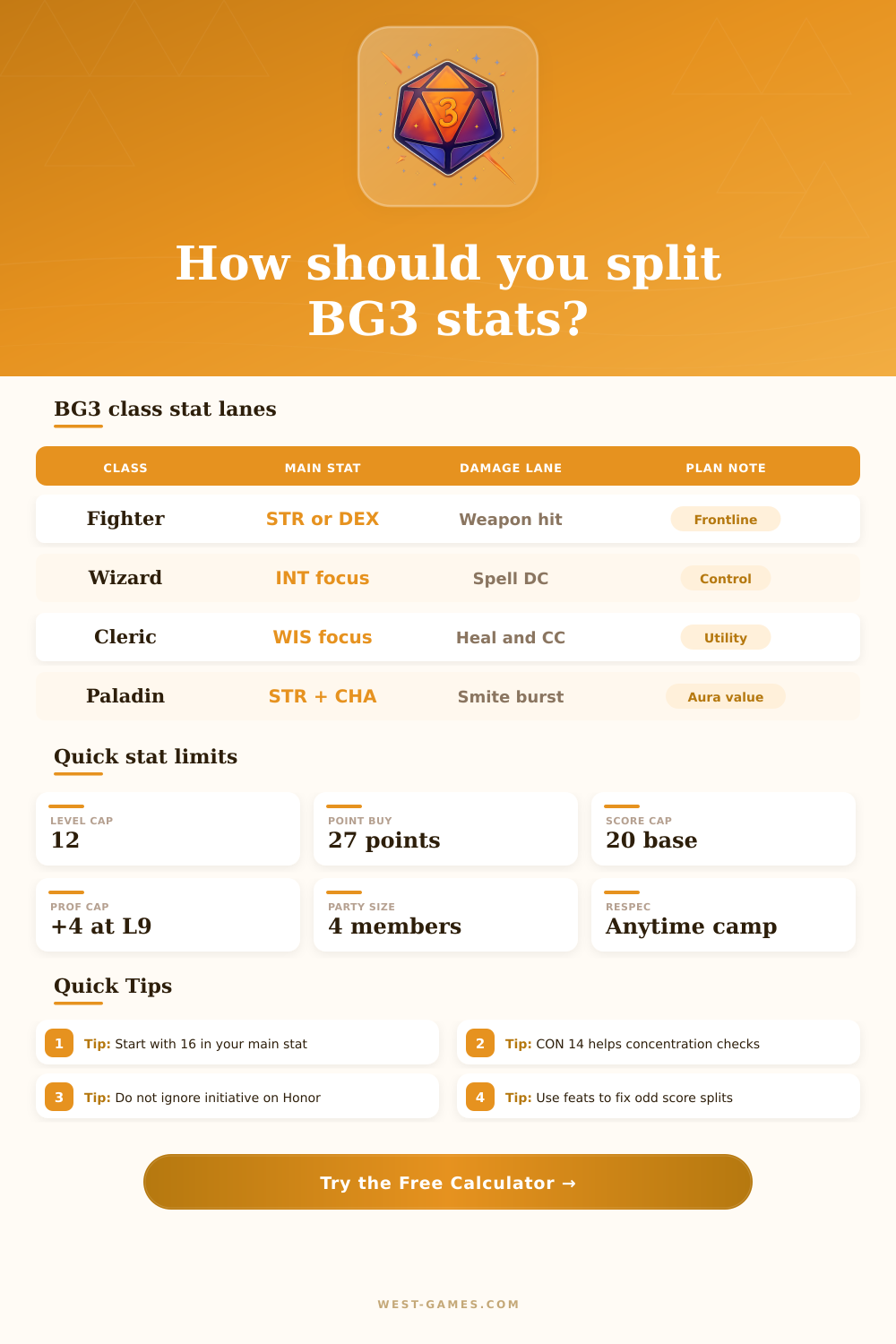
| Class | Main | Backup | Note |
|---|---|---|---|
| Fighter | STR or DEX | CON | Accuracy first |
| Rogue | DEX | CON | Initiative lane |
| Wizard | INT | CON | Control uptime |
| Cleric | WIS | CON | Support safety |
| Paladin | STR | CHA | Smite + aura |
| Bard | CHA | DEX | Face utility |
Most builds stabilize when main stat reaches 16 and CON stays at least 14.
| Score | Mod | Power jump | Use |
|---|---|---|---|
| 10 | +0 | Base | No bonus |
| 12 | +1 | Early | Utility stat |
| 14 | +2 | Stable | CON floor |
| 16 | +3 | Core | Main stat |
| 18 | +4 | Late spike | Act 3 push |
Even-number thresholds matter because odd scores do not increase modifiers.
| Mode | Target AC | Enemy save | Priority |
|---|---|---|---|
| Explorer | 15 to 16 | +2 to +3 | Flexible stats |
| Balanced | 16 to 18 | +3 to +5 | Main stat focus |
| Tactician | 18 to 20 | +5 to +7 | Hit and defense |
| Honor | 19 to 21 | +6 to +8 | Initiative value |
Harder modes reward clean identity and punish over-splitting into too many secondary stats.
| Style | Attack stat | AC trend | Build note |
|---|---|---|---|
| Two-Handed | Strength | Mid | Big hits, lower defense |
| Finesse | Dexterity | High | Fast and accurate |
| Archery | Dexterity | Range safety | Positioning heavy |
| Dual Wield | Dexterity | Low | Many attack rolls |
| Shield Caster | Spell stat | High | Safe concentration |
| Staff Focus | Spell stat | Low | Needs team peel |
Pick style first, then align ability points so feats and equipment scale the same plan.
When you create a character for Baldur’s Gate 3, you will have to distribute your ability scores. These ability scores will determines how well you perform in combat and how well you survive the fight. For instance, if you place too many point into Strength for a character that also has high casting ability, that character will struggle with saving throw.
If you dont place enough points into Constitution for your character, they will have low health and die easy during fights. You should understand the ability score breakpoint for your character so that you can spend your points efficient. Each ability score has a breakpoint, such as 14 or 16, which provides the player with a more higher ability modifier for there character.
How to Choose Ability Scores in Baldur’s Gate 3
The higher the ability modifier for the scores for attacks, saving throws, or health rolls, the more benefit a player will provide to their character. For example, an ability score of 14 will have a higher modifier than an ability score of 13. An ability score of 15, however, will be less efficient as there will be a higher score need for the modifier to increase.
Even ability scores, such as 16, are better for players as every point invested will provide benefits to the characters ability scores. The class of your character will dictate which ability you should prioritize. Fighters and Paladin will take their Strength score as their primary attribute as this will improve their melee attack.
Rogues and Rangers will take their Dexterity score as their primary attribute as this will provide benefit to their initiative and armor class. Wizards will prioritize their Intelligence score for increased spell accuracy. Clerics will prioritize their Wisdom score for improved spell accuracy.
Sorcerers and Bards will prioritize their Charisma score for spell accuracy. These may become more difficult to balance if you are planning to multiclass for your character. Your role in the game also dictates your abilities.
Tanks will have a high value for the Constitution ability score. Rogues will have a high value for their Dexterity score as this will improve their damage, stealth, and dodging check. If you are playing on Honor mode, you must consider your abilities as the enemies has higher armor classes and saving throws.
If your character has a low chance of hit the enemies on Honor mode, they will fail to hit their enemies and struggle in the fights. Other elements to consider include the gear you plan to use and the buff you may use for your character. Gear item such as weapons and spell focuses will increase your attack and spell save rolls.
With the increase in the effectiveness of the gear, you may not need to invest many points into your ability scores. Temporary hit points from potions or aura will also improve the health of your character, which is important in combat as it will allow them to fight longer. A common mistake when creating characters is to distribute the points too thin amongst the six ability scores.
If you make each ability score mediocre, your character will have missed attack and failed save. Focus on your primary and secondary abilities. Make your primary ability score 16 and your Constitution score at least 14.
You can purchase feats, such as the Ability Score Improvement feat, to increase your ability scores after character creation. The composition of your party is also important. Your party will have four member.
Each member should have a different role in the party. A tank, a striker, a controller, and a support character. If all of the member have the same weakness, the party will struggle against enemies with spells or effects that exploit those weaknesses.
In order to succeed in the game, you must have a good understanding of how to distribute your character ability. By focusing on the ability score breakpoints, your class, and your character roles, you can create a well-rounded character. Focus on even number for your ability scores and prioritize your primary abilities for best results.
Following these suggestion will allow your character to perform better in the game encounter.