🔥 Dark Souls Soul Cost Per Level Calculator
Plan the soul cost from your current Soul Level to a target Soul Level, with class starting levels, held souls, bloodstain recovery odds, soul gain modifiers, runs per hour, and remaining time.
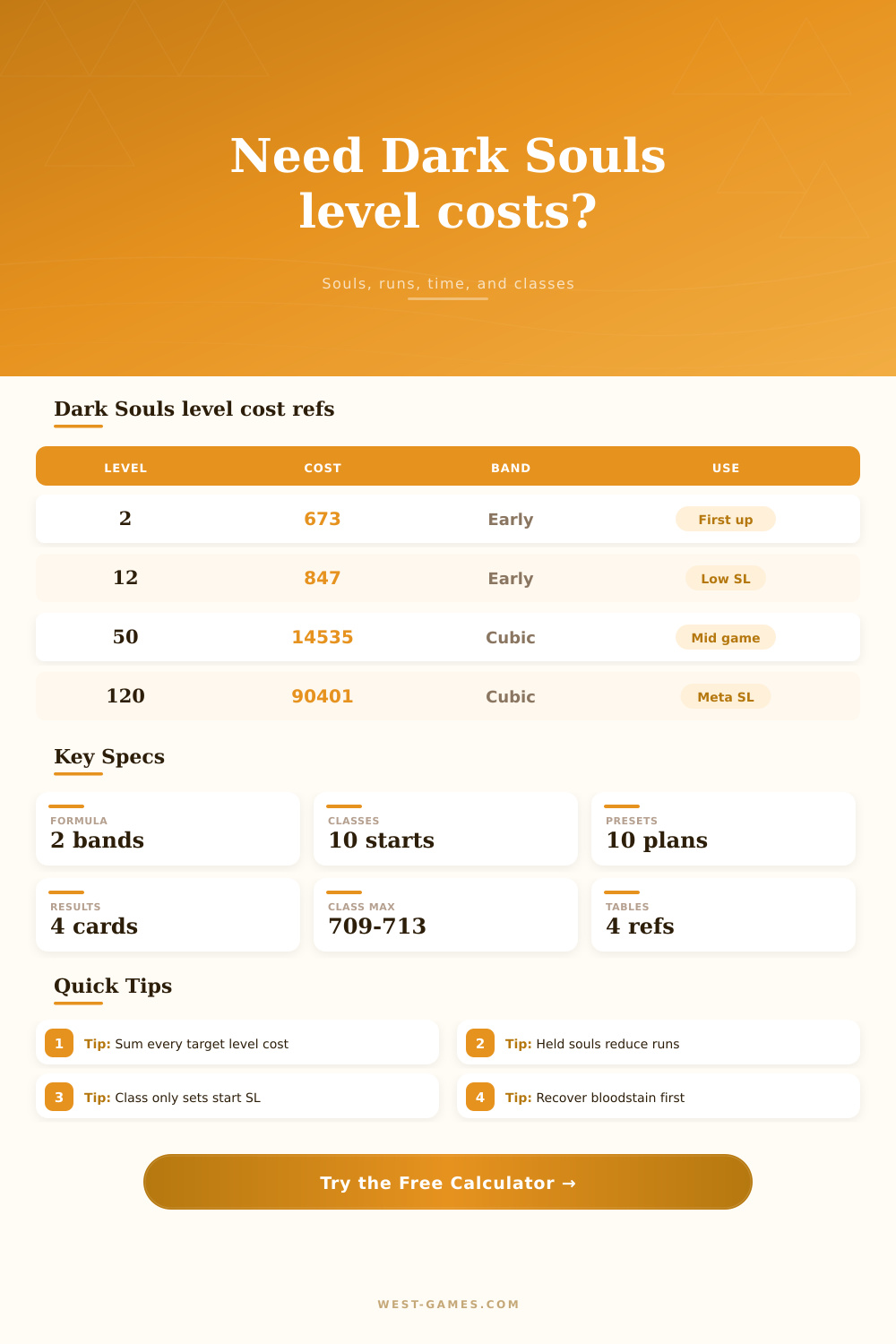
Uses the low-level table curve, with SL2 costing 673 and SL12 costing 847.
Uses the published cubic formula with the desired level as x.
Toggle whether banked or carried souls reduce the number of runs still needed.
Combines souls per run, bonus souls, modifier percentage, efficiency, and minutes.
Starting class does not change the formula; it changes where your sum begins.
| Target level purchased | Formula used | Rounding | Example result | Calculator use |
|---|---|---|---|---|
| SL2 through SL12 | 0.0068x³ - 0.06x² + 17.1x + 639 | Nearest soul | SL2 = 673 | Low starting class plans |
| SL13 and higher | 0.02x³ + 3.06x² + 105.6x - 895 | Nearest soul | SL13 = 1,039 | Most build planning |
| Current to target sum | Sum cost(level) for levels current + 1 through target | Each level rounded | SL1 to SL12 = 8,348 | Total souls needed |
| Bloodstain estimate | Lost souls x recovery chance | Expected value | 20,000 x 75% | Recovery planning |
| Remaining run estimate | Remaining souls / effective souls per run | Runs rounded up | 4.2 runs = 5 | Time and run planning |
The variable x is the target Soul Level being purchased, not the number of level-ups in the plan.
| Class | Starting SL | First paid level | First level cost | Max SL | Use in calculator |
|---|---|---|---|---|---|
| Pyromancer | 1 | SL2 | 673 | 709 | Lowest class start |
| Cleric | 2 | SL3 | 690 | 710 | Faith-oriented start |
| Wanderer | 3 | SL4 | 707 | 709 | Dexterity-oriented start |
| Sorcerer | 3 | SL4 | 707 | 713 | Intelligence-oriented start |
| Warrior | 4 | SL5 | 724 | 710 | Quality stat start |
| Bandit | 4 | SL5 | 724 | 710 | Strength-oriented start |
| Hunter | 4 | SL5 | 724 | 710 | Bow and dex start |
| Knight | 5 | SL6 | 741 | 711 | Durable melee start |
| Thief | 5 | SL6 | 741 | 711 | Dexterity utility start |
| Deprived | 6 | SL7 | 758 | 710 | Even-stat start |
Class choice only sets the starting point. Once two characters share the same Soul Level, the next-level cost is the same.
| Current to target | Levels bought | Last level cost | Total souls | Planning note |
|---|---|---|---|---|
| SL1 to SL12 | 11 | 847 | 8,348 | Entire low-level band |
| SL1 to SL25 | 24 | 3,970 | 39,704 | Early build foundation |
| SL1 to SL50 | 49 | 14,535 | 262,493 | Mid-game stat spread |
| SL1 to SL70 | 69 | 28,351 | 689,404 | Large first-play plan |
| SL1 to SL100 | 99 | 60,265 | 1,997,921 | High character plan |
| SL1 to SL120 | 119 | 90,401 | 3,506,802 | Common meta target |
| SL1 to SL125 | 124 | 99,180 | 3,984,935 | Extended duel target |
Cumulative examples begin from SL1, so a higher starting class needs fewer purchased levels for the same target.
| Run setup | Souls per run | Minutes per run | Souls per hour | Use case |
|---|---|---|---|---|
| Early loop | 2,500 | 5 | 30,000 | Low-level top-ups |
| Depths route | 7,000 | 7 | 60,000 | Early mid-game plan |
| Forest route | 12,000 | 8 | 90,000 | Reliable repeated run |
| Anor Londo route | 18,000 | 9 | 120,000 | Mid-level farming pace |
| Archives route | 28,000 | 10 | 168,000 | Higher-level planning |
| Painted route | 45,000 | 12 | 225,000 | Longer efficient loop |
| NG+ route | 70,000 | 12 | 350,000 | Repeat playthrough pace |
These are calculator planning presets, not walkthrough values. Enter your measured souls and minutes for your exact route.
Dark Souls starts out hopeful: it’s a new game and you’re going to kick ass! By the second bonfire, however, that hope has turned into dread: each point in each stat require a massive number of souls. And those enemies don’t care that you want them dead. They’ll keep coming at you until you get it right, and you will spend hours in combat. That struggle between ambition and resources is game’s loop. It makes you consider whether an additional point in vitality is worth it given how much time you will spend re-running Undead Parish route.
Once you input where you are and what you want to be, the calculator does the rest of work. It calculates cost per stat point, total stat points needed, and hours you’ll need to put in. This way, you can avoid mentally crunching the time estimates and cumulative soul costs. Now you can determine whether you have time for level fifty tonight, or it’s going to take days. Simply input values and let calculator show you what it takes.
Plan Your Leveling in Dark Souls
As you level up, however, equation shifts. There are two very clear levels of difficulty in how hard it is to upgrade your character. In the beginning levels, the game doesn’t want you to be poor. It wants you to have a sense of power following the tutorial. As such, first couple levels are quite cheap. You’ll be able to test out various builds without feeling punished for your souls.
Once you hit that critical mass where you’re no longer in the first 10 levels or so, though, the formula flips over. Instead of being linear, cost becomes exponential. This is the section most people fail to grasp. They see leveling up as a linear process but instead it’s exponential. Going from level 50 to 100 will cost you far more than all the other 50 levels combined. Your efficiency has to increase along with your stats. If you reach higher levels but keep farming mid-to-late game enemies, you will see diminishing returns and spend more time then necessary.
The first thing we do is plug in your starting class; which, contrary to popular belief, isn’t as important as you’d think, since it’s only the starting point for our calculation (a Pyromancer character will begin at level 1 and a Deprived character begins at level 6). But if you’ve used those souls elsewhere (as many builds require), then that means you’re beginning from level 6. And guess what? Even if you start at level six as a Deprived, it doesn’t matter how much you spent getting there: the game only tracks the level you want to buy. It doesn’t matter how you started, whether as a weak sorcerer or a tanky knight. By the late game, all that matters is how many souls you are willing to spend to become whatever you want to be.
This is where planning becomes execution, planning out your farming runs. Depending on the area and your skill level, you should of had some idea of how many souls you will generate each hour. For example, a speedrunner who knows exactly where all the enemies spawn may only take 10 minutes each run, whereas a more casual player may take twice as long with lots of deaths. Plug those numbers into the calculator and it gives you an estimated time to complete.
However, don’t forget to factor in the time it takes to run back to your bloodstain and respawn after death. If you aren’t accounting for this and assuming perfect efficiency, your calculation will be off by hours. That’s why there is an input for recovery chance. It makes you consider the odds of you dying before you’ve had enough time to bank your souls. One careless mistake with your checkpoint placement can negate an hour worth of work.
Leveling up in Dark Souls means balancing your character strength against what it needs to face. How do you become strong enough without making yourself too strong? If you’re too high leveled, you’ll suck all the challenge out of the game. Generally speaking, most optimized builds peak at roughly level one hundred and twenty, after which the next point becomes more expensive than it is worth. Beyond there you need millions of souls and dozens upon dozens of hours spent mindlessly grinding.
Choose between patience and power. That’s your choice: are those extra few points of health/hit damage worth spending all that time away from exploring and experiencing the story? These benchmark reference tables on the page break down this equation so you can get an idea of what the community considers standard goals. Find the meta or forge your own route, but watch the price.
At its core, however, Dark Souls is a game of combat but also a game of resource management. Each soul you acquire is a soul to spend on leveling up. But each one is also a potential loss. The exact cost of your build becomes something calculable; turning abstract anxiety into a concrete plan. Instead of wondering if you’ll make it, instead of wondering if you have enough souls, now you know. Now you know how many runs you need to do. And that understanding lowers the stress of death, because you can see what you’ve gained, and how far you’ve come.
You no longer run back through the Undead Burg with only a sword in your hand. Now you run back with a map in your head, equipped to take on whatever is next. You also know full well that you paid the price to get here.