🎮 Steam Deck Battery Life Calculator
Estimate how long your Steam Deck will last per session & its overall lifespan
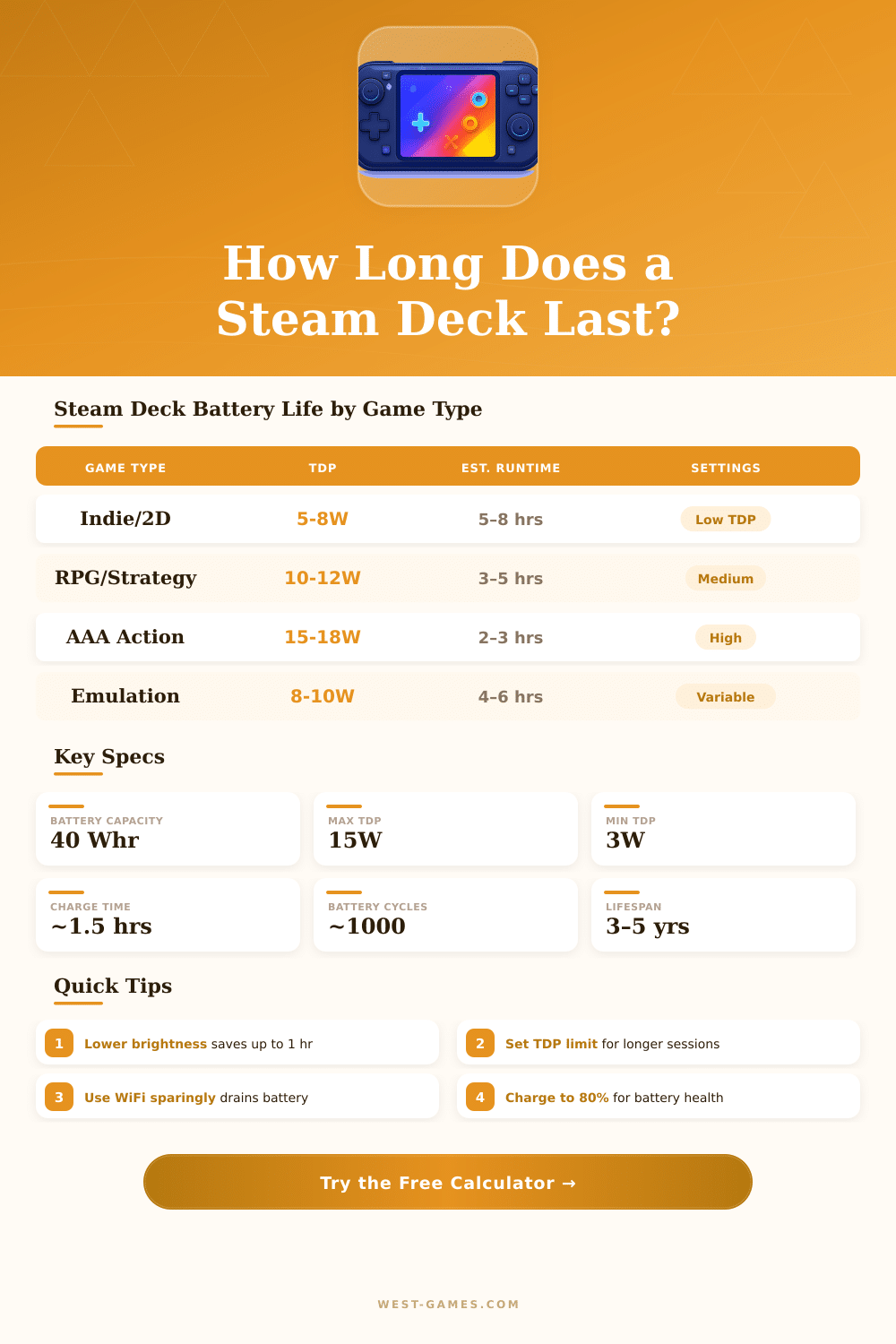
| Game / Use Type | Avg TDP | Est. Runtime (New) | Est. Runtime (80% Health) | FPS Cap Tip |
|---|---|---|---|---|
| Idle / Lock Screen | 3–4W | 8–10 hrs | 6.5–8 hrs | N/A |
| Indie / 2D Games | 5–8W | 5–8 hrs | 4–6.5 hrs | 60 FPS cap |
| Video Playback | 6–9W | 4.5–7 hrs | 3.5–5.5 hrs | N/A |
| Emulation (SNES/GBA) | 5–7W | 5.5–8 hrs | 4.5–6.5 hrs | 60 FPS |
| Emulation (PS2/GCN) | 8–12W | 3.5–5 hrs | 2.5–4 hrs | 30–40 FPS |
| RPG / Strategy | 10–14W | 2.5–4 hrs | 2–3 hrs | 40 FPS cap |
| Competitive FPS | 12–16W | 2.5–3.5 hrs | 2–2.5 hrs | 60 FPS cap |
| AAA Open World | 15–20W | 2–2.5 hrs | 1.5–2 hrs | 30 FPS cap |
| Max Performance | 20–25W | 1.5–2 hrs | 1–1.5 hrs | Uncapped |
| Usage Duration | Charge Cycles | Estimated Capacity | Runtime Impact |
|---|---|---|---|
| New (0–6 months) | 0–180 | ~100% | Full runtime |
| 1 year | ~365 | ~92–95% | -5 to -8% |
| 2 years | ~730 | ~82–88% | -12 to -18% |
| 3 years | ~1,000+ | ~70–80% | -20 to -30% |
| 4–5 years | ~1,200+ | ~60–70% | -30 to -40% |
📶 Wireless: Enabling Airplane Mode when playing offline reduces draw by ~0.5–1.5W.
⏱ Frame Rate Cap: Capping to 30 FPS instead of uncapped can halve GPU power usage on demanding titles.
🔋 Charge Health: Avoid consistently charging to 100% or discharging to 0%. Keeping between 20–80% extends total battery cycle lifespan significantly.
The Steam Deck is portable computer for games, made by the company Valve. It is meant to run games from the Steam store. Based on lessons from past projects of Valve, like the Steam Machine and Steam Controller, the Steam Deck uses a custom AMD APU and runs with SteamOS.
Like this it brings Steam-based play to a mobile device that can go everywhere.
Steam Deck: A Portable Gaming Computer
One considers it the strongest and most complete portable gaming device in the world. It manages to run high-end games in almost console-level quality, although it still has some quirks, that need to be settled. Not each Steam game works without troubles on it.
Some games also need the graphics card, and ohters need a keyboard, what can be hard for a portable device.
The OLED version of the Steam Deck has better internal parts. The OLED screen is more power saving, and the battery bigger, what gives 30 to 50 percent more duration. Actually, the battery life is one of the main advantages.
For older or simple games, as well as for emulated PS2 and GameCube titles, this duration is hardly beat. A new update of SteamOS, version 3.7.8, even added a setting too spare battery for the first time.
The model with 512 GB NVMe has internal storage, protective cover and a matte screen against gloss. For a cheaper option, the basic version with a fast microSD card works well. One can use a USB-C dock and external SSD to connect to other devices.
One of the available docking stations offers HDMI 2.0 in 4K 60Hz, gigabit ethernet, three USB 3.0 ports and 100W USB-C charging. Connecting to a television by means of a dock helps during days, when holding the device is not comfortable.
The layout feels like that of a console, so it clicks easily. It has also a setting for desktop, that lets it work as a regular computer. The touchpads are really useful, and together with the custom controls of SteamOS, playing strategy games or simulations, copying mouse and keyboard, often feels better than using a real mouse and keyboard.
The prices start at 400 dollars and go up to 650 for the best model. That is around half of the cost of the most similar competition. The preorder process at Valve is simple and without reselling problems, without need to pay the whole amount in advance.
The whole Steam store is available on the device, and games can even stream from a home computer directly to the Deck from anywhere. It also runs emulators for old consoles, giving access to hundreds of games outside the Steam library. Playing in short sessions on the sofa fits perfectly with the way thedevice works.